



What Is a Personal Property Demand Letter?
A personal property demand letter is a formal written notice demanding the return of specific belongings that another person is wrongfully keeping. In legal terminology, the wrongful retention of someone else's property is called "conversion" — the civil tort equivalent of theft. The letter serves as both a practical tool to get your property back and a legal prerequisite to filing a lawsuit. Many small claims courts expect to see evidence that you made a written demand before filing a replevin or conversion action, and judges view the demand favorably as proof that you attempted to resolve the matter before burdening the court.
Property disputes after breakups, roommate departures, tenant move-outs, and business separations are among the most common civil disputes in America. The emotional dynamics make informal resolution difficult — an ex-partner may hold your belongings as leverage, a former roommate may refuse access until a financial dispute is settled, or a landlord may threaten to dispose of items left behind. A formal demand letter changes the dynamic by converting an emotional dispute into a documented legal matter with clear deadlines and consequences. The recipient understands that ignoring the letter creates a paper trail that leads directly to court.
The legal remedies available for wrongfully held property are well-established and accessible. Replevin (the action to recover the property itself) is available in every state, and many states allow emergency replevin orders for property at risk of destruction or disposal. Conversion (the action for money damages) allows you to recover the fair market value of the property if it has been sold, destroyed, or damaged. Both actions are well-suited to small claims court for property valued under the state's jurisdictional limit (typically $5,000 to $25,000), making them affordable and accessible without an attorney.
Itemize Belongings
Create a detailed inventory with descriptions, photos, and fair market values
Establish Ownership
Document proof of ownership with receipts, photos, and serial numbers
Warn of Legal Action
Put the holder on notice of replevin, conversion, and small claims consequences
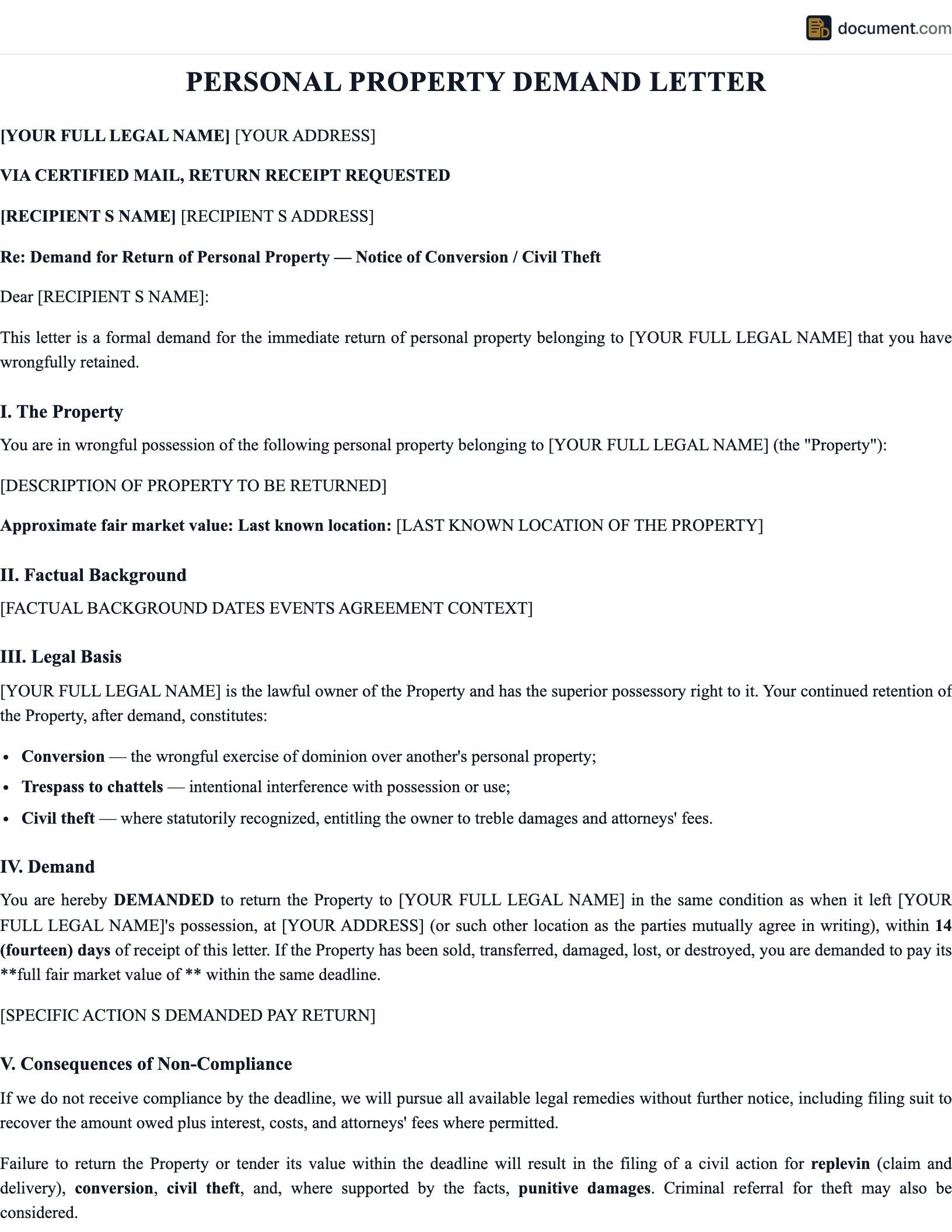
Personal Property Demand Letter Form Preview
Demand for Return of Personal Property
Sent via Certified Mail, Return Receipt Requested
Dear ,
I am writing to formally demand the return of my personal property currently in your possession at . The following items belong to me and must be returned within days of your receipt of this letter:
PROPERTY INVENTORY
1. — FMV: $
2. — FMV: $
3. — FMV: $
PROPERTY OWNER
DATE
Key Components
A thorough personal property demand letter establishes ownership, identifies the property, and creates a clear legal record:
| Component | Purpose | Key Details |
|---|---|---|
| Property Inventory | Identifies each item being demanded | Detailed description, serial numbers, distinguishing features, quantity, color, brand, model |
| Proof of Ownership | Establishes your legal right to the property | Purchase receipts, photos, bank statements, warranty registrations, insurance records |
| Fair Market Valuation | Quantifies damages if property is not returned | Original price, current FMV, depreciation method, comparable sales data, appraisals |
| Circumstances of Possession | Explains how the other party got your property | Breakup, move-out, loan, storage, prior arrangement, abandonment refutation |
| Return Deadline | Creates urgency and a clear compliance date | Specific calendar date (7-14 days), pickup arrangements, shipping instructions |
| Legal Consequences | Warns of the cost of non-compliance | Replevin action, conversion lawsuit, small claims filing, court costs, attorney's fees |
How to Write a Personal Property Demand Letter
Create a Detailed Property Inventory
List every item you want returned with a specific description: brand, model, color, size, serial number (if applicable), distinguishing features, and approximate fair market value. Be thorough — if you do not list an item, the recipient can claim it was not part of the demand. Photograph the items if you still have access, or use old photos from social media or home videos.
Gather Proof of Ownership
For each item, collect your strongest proof of ownership: purchase receipts, credit card statements, warranty cards, product registration emails, serial numbers registered to your name, photos showing you with the item, gift acknowledgments, or insurance records listing the item. The more documentation you have, the stronger your legal position.
Calculate Fair Market Values
Research the current FMV of each item using comparable sales on eBay, Facebook Marketplace, or similar platforms. For high-value items, consider a professional appraisal. Present both the original purchase price and the current FMV so the recipient understands the monetary exposure they face if you sue for conversion.
Explain How the Person Got Your Property
State clearly how the recipient came into possession of your belongings — you lived together and left items when you moved out, you lent the item and it was not returned, the landlord is holding items after your lease ended, etc. This establishes that the possession began lawfully but has become wrongful because you have demanded the property back.
Set a Return Deadline and Logistics
Give the recipient 7 to 14 days to return the property. Specify how the return should happen: you will pick up the items at a specific date and time, the recipient should ship the items at their expense, or you propose meeting at a neutral public location (like a police station lobby, which many communities offer for safe exchanges). Provide your contact information for coordinating the return.
State the Legal Consequences of Refusal
Warn that if the property is not returned by the deadline, you will file a replevin action or conversion lawsuit in small claims or civil court, seeking the return of the property and/or its fair market value plus court costs, filing fees, and any available attorney's fees. Follow through on this threat if the deadline passes — empty threats undermine future demands.
Common Personal Property Recovery Scenarios
Personal property disputes arise in predictable situations. Each scenario has unique legal considerations that should be reflected in your demand letter:
Ex-Partner After Breakup
The most emotionally charged scenario. Distinguish between items you brought into the relationship, items purchased during the relationship, and gifts. Gifts generally belong to the recipient; jointly purchased items may require negotiation.
Former Roommate
Common disputes involve shared household items, furniture with unclear ownership, and property left behind after one party moves out. Check your roommate agreement for any property provisions and keep utility/purchase records as proof.
Landlord Holding Tenant Property
Landlords must follow state-specific abandoned property statutes, which require written notice and waiting periods before disposal. A landlord cannot hold your property hostage for unpaid rent without a court order in most states.
Business or Employer
Recovering personal items left at a workplace after termination, retrieving business equipment lent to a client or vendor, or demanding return of inventory or tools from a former business partner.
Frequently Asked Questions
Official Resources
Authoritative resources on personal property rights, small claims procedures, and tenant protections.
Nolo - Small Claims Court Guide
Comprehensive guide to filing a small claims case for property recovery, including state-specific limits and procedures.
USA.gov - State Attorney General Directory
File consumer complaints about businesses wrongfully holding personal property or refusing refunds.
HUD - Tenant Rights Resources
Federal housing resources including tenant rights regarding personal property during and after tenancy.
CFPB - Housing and Rental Resources
Consumer protection guidance on landlord-tenant property disputes and security deposit recovery.
ABA - Free Legal Help Directory
American Bar Association directory of free legal aid organizations that assist with property recovery cases.
Uniform Disposition of Unclaimed Property Act
Uniform Law Commission model legislation governing the disposition of abandoned and unclaimed personal property.
Create Your Personal Property Demand Letter
Recover your belongings with a professional demand letter that documents ownership and warns of legal consequences.
Create DocumentNo account required. Free to create and preview.