



What Is a Child Support Demand Letter?
A child support demand letter is a formal written notice sent by the custodial parent to the non-custodial parent demanding payment of overdue child support obligations. Unlike a casual text or phone call asking for money, a demand letter formally documents the arrears, references the underlying court order or separation agreement, calculates the total amount owed (including statutory interest), and spells out the enforcement consequences of continued non-payment. It transforms an informal dispute into a documented record that carries legal weight.
Child support is unique among civil obligations because it is backed by some of the most aggressive enforcement mechanisms in American law. Congress and every state legislature have enacted comprehensive enforcement statutes that go far beyond what is available for ordinary debts — including automatic wage withholding, tax refund interception, passport denial, license suspension, property liens, bank account seizure, and even incarceration for willful contempt. A demand letter is the practical first step that gives the obligor one final opportunity to comply voluntarily before these mechanisms are triggered. Many family law attorneys recommend sending a demand letter before filing a contempt motion because it often produces faster results at lower cost.
The letter also serves an important evidentiary purpose. When you later file a contempt motion or enforcement action, the court will ask whether the obligor was aware of the arrears. A certified-mail demand letter with a signed return receipt is compelling proof that the non-custodial parent was on notice of the exact amount owed and the deadline for payment — making it much harder for them to argue ignorance or misunderstanding in court. The letter becomes exhibit A in your enforcement file.
Calculate Arrears
Document every missed payment with principal and interest totals
Enforce Court Orders
Reference your existing order and warn of contempt proceedings
Create Evidence
Certified-mail proof of notice becomes a court exhibit
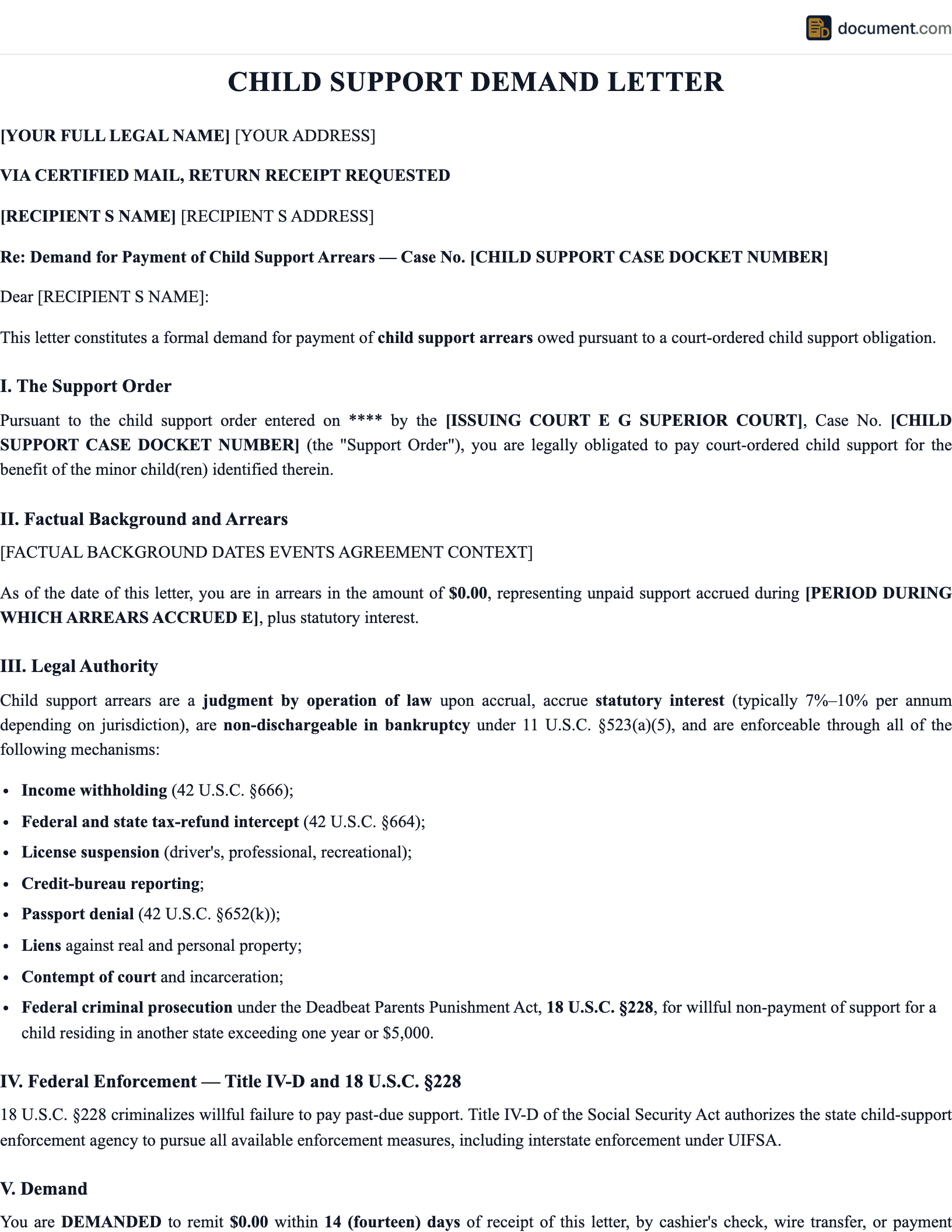
Child Support Demand Letter Form Preview
Demand for Payment of Child Support Arrears
Sent via Certified Mail, Return Receipt Requested
RE: Past-Due Child Support — Case No.
Dear ,
Pursuant to the child support order entered on by the Court, you are obligated to pay $ per month in child support for .
ARREARS CALCULATION
As of the date of this letter, you are in arrears in the total amount of $ , calculated as follows:
CUSTODIAL PARENT
DATE
Key Components
An effective child support demand letter covers these critical elements to maximize the likelihood of voluntary compliance and build a strong record for enforcement:
| Component | Purpose | Key Details |
|---|---|---|
| Court Order Reference | Establishes the legal obligation | Case number, court name, date of order, monthly amount, name(s) of child(ren) |
| Arrears Calculation | Quantifies the total amount owed | Months unpaid, principal arrears, statutory interest rate, credits for partial payments, total balance |
| Payment Deadline | Creates urgency and a clear compliance window | Specific calendar date (typically 14-30 days), acceptable payment methods, where to send payment |
| Enforcement Consequences | Motivates compliance through concrete threats | Contempt motion, wage garnishment, license suspension, tax intercept, passport denial, credit reporting |
| Unreimbursed Expenses | Recovers additional court-ordered cost sharing | Medical bills, dental work, therapy costs, insurance EOBs, the obligor's share percentage |
| Payment History | Shows the pattern of non-compliance | Month-by-month record of ordered amounts, payments received, and running balance |
| Modification Notice | Addresses the "can't pay" defense | Instruction that obligor must file a modification motion if circumstances have changed — arrears still accrue |
How to Write a Child Support Demand Letter
Gather Your Court Order and Payment Records
Locate the original child support order (or the most recent modification) and note the case number, court name, ordered monthly amount, and effective date. Pull payment records from the state disbursement unit, your bank statements, or personal payment log showing every payment received and every missed month.
Calculate Total Arrears with Interest
List each month the obligor failed to pay or underpaid, showing the ordered amount, the amount actually received, and the shortfall. Apply your state's statutory interest rate to the running balance (e.g., 10% per year in California, 12% in Florida, 6% in Texas). Present the calculation as a clear table or itemized list so the figure is transparent and verifiable.
Include Unreimbursed Expenses
If the court order allocates unreimbursed medical, dental, educational, or childcare expenses between the parents, calculate the obligor's unpaid share. Attach copies of bills, insurance EOBs, and receipts. This is a commonly overlooked component that can add thousands to the demand.
Set a Firm Payment Deadline
Give the obligor 14 to 30 days from the date of the letter to pay the full arrears balance. Specify acceptable payment methods (cashier's check, wire transfer, state disbursement unit) and the address or account for payment. Avoid accepting cash, which is impossible to document.
Describe Enforcement Consequences
List the specific enforcement actions you will pursue if payment is not received by the deadline: filing a contempt of court motion (with potential jail time), requesting an income withholding order, seeking license suspension, requesting tax refund interception, and referring the case to your state's child support enforcement agency. Be specific and accurate — do not threaten actions that are not available in your state.
Send by Certified Mail
Print the letter, sign and date it, and send it by USPS certified mail with return receipt requested. Also send a copy by regular first-class mail and email. File the return receipt and a date-stamped copy of the letter — these become court exhibits in any future enforcement proceeding.
Enforcement Options After the Demand Letter
Child support enforcement is uniquely powerful because Congress and state legislatures have created mechanisms that go well beyond what is available for ordinary debts. If the obligor ignores your demand letter, these are the primary enforcement tools available to you — most of which can be initiated through your state's child support enforcement agency (the Title IV-D agency) at no cost.
Income Withholding
Mandatory under federal law. The employer deducts support directly from the obligor's paycheck, similar to tax withholding.
Contempt of Court
A judge can hold the obligor in contempt for willful non-payment, resulting in fines, purge conditions, or incarceration of up to six months.
License Suspension
States can suspend driver's licenses, professional licenses, and recreational licenses for arrears exceeding state thresholds.
Tax Refund Interception
Federal and state tax refunds can be intercepted and redirected to the custodial parent through the Treasury Offset Program.
Frequently Asked Questions
Official Resources
Authoritative federal and state resources for child support enforcement, arrears calculation, and legal guidance.
Office of Child Support Services (OCSS)
Federal agency overseeing the national child support program, including enforcement tools and interstate cooperation.
State Child Support Agency Directory
Contact your state's Title IV-D agency to open an enforcement case or request wage withholding at no cost.
U.S. Courts - Child Support Resources
Federal judiciary resources on child support enforcement, modification, and interstate proceedings.
Uniform Interstate Family Support Act (UIFSA)
Uniform Law Commission resources on enforcing child support orders across state lines.
IRS Form 8379 - Injured Spouse Allocation
Guidance for spouses whose tax refund was intercepted for the other spouse's child support arrears.
NCSL - Child Support Enforcement Overview
National Conference of State Legislatures summary of enforcement tools available in each state.
Create Your Child Support Demand Letter
Calculate arrears, apply statutory interest, and put the non-paying parent on formal notice with a professional demand letter.
Create DocumentNo account required. Free to create and preview.