
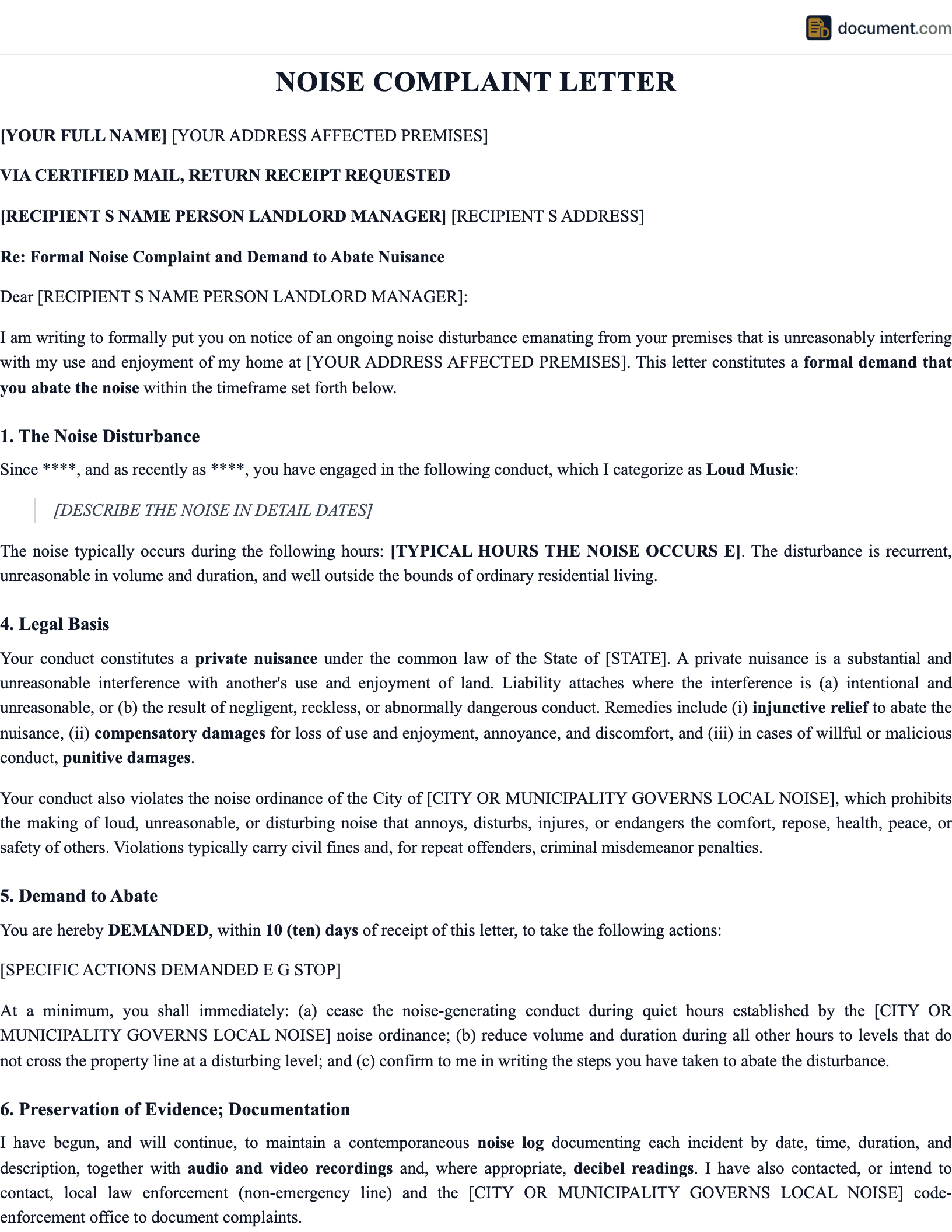



What Is a Noise Complaint Letter?
A noise complaint letter is a formal written communication sent to a landlord, property manager, or neighbor to report persistent noise disturbances that interfere with the tenant's right to quiet enjoyment of their rental property. Unlike an informal verbal complaint, a written noise complaint creates a dated, documented record that can be used as evidence if the situation escalates to legal action, lease termination, or eviction proceedings against the offending party.
The right to quiet enjoyment is a fundamental tenant right implied in virtually every residential lease, whether explicitly stated or not. This legal doctrine guarantees that tenants can use and enjoy their rental unit without unreasonable interference from other tenants, the landlord, or third parties under the landlord's control. When a landlord fails to address legitimate noise complaints, they may be in breach of this implied covenant, potentially giving the affected tenant grounds for rent reduction, lease termination, or a constructive eviction claim.
Effective noise complaint letters are specific, factual, and professional. They describe the nature and frequency of the noise, reference specific dates and times, cite relevant lease provisions and local ordinances, and request specific action by a stated deadline. The letter should avoid emotional language and personal attacks, focusing instead on objective descriptions of the disturbances and their impact on the complainant's ability to enjoy their home.
Many tenants make the mistake of relying solely on verbal complaints, which can be difficult to prove later. A formal written complaint, sent via email with delivery confirmation or by certified mail, establishes an irrefutable timeline and puts the landlord on notice. If the noise continues without resolution, subsequent letters can reference earlier complaints to demonstrate a pattern of inaction, strengthening the tenant's position for any future legal proceedings.
Quiet Enjoyment
Assert your legal right to peaceful use of your rental unit without interference
Documentation
Create a formal record of noise disturbances with dates, times, and descriptions
Escalation Path
Establish a clear escalation process from complaint to legal action if needed
Noise Complaint Letter Preview
Our noise complaint letter includes professional language and all essential elements. Below is a preview of the key sections.
FORMAL NOISE COMPLAINT
Written Notice of Noise Disturbance
SENDER INFORMATION
Name: [Your Name]
Unit: [Unit #]
Date: [Date]
RECIPIENT
To: [Landlord / Property Manager Name]
Property: [Property Address]
NOISE DISTURBANCE DETAILS
Source: [Unit # / Location]
Type of Noise: [Description]
Frequency: [Daily / Weekly / etc.]
Dates/Times: [Specific Incidents]
REQUESTED ACTION
I respectfully request that management address this ongoing noise disturbance within [# days] to protect my right to quiet enjoyment under the lease agreement...
How to Write a Noise Complaint Letter
Follow these steps to create an effective and legally sound noise complaint letter.
Document the Disturbances First
Before writing the letter, compile a detailed log of noise incidents including dates, times, duration, type of noise, and any steps you took to address it (such as knocking on the neighbor's door). Include audio or video recordings if available and permitted under your state's recording laws. This documentation will be attached to or referenced in your complaint letter.
Review Your Lease and Local Ordinances
Review your lease agreement for quiet hours provisions, noise restrictions, and the complaint process. Research your local noise ordinances to determine if the noise violates any laws. Reference specific lease clauses and ordinance numbers in your letter to demonstrate that the noise is not merely annoying but violates established rules. This gives your complaint legal weight.
Address the Letter Properly
Address the letter to your landlord or property management company using their official name and address as listed on your lease. Include your name, unit number, date, and contact information. Use a professional, formal tone throughout. If you have a property manager, send copies to both the manager and the property owner to ensure the complaint reaches the person with authority to act.
Describe the Noise Objectively
Describe the noise factually and specifically — avoid emotional language, exaggeration, or personal attacks. State the type of noise (loud music, barking dogs, construction, stomping), its source (specific unit or area), frequency (nightly, weekends, several times per week), and how it affects your daily life (lost sleep, inability to work from home, health impacts). The more specific and objective your description, the more credible and actionable your complaint will be.
Reference Your Legal Rights
Cite the specific lease provisions being violated (quiet hours, noise restrictions, right to quiet enjoyment) and any applicable local noise ordinances. Mention your right to quiet enjoyment and the landlord's obligation to enforce lease terms against other tenants. This demonstrates that you understand your legal rights and that the complaint carries legal significance beyond a mere preference.
Request Specific Action and Set a Deadline
Clearly state what you want the landlord to do: issue a warning to the offending tenant, enforce quiet hours, mediate the dispute, or take other specific action. Set a reasonable deadline for response (typically 7-14 days). State what steps you will take if the issue is not resolved, such as contacting local authorities, filing a formal complaint with the housing authority, or seeking legal counsel.
Send Via Documented Method
Send the letter via a method that creates proof of delivery: certified mail with return receipt requested, email with read receipt, or hand delivery with a signed acknowledgment. Keep copies of the letter, proof of delivery, and all supporting documentation. If using email, copy yourself and save the sent message. This delivery proof is essential if the situation escalates to legal proceedings.
Key Components of a Noise Complaint Letter
An effective noise complaint letter must include these essential elements.
| Component | Description |
|---|---|
| Sender Information | Full name, unit number, address, phone, and email of the complainant |
| Recipient Details | Landlord or property manager name and address |
| Date of Letter | Date the complaint is written and sent |
| Noise Source | Specific unit number, tenant name (if known), or location of the noise |
| Noise Description | Type, volume, frequency, and character of the noise disturbance |
| Incident Log | Detailed list of dates, times, and duration of each noise incident |
| Impact Statement | How the noise affects your daily life, sleep, work, and well-being |
| Lease References | Specific lease clauses on quiet hours, noise, and quiet enjoyment |
| Ordinance Citations | Applicable local noise ordinance numbers and provisions violated |
| Prior Attempts | Documentation of any previous verbal complaints or attempts to resolve |
| Requested Action | Specific steps you want the landlord to take to resolve the issue |
| Response Deadline | Reasonable timeframe for the landlord to respond and take action |
Legal Requirements and Tenant Rights
Understanding the legal framework surrounding noise complaints strengthens your position and helps ensure your rights are protected.
Important: Document Everything
Courts and housing authorities rely heavily on documentation when evaluating noise complaints. A single verbal complaint carries little weight, but a series of written complaints with detailed incident logs, recordings, and evidence of the landlord's failure to act creates a compelling case for constructive eviction or lease termination.
Quiet Enjoyment Rights
- Implied Covenant: The right to quiet enjoyment is implied in every residential lease, even if not explicitly stated, in virtually every state
- Landlord Obligation: Landlords have a duty to enforce lease terms against noisy tenants and maintain habitable conditions for all residents
- Local Enforcement: Noise ordinance violations can be reported to local police or code enforcement independent of the landlord
- Constructive Eviction: Persistent unresolved noise may constitute constructive eviction, allowing lease termination without penalty
Escalation Process
The typical escalation path for noise complaints is: (1) polite verbal request to the neighbor, (2) written complaint to the landlord, (3) follow-up letter if no action is taken, (4) report to local code enforcement or police for ordinance violations, (5) formal demand letter from an attorney, and (6) legal action including potential constructive eviction claim or rent withholding where permitted by state law. Each step should be documented in writing.
Sample Noise Complaint Letter
Below is a preview of a professional noise complaint letter.
[Your Name] | [Unit #] | [Date]
To: [Landlord/Property Manager Name]
Re: Formal Noise Complaint — Unit [#]
Dear [Landlord Name],
I am writing to formally report ongoing noise disturbances originating from Unit [#] that have significantly impacted my ability to peacefully enjoy my residence at [Address]. These disturbances constitute a violation of Section [#] of our lease agreement regarding quiet hours and my right to quiet enjoyment.
INCIDENT LOG (Partial)
[Date/Time]: Loud music from 11 PM to 2 AM
[Date/Time]: Extended party with shouting until 3 AM
[Date/Time]: Repeated bass vibrations from 10 PM to midnight
I respectfully request that you address this matter within 14 days by enforcing the quiet hours provision of the lease...
Sincerely,
[Signature]
Frequently Asked Questions
Find answers to common questions about noise complaints, quiet enjoyment rights, and the escalation process.
Official Resources
Use these resources for information about noise ordinances and tenant rights.
Related Documents
These related documents may complement your noise complaint.
Create your Noise Complaint Letter in under 10 minutes.
Answer a few questions and download a compliant, attorney-drafted document ready for your state.