



What Is a Property Condition Report?
A property condition report (also known as a rental inspection report or move-in/move-out checklist) is a detailed written assessment of a rental property's physical condition at a specific point in time. The report documents the state of every room, surface, fixture, appliance, and system in the property, using a standardized grading scale and written descriptions of any damage, defects, or wear. When accompanied by date-stamped photographs, it creates an authoritative record that can be used to resolve disputes about property damage and security deposit deductions.
The primary purpose of a property condition report is to establish a clear, agreed-upon baseline of the property's condition at the start of a tenancy. By documenting pre-existing conditions before the tenant moves in, both the landlord and tenant are protected: the tenant cannot be held responsible for damage that existed before they took possession, and the landlord can clearly demonstrate when new damage occurred during the tenancy. This documentation is essential for fair and legally defensible security deposit dispositions.
A thorough property condition report covers every area of the property systematically, typically organized room by room. For each area, the report assesses structural elements (walls, ceilings, floors), fixtures (lighting, faucets, outlets), appliances (refrigerator, stove, dishwasher, HVAC), plumbing and electrical systems, windows and doors, and any built-in features such as closets, shelving, or cabinets. The exterior of the property — including the roof, siding, landscaping, driveway, and common areas — should also be documented.
Many states require landlords to provide a property condition report as part of the lease agreement, and some states make it a prerequisite for withholding any portion of the security deposit. Even in states where it is not legally mandated, completing a thorough report is considered best practice and is strongly recommended by landlord associations, property management organizations, and tenant advocacy groups alike.
Room-by-Room
Systematic inspection of every room, closet, and area of the property
Photo Documentation
Date-stamped photographs of every room and any existing damage or defects
Grading Scale
Standardized ratings from Excellent to Poor for consistent assessment
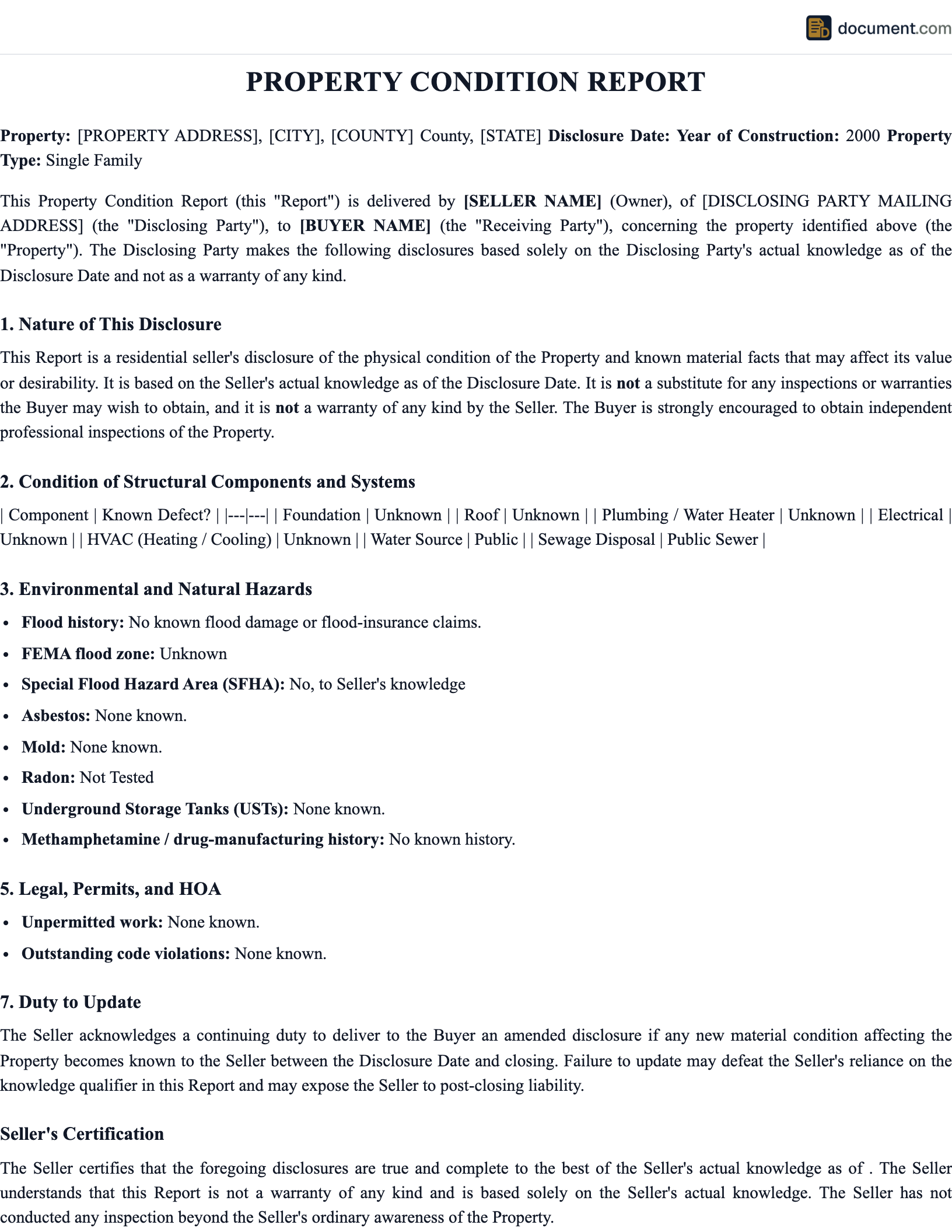
Property Condition Report Preview
Our report template covers every area of the property with a professional grading system. Below is a preview of the key sections included in your customized report.
PROPERTY CONDITION REPORT
Move-In / Move-Out Inspection
PROPERTY & TENANT INFORMATION
Property Address: [Full Address]
Tenant Name: [Name]
Inspection Type: [Move-In / Move-Out]
Inspection Date: [Date]
GRADING SCALE
E = Excellent | G = Good | F = Fair | P = Poor | N/A = Not Applicable
LIVING ROOM
Walls: [E/G/F/P] Ceiling: [E/G/F/P] Floor: [E/G/F/P]
Windows: [E/G/F/P] Lighting: [E/G/F/P] Outlets: [E/G/F/P]
Notes: [Description of damage or issues]
SIGNATURES
Landlord/Agent: [Signature] Date: [Date]
Tenant: [Signature] Date: [Date]
How to Complete a Property Condition Report
Follow these steps to create a thorough and legally defensible property condition report that will protect both landlord and tenant interests.
Schedule the Inspection
Schedule the inspection at a time when both the landlord (or property manager) and the tenant can be present. For move-in inspections, this should be done on or just before the lease start date, before the tenant moves any belongings into the property. For move-out inspections, schedule it after the tenant has removed all personal property. Ensure adequate natural lighting or bring supplemental lighting for a thorough examination.
Prepare Equipment and Forms
Bring the property condition report form, a camera or smartphone for photographs, a flashlight for dark areas, a notepad for additional observations, and any previous inspection reports for comparison. Test the camera before starting and ensure you have enough storage for hundreds of photos. Consider taking a video walkthrough as supplemental documentation.
Inspect Each Room Systematically
Work through the property room by room, starting at the front entrance and moving through each space in a logical order. For each room, examine walls (scuffs, holes, stains, paint condition), ceilings (water stains, cracks, peeling), floors (scratches, stains, carpet wear, tile damage), windows (glass condition, locks, screens, blinds), doors (operation, locks, damage), lighting fixtures (working bulbs, fixture condition), and electrical outlets (functioning, cover plates).
Test All Appliances and Systems
Turn on every appliance to verify it is working properly. Run water in all sinks, tubs, and showers to check for leaks and proper drainage. Flush all toilets. Test the heating and cooling system. Open and close all windows and doors. Check the garbage disposal, dishwasher, oven, stovetop burners, microwave, and refrigerator/freezer temperature. Document the condition and working status of each item on the report.
Inspect Exterior and Common Areas
Examine the exterior of the property including the roof (visible damage from ground level), siding or paint, windows, gutters, landscaping, driveway, walkways, patio or deck, fencing, and any outbuildings such as garages or storage sheds. Note the condition of exterior lighting, house numbers, mailbox, and any common areas the tenant is responsible for maintaining.
Photograph Everything
Take wide-angle photos of each room showing overall condition, plus close-up photos of any damage, defects, or areas of concern. Photograph all appliances, bathroom fixtures, flooring, and windows. Include photos of smoke detectors, carbon monoxide detectors, and fire extinguishers. Ensure all photos are date-stamped and clearly labeled with the room and area they depict.
Record Meter and Utility Readings
Document current readings for all utility meters (electric, gas, water) if the tenant is responsible for utilities. Record the number of keys, garage remotes, access cards, and mailbox keys provided to the tenant. Note the location of the main water shutoff, electrical panel, and gas shutoff valve. This information is valuable for both the move-in documentation and the eventual move-out process.
Sign and Distribute the Report
Both the landlord and tenant should sign and date the completed report, acknowledging that it accurately reflects the property's condition at the time of inspection. Provide the tenant with a copy of the report and all photographs within the timeframe required by your state law (typically 3-7 days). Keep the original report, photos, and any supplemental notes in a secure location for the duration of the tenancy and security deposit holding period.
Key Components of a Property Condition Report
A thorough property condition report should cover every area and system in the property.
| Component | Description |
|---|---|
| Property Information | Address, unit number, landlord and tenant names, inspection date and type |
| Living Room | Walls, ceiling, floor, windows, doors, lighting, outlets, built-in features |
| Kitchen | Countertops, cabinets, sink, faucet, appliances, floor, backsplash, ventilation |
| Bedrooms | Walls, ceiling, floor, closets, windows, doors, lighting, outlets per room |
| Bathrooms | Tub/shower, toilet, vanity, sink, faucet, mirrors, tile, ventilation, grout |
| Plumbing Systems | Water heater, main shutoff, pipes, drains, water pressure, leaks |
| Electrical Systems | Panel condition, outlets, switches, GFCIs, light fixtures, smoke detectors |
| HVAC System | Heating and cooling units, thermostat, filters, vents, ductwork condition |
| Exterior | Roof, siding, gutters, foundation, landscaping, driveway, fencing, lighting |
| Safety Equipment | Smoke detectors, CO detectors, fire extinguishers, deadbolts, window locks |
| Keys & Access | Number of keys, garage remotes, access cards, mailbox keys provided |
| Photographs | Date-stamped photos of every room and all damage, attached as exhibits |
Legal Requirements for Property Condition Reports
Several states mandate property condition reports as part of the landlord-tenant relationship, particularly in connection with security deposit handling.
Important: Security Deposit Connection
In many states, a landlord who fails to conduct a move-in inspection or provide a written condition report may forfeit the right to make deductions from the security deposit for property damage. This can result in the landlord being required to return the full deposit regardless of the property's condition at move-out. Always complete and document the move-in inspection before the tenant takes possession.
State Requirements
- Mandatory States: Washington, Wisconsin, Georgia, Hawaii, Kansas, Kentucky, Maryland, Massachusetts, Michigan, Montana, Nevada, North Dakota, Virginia, and others require written condition reports
- Tenant Response Period: Most states allowing tenant review provide 3-7 days for the tenant to submit written objections or additions to the report
- Record Retention: Maintain inspection records for at least the duration of the tenancy plus the statute of limitations for deposit claims (typically 2-6 years)
- Photo Documentation: While not always legally required, photographs are admissible evidence and strongly recommended by courts in deposit disputes
Sample Property Condition Report
Below is a preview of a standard property condition report.
PROPERTY CONDITION REPORT
Inspection Date: _______________
Property: _______ | Tenant: _______ | Type: Move-In / Move-Out
KITCHEN
Countertops: ___ | Cabinets: ___ | Sink/Faucet: ___ | Stove: ___ | Refrigerator: ___ | Dishwasher: ___ | Floor: ___ | Walls: ___
BATHROOM
Tub/Shower: ___ | Toilet: ___ | Vanity: ___ | Sink: ___ | Mirror: ___ | Floor: ___ | Walls: ___ | Ventilation: ___
Landlord Signature
Date: ___________
Tenant Signature
Date: ___________
Frequently Asked Questions
Find answers to common questions about property condition reports, inspections, and security deposits.
Official Resources
Use these trusted resources for additional information about property inspections and tenant rights.
Related Documents
These related documents complement your property condition report.
Create your Property Condition Report in under 10 minutes.
Answer a few questions and download a compliant, attorney-drafted document ready for your state.