
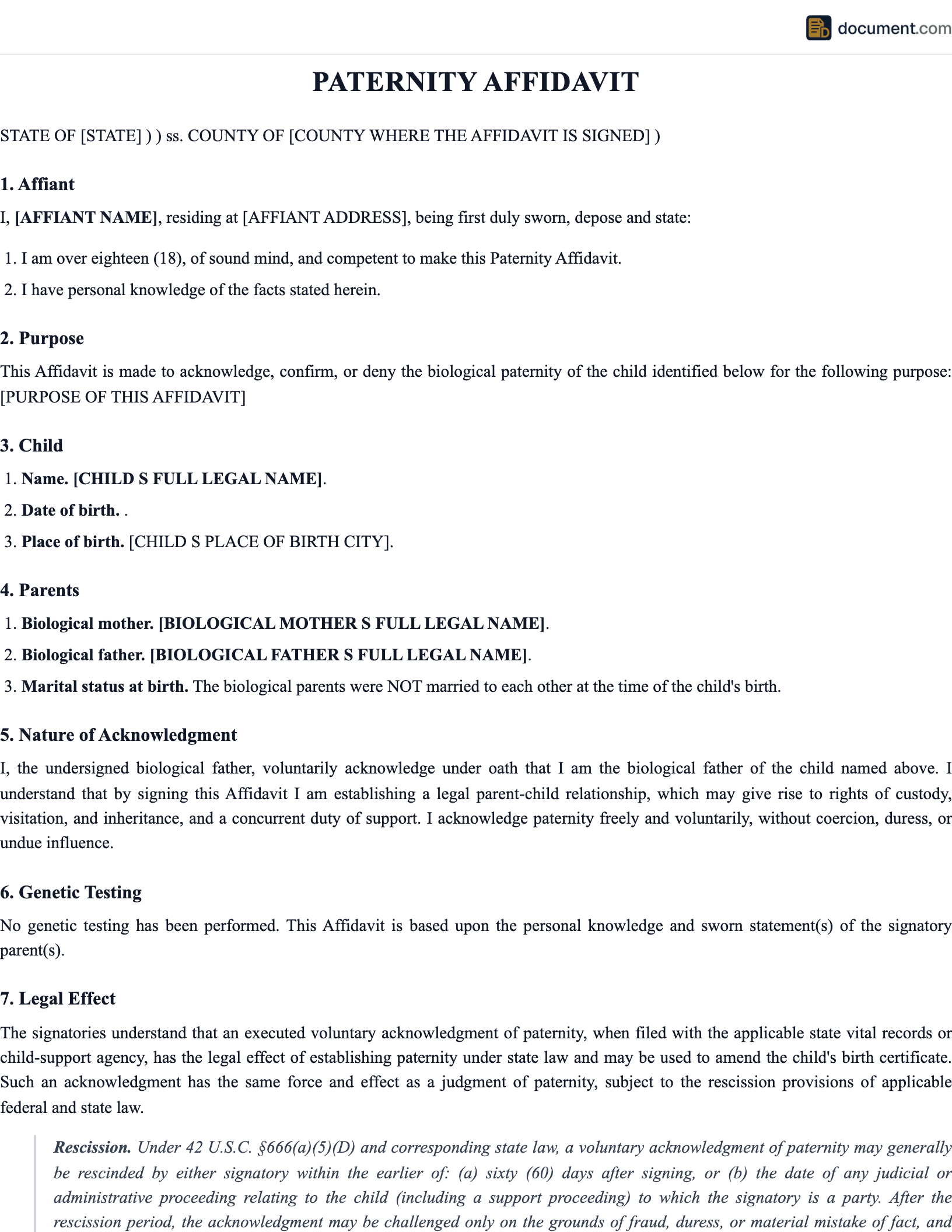



What Is an Affidavit of Paternity
An affidavit of paternity, formally a voluntary acknowledgment of paternity (AOP), is a sworn instrument by which an unmarried mother and a man establish legal parentage without court proceedings. Federal Title IV-D of the Social Security Act (42 U.S.C. § 666(a)(5)(C)) requires every state to maintain a paternity-acknowledgment program meeting federal procedural standards including hospital availability, written rights-and-responsibilities notice, and a defined rescission window. The Uniform Parentage Act (UPA) Article 3, adopted in some form by 19 states including Washington, Texas, Delaware, and Wyoming, codifies acknowledgment procedures and substantive requirements. Once filed with state vital records, the AOP has the legal effect of a judgment of paternity for purposes of child support, inheritance, and federal benefits.
The federal program traces to the 1996 welfare reform under the Personal Responsibility and Work Opportunity Reconciliation Act (PRWORA, Pub. L. 104-193), which conditioned state IV-D funding on creation of voluntary-acknowledgment programs as an alternative to paternity litigation. The reform was designed to reduce administrative caseloads and accelerate child support establishment by replacing months-long paternity actions with hospital-based acknowledgment. The result is the same legal certainty as a court judgment, available at the bedside immediately after birth.
UPA Article 3 framework and state implementations
UPA Article 3 governs voluntary acknowledgment in adopting jurisdictions. The procedural requirements include execution before a notary or designated witness, written rights-and-responsibilities notice in plain language, and filing with the state registrar of vital statistics. Texas Family Code § 160.302 requires notarization plus the federal rights notice. California Family Code § 7574 permits witness signature in lieu of notarization. New York Public Health Law § 4135-b governs hospital-based acknowledgment. Florida Stat. § 742.10 codifies the federal Title IV-D framework. The substantive rules are largely uniform; the procedural details (notary requirement, witness adequacy, post-hospital filing process) vary by state.
Rescission window and post-window challenge grounds
Federal law (42 U.S.C. § 666(a)(5)(D)(ii)) requires states to permit rescission within the earlier of 60 days from signing or the date of the first administrative or judicial proceeding relating to the child in which the signer is a party. After the rescission window closes, challenge requires court action under state law on grounds of fraud, duress, or material mistake of fact (Cal. Fam. Code § 7575, Tex. Fam. Code § 160.308, NY Family Court Act § 516-a). DNA evidence excluding the acknowledged father is generally insufficient on its own to set aside the AOP; the petitioner must show one of the three substantive grounds plus prompt filing, typically within two years of discovery under most state codes. The set-aside standard is intentionally rigorous to protect the child's status from belated paternity disputes.
Legal Effect of Signing
A filed AOP has the legal effect of a court judgment of paternity. The man becomes the child's legal parent for every purpose: intestate inheritance under state probate codes, Social Security survivor benefits under 42 U.S.C. § 402(d), VA dependency benefits under 38 U.S.C. § 101, federal tax dependency status under IRC § 152, immigration sponsorship under INA § 101(b)(1)(D), and standing to seek custody and visitation under state family-law codes. Full faith and credit under 28 U.S.C. § 1738 requires every state to recognize the AOP regardless of where it was executed.
The principal financial consequence is child support liability under state guidelines incorporating the federal IV-D framework (42 U.S.C. § 666 and § 667). Enforcement tools include mandatory income withholding under 42 U.S.C. § 666(b)(3), federal tax intercept under 26 U.S.C. § 6402(c), state and federal license suspension under 42 U.S.C. § 666(a)(16), passport denial for arrearages over $2,500 under 42 U.S.C. § 652(k), credit-bureau reporting, and civil and criminal contempt. Custody and parenting-time rights require a separate court order; the AOP supplies standing to file but does not allocate parenting time.
AOP vs Court Order
| Feature | Voluntary AOP | Paternity Lawsuit |
|---|---|---|
| Cost | Free | Filing fees and possibly legal fees |
| Time to Complete | Minutes | Months |
| DNA Testing | Optional | Often court ordered |
| Requires Both Parents to Agree | Yes | No |
| Establishes Custody | No | Possibly |
| Easy to Undo | Only within rescission window | Requires appeal or motion |
How to Complete the AOP
Confirm Biological Parentage
Discuss whether genetic testing is appropriate before signing, especially if either party has any doubt.
Obtain the State AOP Form
Request the official form from the hospital, vital records office, or state child support agency.
Read the Rights Notice Carefully
Both signers should review the disclosures explaining custody, support, and inheritance consequences.
Complete Identifying Information
Fill in the mother, father, and child sections accurately, including Social Security numbers if requested.
Sign in the Presence of a Witness or Notary
Follow your state's witness requirement; some states require a notary, while others accept staff witnesses.
File With Vital Records
Submit the completed AOP to the state office of vital records, either through the hospital or directly by mail.
Key Components
Mother Identification
Full legal name, date of birth, Social Security number, and current address of the child's mother.
Father Identification
Full legal name, date of birth, Social Security number, and address of the man acknowledging paternity.
Child Information
Child's full legal name, date and place of birth, and assigned birth certificate number if available.
Statement of Parentage
Sworn declaration that the man is the biological father of the named child.
Rights and Responsibilities Notice
Required disclosure explaining the legal effect of signing, including support and custody implications.
Rescission Notice
Plain-language explanation of the right to cancel within the state's rescission window.
Witness or Notary Block
Signatures of witnesses or a notary public, depending on state requirements.
Sample AOP
VOLUNTARY ACKNOWLEDGMENT OF PATERNITY
CHILD: ______________________ DOB: __________
MOTHER: _____________________ DOB: __________
FATHER: _____________________ DOB: __________
We, the undersigned, swear under penalty of perjury that the man named above is the biological father of the child named above. We have read and understood the rights, responsibilities, and consequences notice. We waive the right to genetic testing and to a court hearing on paternity.
__________________________ Mother Signature / Date
__________________________ Father Signature / Date
Frequently Asked Questions
Common questions about voluntary acknowledgment of paternity, rescission windows, custody, and federal benefits.
Official Resources
Office of Child Support Services: Establishing Paternity
Federal program overview of voluntary acknowledgment
CDC National Vital Statistics: Paternity Establishment
Statistics and registration practices for paternity
Social Security Administration: Numbers for Children
Apply for an SSN at the time of birth registration
Child Welfare Information Gateway: Paternity Laws
Compendium of state paternity establishment statutes
Establish legal fatherhood in under 10 minutes.
Answer a few questions and download a federal-IV-D-compliant voluntary acknowledgment ready for the hospital or vital records office.