



Pennsylvania Quitclaim Deed Overview
In Pennsylvania, quitclaim deeds are a recognized legal instrument for transferring whatever property interest the grantor holds to the grantee without any warranty of title. Pennsylvania law allows quitclaim deeds to be used for a variety of purposes, including transfers between family members, property divisions during divorce, transfers to living trusts and LLCs, and correcting title defects. The deed must be properly executed, notarized, and recorded with the county recorder in the county where the property is located to provide constructive notice of the transfer.
Pennsylvania imposes a transfer tax on real property conveyances, which applies to most quitclaim deed transfers where consideration is paid. The rate is 2% (1% state + 1% local), though certain transfers may qualify for exemptions. Understanding Pennsylvania's specific recording requirements, transfer tax rules, and exemptions is essential for ensuring your quitclaim deed is properly filed and you do not overpay on taxes. Pennsylvania recording fees start at $40+ (varies by county).
$40+
Recording fee
2%
Transfer tax
Required
Notarization
0
Witnesses required
Pennsylvania Recording Requirements
Pennsylvania has specific requirements for recording quitclaim deeds. Meeting these requirements ensures your deed is accepted by the county recorder and provides proper legal notice of the property transfer.
Pennsylvania Specific Note
Pennsylvania imposes a combined transfer tax of 2% of the property value (1% state plus 1% local in most jurisdictions). Philadelphia charges a higher local rate of 3.278% plus the 1% state rate. A Statement of Value (REV-183) must be filed with all deed recordings. Certain transfers are exempt from the state transfer tax, including transfers between spouses, parent-child transfers, and transfers to trusts where the grantor is the beneficiary. All exemptions must be claimed on the Statement of Value.
Document Requirements
- Notarization: The grantor's signature must be notarized by a Pennsylvania notary public or a notary authorized in the state where the deed is signed
- Witnesses: Pennsylvania requires 0 witness(es) for quitclaim deed recording
- Legal Description: Must include the complete legal description of the property as it appears on the current deed of record or county assessor records
- Parcel Number: The assessor's parcel number (APN) or tax ID number must be included on the deed
- Return Address: A mailing address for returning the recorded deed must appear on the first page
- Formatting: Pennsylvania requires standard document formatting with adequate margins for recording stamps, black ink, and minimum 10-point font
How to File a Quitclaim Deed in Pennsylvania
Filing a quitclaim deed in Pennsylvania involves preparing the document, getting it notarized, and recording it with the appropriate county office. Follow these steps for a smooth process.
Prepare the Quitclaim Deed
Complete all required fields including grantor and grantee names, the property's complete legal description, parcel number, and consideration amount. Ensure the deed meets Pennsylvania's formatting requirements
Get the Deed Notarized
The grantor must sign before a notary public with a valid government-issued photo ID. Pennsylvania does not require additional witnesses beyond the notary
File With the County recorder
Take the notarized deed to the county recorder in the county where the property is located. Some Pennsylvania counties accept e-recording for faster processing
Pay Recording Fees and Transfer Taxes
Pay the recording fee ($40+ (varies by county)) and any applicable transfer tax (2% (1% state + 1% local)). Bring payment in a form accepted by the county recorder
Notify Relevant Parties
Inform your mortgage lender, title insurance company, homeowners insurance provider, and the county tax assessor of the ownership change
Pennsylvania Tax Implications
Pennsylvania imposes a transfer tax of 2% (1% state + 1% local) on real property conveyances. This tax applies when the deed is recorded and is based on the consideration paid. Several types of transfers may be exempt from the transfer tax, including transfers between spouses, transfers pursuant to divorce decrees, and transfers to trusts where the grantor is the beneficiary. Be sure to check whether your specific transfer qualifies for an exemption.
Regardless of Pennsylvania's transfer tax rules, federal gift tax implications apply when property is transferred without fair market value consideration. If the value of the gifted property exceeds the annual gift tax exclusion ($18,000 per recipient in 2024), the grantor must file IRS Form 709. The grantee receives the grantor's cost basis rather than a stepped-up basis, which can result in significant capital gains tax when the property is eventually sold.
Property tax reassessment rules vary across Pennsylvania. Some counties reassess property values upon a change of ownership, while others follow a regular assessment cycle. Contact your local county assessor to understand how the transfer will affect your property tax assessment and whether any homestead or other exemptions need to be re-applied for by the new owner.
Pennsylvania Quitclaim Deed Fees & Costs
Below is a breakdown of the typical costs associated with filing a quitclaim deed in Pennsylvania. Actual fees may vary by county.
| Fee / Tax | Amount |
|---|---|
| Recording Fee | $40+ (varies by county) |
| Transfer Tax / Documentary Stamps | 2% (1% state + 1% local) |
| Notarization | $5 - $25 per signature |
| Certified Copy | $1 - $5 per page |
| Attorney Review (optional) | $150 - $500 |
Sample Pennsylvania Quitclaim Deed
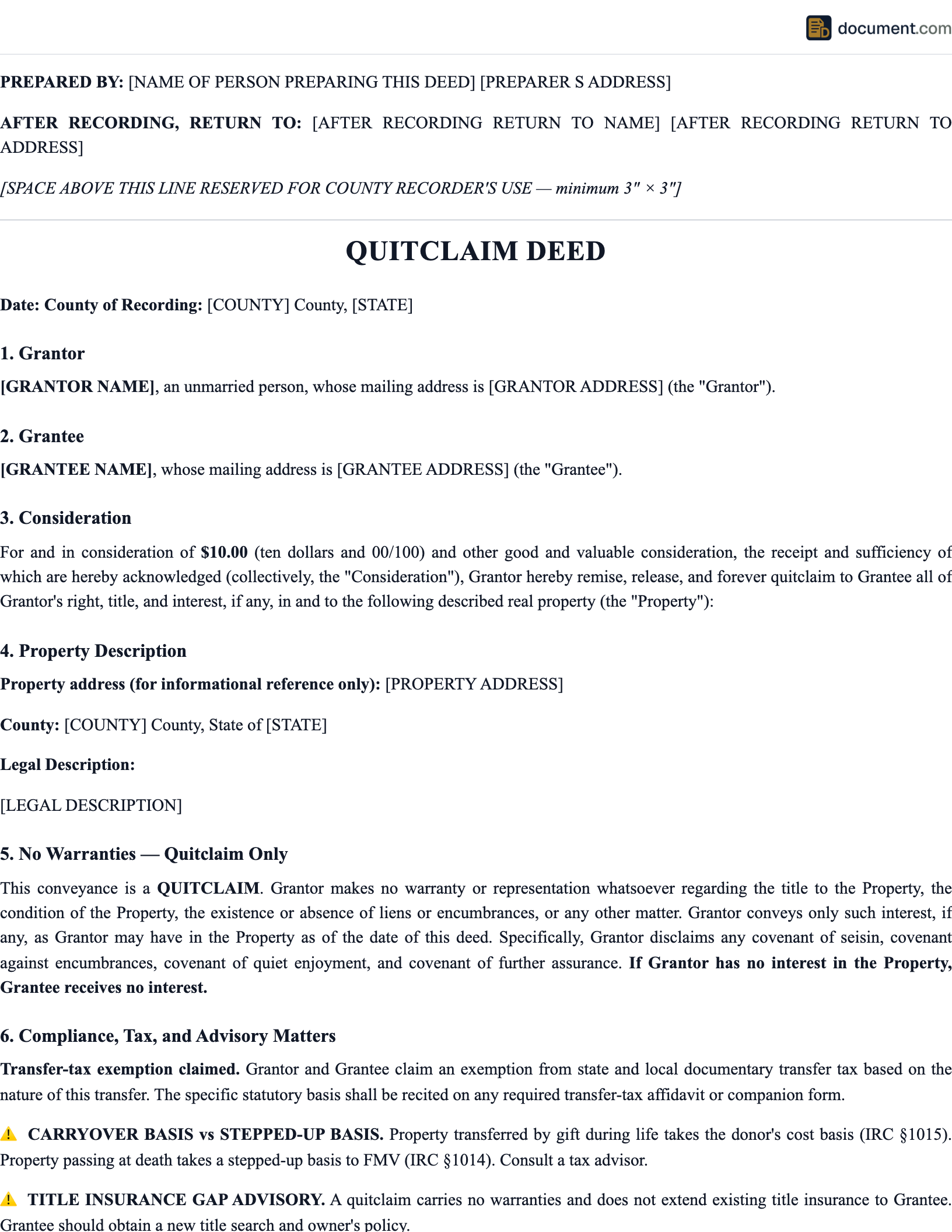
Below is a preview of our Pennsylvania-specific quitclaim deed. Your customized document will include all fields and declarations required for recording in any Pennsylvania county.
QUITCLAIM DEED
STATE OF PENNSYLVANIA
Property Transfer Without Warranty
GRANTOR:
Name: [Full Legal Name]
Address: [Pennsylvania Address]
County: [County]
GRANTEE:
Name: [Full Legal Name]
Address: [Mailing Address]
Vesting: [Tenancy Type]
PROPERTY DESCRIPTION
County: [County] State: Pennsylvania
Legal Description: [Per Recorded Plat]
Parcel No.: [APN]
Consideration: $[Amount]
Pennsylvania Quitclaim Deed FAQ
Answers to common questions about filing a quitclaim deed in Pennsylvania, including recording requirements, fees, and tax implications.
Official Pennsylvania Resources
Use these official state resources to verify recording requirements, find your county recorder office, and access government forms for your Pennsylvania property transfer.
Pennsylvania County Recorder of Deeds
Official recording office and deed requirements
Pennsylvania DOR - Realty Transfer Tax
Transfer tax rates, exemptions, and property tax information
IRS Gift Tax Information
Federal gift tax rules for property transfers
American Land Title Association (ALTA)
Title insurance standards and find a title company
Related Pennsylvania Documents
Depending on your property transfer situation, you may need additional documents alongside your Pennsylvania quitclaim deed.
Create your Pennsylvania Quitclaim Deed in under 5 minutes.
Answer a few questions and download a Pennsylvania-compliant document, ready for the state agency.