
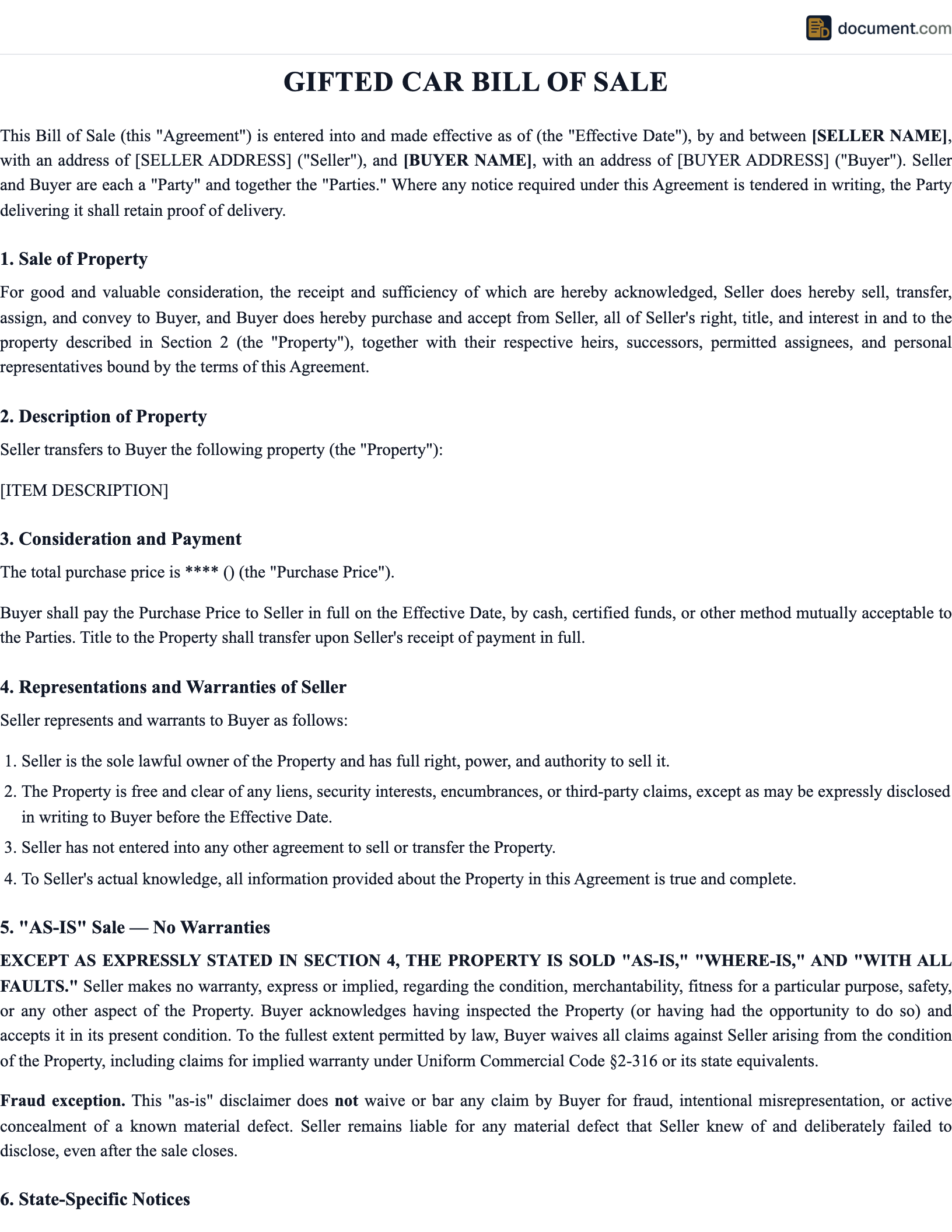



What Is a Gifted Car Bill of Sale?
A gifted car bill of sale is a legal document used to transfer ownership of a vehicle from one person to another as a gift, with no money exchanged. It functions like a standard vehicle bill of sale but explicitly states that the consideration (purchase price) is zero dollars and that the vehicle is being given freely. This distinction is critical because it affects how the state's DMV processes the title transfer and, more importantly, whether the recipient owes sales tax on the transaction.
Gifting a car is one of the most common vehicle transfers in America. Parents give cars to children when they start driving, families pass vehicles between generations, and spouses transfer titles during marriage or divorce. In each case, the DMV needs written documentation to process the title change — and the correct documentation can save the recipient significant money in sales tax. Many states waive sales tax entirely for gift transfers between immediate family members, but only if the transfer is properly documented.
Without a proper gifted car bill of sale, the DMV may treat the transfer as a sale at fair market value and charge the full sales tax rate. On a vehicle worth $15,000 in a state with a 6% sales tax, that mistake costs the recipient $900. The bill of sale, combined with any required gift affidavit, prevents this by clearly establishing the transfer as a bona fide gift.
Zero-Dollar Transfer
Documents the vehicle as a gift with no payment
DMV Ready
Accepted by all state DMVs for gift title transfers
Tax Exemption Support
Helps qualify for family gift tax exemptions
Why You Need a Gifted Car Bill of Sale
A gifted car bill of sale is more important than most people realize. Skipping this document can cost the recipient hundreds or thousands of dollars and create legal complications.
Avoid Unnecessary Sales Tax
The primary financial reason for a gifted car bill of sale is sales tax avoidance. When you present a properly documented gift transfer to the DMV, many states waive the sales tax that would otherwise be assessed on the vehicle's fair market value. Without gift documentation, the DMV will calculate tax based on the vehicle's book value or the price on the title assignment — which could be thousands of dollars.
Complete the Title Transfer
The DMV needs documentation to process any title transfer. While the signed title is the primary document, many states also require a bill of sale as supporting documentation. The gifted car bill of sale explains the zero-dollar transaction and provides the additional details the DMV needs — the relationship between donor and recipient, the vehicle description, and confirmation that no money was exchanged.
Insurance Documentation
The recipient needs to insure the vehicle in their own name. Insurance companies require proof of ownership, and a gifted car bill of sale serves this purpose. It also establishes the vehicle's value for insurance coverage purposes. Without it, the insurer may require additional documentation or delay the policy issuance.
How to Write a Gifted Car Bill of Sale
A gifted car bill of sale follows the same structure as a standard vehicle bill of sale with key modifications to document the gift nature of the transfer.
Identify the Donor and Recipient
Use "Donor" and "Recipient" rather than "Seller" and "Buyer" to reinforce the gift nature. Include full legal names, addresses, phone numbers, and driver's license numbers for both parties. Crucially, state the relationship between the parties (parent/child, spouse, sibling, etc.) — this is required for sales tax exemptions in most states.
Describe the Vehicle
Include the year, make, model, body style, color, VIN (Vehicle Identification Number), current odometer reading, and license plate number. The VIN is the most important identifier — it must match the title exactly. Note the vehicle's condition and any known issues, just as you would in a standard bill of sale.
State the Gift Terms
This is the most important section. Clearly state: "The vehicle is transferred as a gift. No monetary consideration is given or received. The sale price is $0.00 (zero dollars)." Include the fair market value of the vehicle for tax documentation purposes. State that the donor is transferring the vehicle freely and voluntarily.
Confirm Title Is Clear
The donor must confirm the vehicle is free of liens, encumbrances, and legal claims. If there is an existing loan, it must be paid off and the lien released before the gift transfer can proceed. The bill of sale should include a statement that the title is clear and the donor has full authority to transfer it.
Sign and Visit the DMV
Both donor and recipient sign and date the bill of sale. The donor also signs the vehicle title. The recipient takes the signed title, bill of sale, and any required gift affidavit to the DMV to complete the transfer. Some states require both parties to be present at the DMV. Bring valid photo ID and be prepared to pay registration fees (even if sales tax is waived).
Key Components of a Gifted Car Bill of Sale
A gifted car bill of sale includes all standard vehicle bill of sale elements plus gift-specific provisions. Every component below should be present.
| Component | Description |
|---|---|
| Donor & Recipient Names | Full legal names, addresses, and driver's license numbers |
| Relationship | Family relationship (parent, child, spouse, sibling, etc.) |
| Vehicle Description | Year, make, model, color, VIN, odometer reading |
| Gift Statement | "This vehicle is transferred as a gift — $0 consideration" |
| Fair Market Value | Estimated value for tax and gift tax documentation |
| Lien Statement | Donor confirms the vehicle is free and clear of liens |
| Condition | Vehicle condition and any known issues (typically as-is) |
| Date of Gift | Exact date the vehicle is gifted |
| Signatures | Both donor and recipient sign and date |
Sales Tax Exemptions for Gifted Vehicles
One of the most significant benefits of properly documenting a vehicle gift is the potential sales tax exemption. Many states waive sales tax when a vehicle is gifted between qualifying family members.
Important: State Rules Vary Significantly
Sales tax rules for gift transfers vary widely by state. Some states offer full exemptions for immediate family, some offer partial exemptions, and a few charge full sales tax on all transfers regardless of the relationship. Always check your specific state's DMV requirements before completing the transfer. Our state-specific templates include the relevant rules for each state.
- Full Exemption States: Texas, Florida, Georgia, Illinois, and many others exempt family gifts from sales tax entirely
- No Exemption States: California and Hawaii charge sales or use tax on all vehicle transfers including gifts
- Gift Affidavit: Many states require a separate gift affidavit form in addition to the bill of sale
- Federal Gift Tax: Vehicles under the annual exclusion ($18,000 for 2024) require no IRS reporting
- Registration Fees: Even when sales tax is waived, registration and title fees still apply
Sample Gifted Car Bill of Sale
Below is a preview of our gifted car bill of sale template. Your customized document will include all gift-specific language and your state's requirements.
GIFTED VEHICLE BILL OF SALE
Vehicle Gift Transfer Document
This Gifted Vehicle Bill of Sale is entered into on[Date]between:
DONOR:
Name: [Donor Name]
Address: [Donor Address]
RECIPIENT:
Name: [Recipient Name]
Address: [Recipient Address]
Relationship: [Relationship]
1. VEHICLE DESCRIPTION
Year: [Year] Make: [Make] Model: [Model]
VIN: [VIN]
2. GIFT DECLARATION
"This vehicle is transferred as a GIFT. No monetary consideration is given or received. Sale Price: $0.00 (Zero Dollars). Fair Market Value: $_______."
Official Gift Transfer Resources
Use these official resources for DMV requirements, gift tax information, and vehicle valuation.
Frequently Asked Questions
Find answers to common questions about gifted car bills of sale, tax exemptions, and title transfers.
Create your Gifted Car Bill of Sale in under 10 minutes.
Answer a few questions and download a compliant, attorney-drafted document ready for your state.