
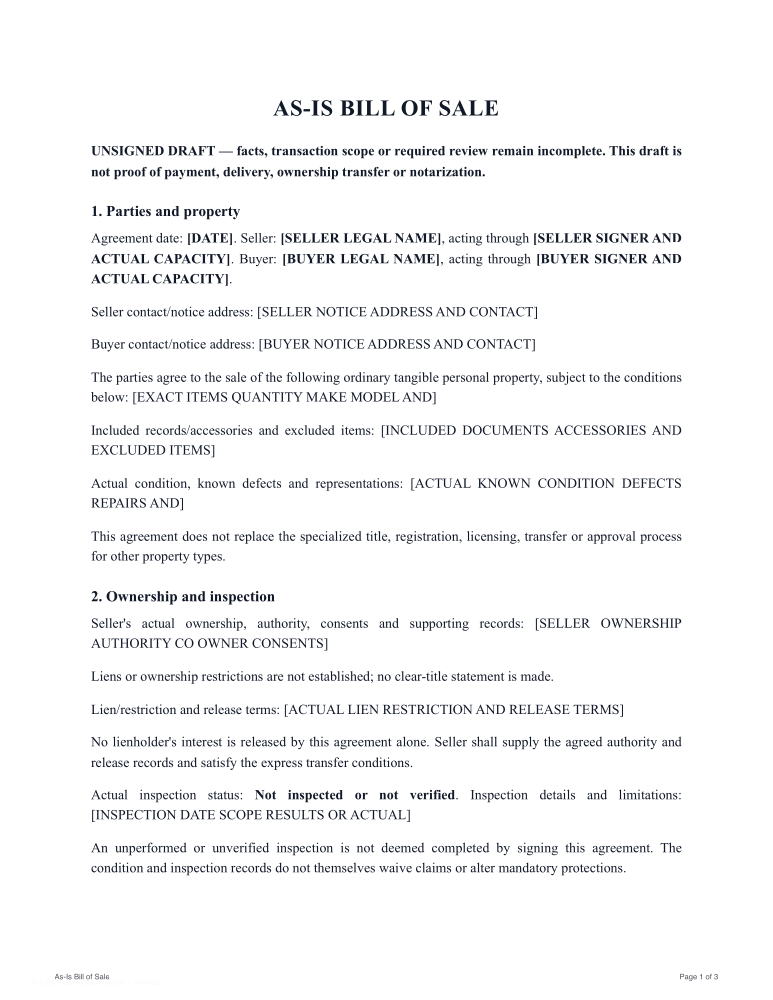



As-Is Bill of Sale: record the actual sale
Identify the seller, buyer, actual signers and their capacities, notice addresses, property description, serial numbers where relevant, included accessories and records, exclusions, known condition and defects. A sample does not prove title or ownership.
Describe the seller’s actual authority, consents, title records and any liens or release conditions. A disclosed lien is not silently contradicted by a clear-title warranty, and a lienholder’s rights are not released by this form alone.
Use this interview for ordinary tangible personal property. A titled or regulated transfer, business acquisition or other specialized transaction needs its own tailored documents and official process. Unknown ownership or unresolved scope stays in an unsigned draft.
Distinguish the price from money received
Enter the actual total price and actual amount received. Record the payment date, method, evidence and any qualification. Choose unpaid, partly paid or paid in full consistently; the remaining price is calculated from those amounts.
State actual remaining due dates, financing conditions and required credit or security documents. A plan to obtain a loan is not lender approval. An installment sale does not automatically permit repossession and forfeiture of all earlier payments.
If security is intended, review creation, attachment, perfection, priority and lawful enforcement for the transaction. A title-retention label alone does not complete those steps.
Agree on delivery, title, risk and costs
Record the delivery date and location, whether delivery actually happened, any outstanding items and the conditions for transfer. A scheduled date does not certify delivery.
Write the parties’ actual title-transfer trigger and risk-of-loss allocation, subject to mandatory law and existing third-party rights. Goods-law defaults vary with the transaction; receipt by the buyer is not a universal statutory rule.
Specify taxes, fees, filings and the party performing each obligation. The agreement cannot bind a taxing authority or create an exemption. Check the current rate and rules for the actual property, location and transaction; this guide does not supply a generic statewide tax calculation.
Choose condition and warranty terms explicitly
Describe the actual inspection status and limitations. Signing does not certify an inspection or an opportunity that never occurred. Keep express promises, descriptions, disclosed defects and any written warranty consistent.
The interview does not preselect as-is treatment. If the parties request an exclusion, confirm the actual consumer status, seller warranty, service contract and applicable state restrictions. A covered written consumer-product warranty or service contract can prevent an implied-warranty disclaimer under federal law.
Massachusetts, Maine and Maryland have significant consumer-warranty restrictions reflected in this workflow. Other state rules and transaction-specific protections still require review. No as-is clause is inserted when a requested exclusion is prohibited or its review is incomplete.
If the parties preserve applicable warranties or agree to a written warranty, record the actual coverage, duration and remedies. An express promise is not silently erased by a conflicting general disclaimer.
Jurisdiction and execution
For the actual transaction jurisdiction, identify the property type, seller status, buyer’s intended use, and applicable sales, consumer-warranty, tax, execution and transfer rules. The ordinary-property form does not establish a tax exemption, registration transfer or enforceable disclaimer merely because a state is selected. Confirm the applicable rule using current primary sources before signing.
Document the actual mandatory requirements, separate instruments, attachments and delivery. Keep an unsigned draft until the transaction scope, substantive facts and required review are resolved. A user’s completion selection records their answer; it is not independent legal approval.
For the notarized variant, identify the required act and separate certificate arrangements. The notary must complete the appropriate certificate after performing the required steps. This form does not falsely certify an appearance, oath or acknowledgment.
Review the illustration and enter the real terms
The downloadable sample is an unsigned illustration with placeholders. It is not proof of payment, ownership, delivery, inspection or notarization. Review the completed document and its actual attachments before signing.