
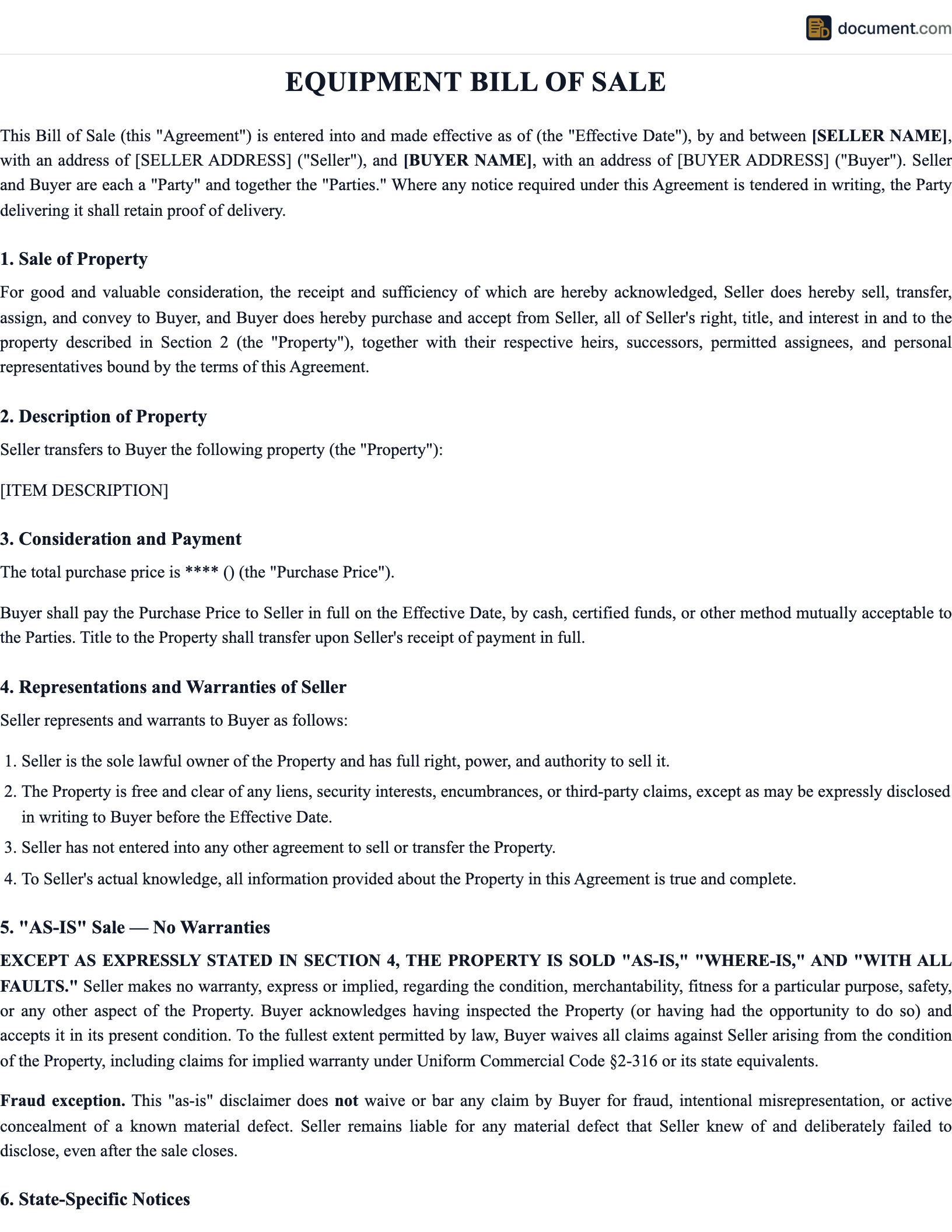



What Is an Equipment Bill of Sale?
An equipment bill of sale is a legal document that records the transfer of ownership of machinery, tools, or industrial assets from a seller to a buyer. It identifies each piece of equipment by manufacturer, model, serial number, and condition, and it establishes the terms of the sale including price, payment method, and any warranty or as-is disclaimers.
Equipment transactions are fundamentally different from consumer goods sales because of the dollar amounts involved and the tax implications. A single piece of construction equipment can cost tens of thousands of dollars, and the purchase price directly affects the buyer's depreciation deductions over the equipment's useful life. The IRS requires documentation of the purchase price and date for Section 179 expensing and MACRS depreciation schedules, making the bill of sale an essential tax document as well as a legal one.
Equipment bills of sale are used across every industry — construction companies buying used excavators, restaurants acquiring commercial kitchen equipment, medical practices purchasing pre-owned imaging machines, and farms trading agricultural machinery. In each case, the bill of sale protects both parties by documenting exactly what was transferred, in what condition, and for what price.
All Equipment Types
Construction, farm, medical, restaurant, and industrial
Tax Documentation
Supports Section 179 and MACRS depreciation claims
Liability Transfer
Documents when ownership and risk shifted to buyer
Types of Equipment Covered
Our equipment bill of sale templates are designed to handle any category of business, industrial, or commercial equipment. Select the category that matches your transaction.
Construction Equipment
Excavators, bulldozers, loaders, cranes, concrete mixers, and heavy earthmoving machinery
Farm & Agricultural
Tractors, combines, plows, irrigation systems, balers, and crop processing equipment
Restaurant & Commercial Kitchen
Ovens, refrigeration, fryers, dishwashers, and food preparation equipment
Medical & Dental
Imaging machines, examination chairs, sterilizers, and diagnostic equipment
Office & Technology
Computers, servers, copiers, phone systems, and networking equipment
Landscaping & Grounds
Mowers, trimmers, blowers, chippers, and commercial landscaping machinery
Manufacturing & Industrial
CNC machines, lathes, presses, welders, and production line equipment
Fitness & Recreation
Gym machines, treadmills, weight systems, and commercial fitness equipment
How to Write an Equipment Bill of Sale
An equipment bill of sale must capture sufficient detail for both legal protection and tax compliance. Follow these steps to ensure your document is complete.
Identify the Parties
Include the full legal names and addresses of both buyer and seller. If either party is a business entity (LLC, corporation, sole proprietorship), include the business name, EIN or tax ID number, and the name of the authorized representative signing on behalf of the business.
Describe Each Piece of Equipment
For each item included in the sale, record the manufacturer, model name and number, serial number, year of manufacture, and any other identifying information (asset tag numbers, license plates for road-legal equipment). If selling multiple items in a single transaction, list each one separately with its own description and individual price if possible.
Document Condition and Hours
Record the operational status of the equipment, the hour meter reading (for machinery that tracks hours), odometer reading (for road-legal equipment), and any known defects, wear items, or needed repairs. Attach photos of the equipment and the hour meter. If maintenance records are available, reference them and provide copies to the buyer.
Set Price, Payment, and Warranty Terms
State the total purchase price in numerals and written form. Specify the payment method and terms — full payment at closing, installment plan, or financing. Clearly state whether the sale is as-is or includes a warranty, and if warranted, detail exactly what is covered, for how long, and the remedy for covered defects.
Execute and Retain Records
Both parties sign and date the bill of sale. Each party retains a copy for their records. The buyer should keep the bill of sale with their tax records for depreciation purposes. If the equipment requires registration (construction equipment, farm implements in some states), the buyer should complete the transfer with the appropriate state agency.
Key Components of an Equipment Bill of Sale
A complete equipment bill of sale should include all of the following elements.
| Component | Description |
|---|---|
| Buyer & Seller Information | Legal names, addresses, business names, and tax IDs |
| Manufacturer & Model | E.g., Caterpillar 320 Excavator, Hobart D300 Mixer |
| Serial Number | Unique manufacturer identifier for each item |
| Year of Manufacture | Production year for depreciation calculations |
| Condition & Hours | Operational status, hour meter, known defects |
| Sale Price | Total price in numbers and words, per-item pricing if multiple |
| Payment Terms | Full payment, installments, financing details |
| Warranty / As-Is | Warranty terms or explicit as-is disclaimer |
| Lien Statement | Seller confirms equipment is free of liens |
| Signatures | Dated signatures of both parties or authorized representatives |
Tax & Depreciation Considerations
For business buyers, the equipment bill of sale is a key tax document. The purchase price and date of acquisition are the starting points for calculating depreciation deductions that can significantly reduce your taxable income.
Important: Consult Your Accountant
Tax depreciation rules are complex and change frequently. The information below is general guidance — always consult a qualified tax professional for advice specific to your situation, equipment type, and current tax law.
- Section 179 Deduction: Allows businesses to deduct the full purchase price of qualifying equipment in the year of purchase rather than depreciating over time
- Bonus Depreciation: Allows additional first-year depreciation on new and used equipment beyond Section 179 limits
- MACRS Depreciation: The standard depreciation method assigning equipment to recovery period classes (3, 5, 7, 10, 15, or 20 years)
- Sales Tax Records: Document any sales tax paid — in some states, the amount paid is deductible or can be added to the equipment's depreciable basis
- Date of Acquisition: The purchase date on the bill of sale determines which tax year the depreciation begins
Sample Equipment Bill of Sale
Below is a preview of our equipment bill of sale template. Your customized document will include all fields appropriate for your equipment type and state.
EQUIPMENT BILL OF SALE
Equipment Transfer Document
This Equipment Bill of Sale is entered into on[Date]between:
SELLER:
Name/Business: [Name]
Address: [Address]
BUYER:
Name/Business: [Name]
Address: [Address]
1. EQUIPMENT DESCRIPTION
Manufacturer: [Mfr] Model: [Model]
Serial #: [Serial Number]
Year: [Year] Hours: [Hours]
2. SALE PRICE
$[Amount]([Amount in Words] Dollars)
Official Equipment & Tax Resources
These official resources provide guidance on equipment sales, tax depreciation, and UCC filings.
Frequently Asked Questions
Find answers to common questions about equipment bills of sale, depreciation, and ownership transfers.
Create your Equipment Bill of Sale in under 10 minutes.
Answer a few questions and download a compliant, attorney-drafted document ready for your state.