



What Is a Snowmobile Bill of Sale?
A snowmobile bill of sale is a written record of the private transfer of a sled from one owner to another. Snowmobiles sit in the same legal category as other off-highway recreational vehicles — they are not street-legal, they are registered through state snowmobile programs rather than the DMV in some states, and they rely on the bill of sale as a key piece of the ownership chain regardless of whether the state issues a title.
Snowmobile culture is concentrated in a handful of states — Minnesota, Wisconsin, Michigan, New York, Maine, New Hampshire, Vermont, Alaska, and the mountain states of Colorado, Wyoming, Montana, and Idaho. Each state runs its own registration and trail pass program, often through the Department of Natural Resources rather than the DMV, and each state's paperwork is a little different. The bill of sale is the one document that works everywhere.
A proper snowmobile bill of sale identifies the make (Ski-Doo, Polaris, Arctic Cat, Yamaha), the model and year, the VIN stamped into the tunnel, the engine displacement and type (two-stroke or four-stroke), the track size and length, the hour meter reading, and any accessories included in the sale. High-value mountain sleds and performance trail sleds can approach the price of a new car, making documentation critical.
Whether you are buying a lightly used lake sled from a neighbor or selling a high-mileage mountain rig at the end of a long winter, the bill of sale protects both parties. The seller is shielded from later claims about trail damage, collisions, or mechanical problems; the buyer gets the document they need to register the sled, buy a trail pass, obtain insurance, and prove ownership if the machine is ever stolen or involved in an accident.
All Sled Types
Trail, mountain, crossover, and utility sleds from every manufacturer
Hours & Miles
Captures both readings for accurate valuation
Registration Ready
Accepted by state snowmobile programs in every snowy state
Snowmobile vs ATV vs Dirt Bike
Snowmobiles share a regulatory family with other off-highway machines but have their own paperwork quirks. Pick the right document for the right machine.
| Machine | Season | Use This Form |
|---|---|---|
| Snowmobile | Winter (track and skis) | Snowmobile Bill of Sale (this page) |
| ATV / Quad | Year-round (four wheels) | ATV Bill of Sale |
| UTV / Side-by-Side | Year-round (cab, roll cage) | UTV Bill of Sale |
| Dirt Bike | Warm season (two wheels) | Dirt Bike Bill of Sale |
How to Create a Snowmobile Bill of Sale
Six steps cover every requirement for a clean sled transfer.
Find and Verify the VIN
The VIN is stamped into the tunnel near the rear of the sled, usually on the throttle side. Photograph it, write it down, and compare character-by-character to the title and prior registration. If the stamped VIN has been ground down, re-stamped, or is obscured by paint, walk away.
Record Engine Hours and Miles
Turn on the dash and record both the engine hours and the odometer reading if the sled is equipped with one. Photograph the display. Note whether the sled is a two-stroke or four-stroke and write the displacement (600, 850, 998, etc.) — these fields shape pricing and service schedules.
Document the Track and Skis
Note the track size (width x length x lug height) — a 137" trail track and a 165" mountain track are very different machines. Inspect the track for lug damage and stud count. Record the ski type (carbide runners, plastic loops) and general condition. Aftermarket tracks and skis add real value and should be itemized.
List Accessories
Aftermarket parts — avalanche packs, heated grips and shields, studs, aftermarket handlebars, cargo racks, GPS units — can add thousands to sled value. Itemize them so there is no confusion at delivery. If a trailer, cover, or gear bag is included, list each one separately with an allocated value.
State the Price and As-Is Terms
Write the sale price in numbers and words. Include a clear as-is clause stating that the buyer has inspected the sled and accepts it in its current condition, along with disclosure of any known defects — belt issues, clutch wear, track damage, chaincase leaks. Disclosed defects are not grounds for a later lawsuit; concealed ones are.
Sign, Hand Over the Title and Keys
Both parties sign and date the document. The seller hands over the title (in title states) or the prior registration, both keys, the manuals, and any service records. The buyer should register the sled with the state snowmobile program and buy a trail pass before the next ride.
Key Components
Every field below should appear on a snowmobile bill of sale.
| Component | Description |
|---|---|
| Buyer & Seller | Names, addresses, phone numbers |
| Year, Make, Model | E.g., 2024 Ski-Doo Summit X 850 E-TEC |
| VIN | Tunnel-stamped serial number |
| Engine Type | Two-stroke or four-stroke; displacement |
| Hour Meter / Odometer | Both readings captured at sale |
| Track Size | Width x length x lug height |
| Accessories List | Itemized aftermarket parts |
| Sale Price | Numerals and words, payment method |
| As-Is Clause | No-warranty language and disclosed defects |
| Signatures | Dated; notarized in select states |
Registration, Trail Passes, and Safety
After the bill of sale is signed, the buyer needs to register the sled through the state snowmobile program and buy a trail pass if applicable. Bring the bill of sale, the title or prior registration, and a photo ID.
Buyer Reminder: Don't Ride Without a Trail Pass
In heavy-use states like Minnesota, Wisconsin, New York, and Vermont, trail passes are separate from registration and are actively checked by conservation officers. A citation can cost 10x the price of a seasonal pass.
- State Registration: Required in every snowmobile-active state
- Trail Pass: Separate permit, typically $50–$150 per season
- Helmet Law: Required in nearly every snowmobile state
- Safety Course: Required for younger operators in most states
- Insurance: Required in MN, WI, MI, NY, and others
- Use Tax: Calculated from sale price on the bill of sale
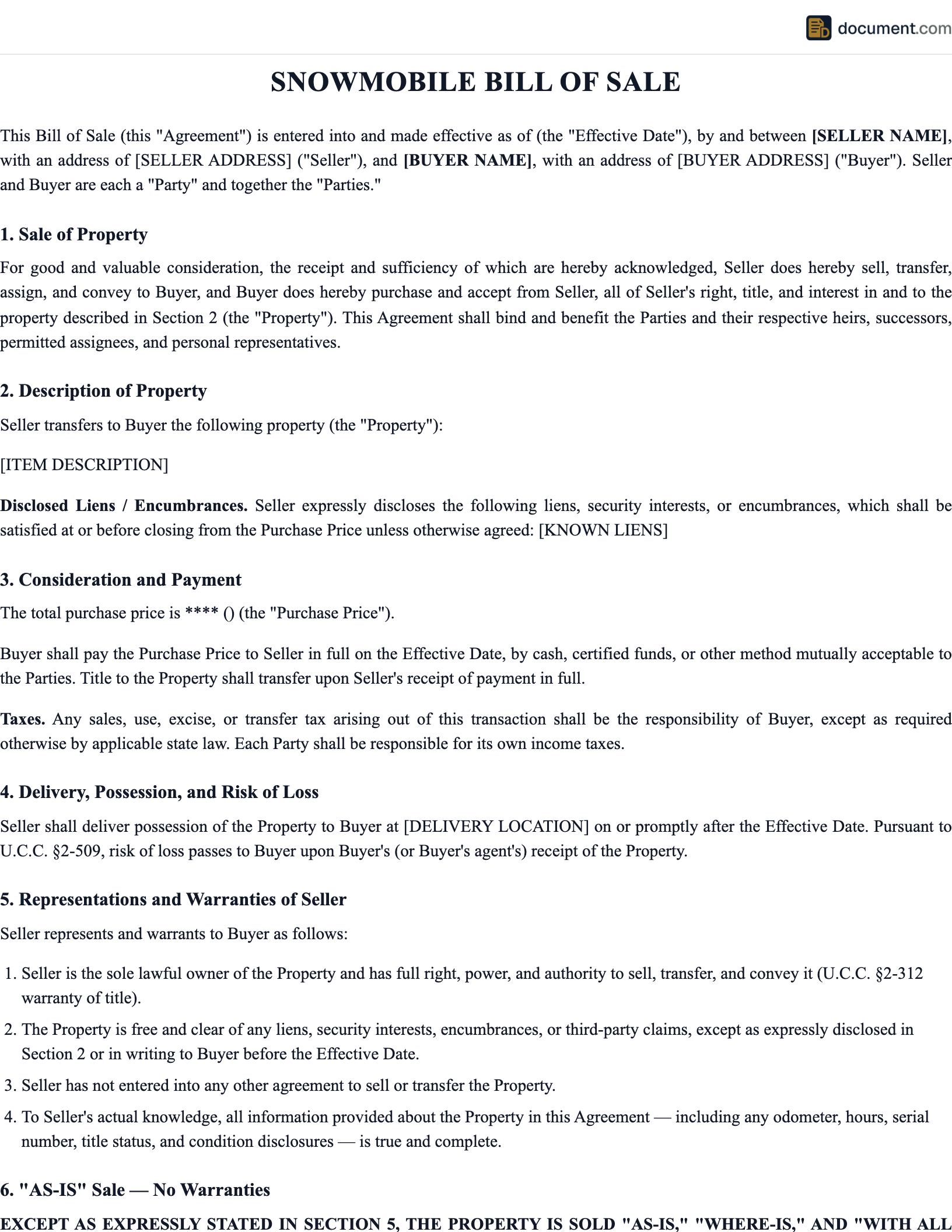
Sample Snowmobile Bill of Sale
Preview of the completed snowmobile bill of sale. Your finished document is customized to your state's snowmobile registration rules.
SNOWMOBILE BILL OF SALE
Snowmobile Transfer Document
This Snowmobile Bill of Sale is entered into on[Date]between:
SELLER:
Name: [Seller Name]
Address: [Seller Address]
BUYER:
Name: [Buyer Name]
Address: [Buyer Address]
1. SNOWMOBILE DESCRIPTION
Year: [Year] Make: [Ski-Doo] Model: [Summit X 850]
VIN / Serial: [VIN]
Engine: ☐ 2-stroke ☐ 4-stroke Displacement: [cc]
2. HOURS & MILEAGE
Engine hours: [Hours] Miles: [Miles]
3. TRACK & SKIS
Track size: [WxLxH]
4. SALE PRICE
$[Amount]([Amount in Words] Dollars)
Frequently Asked Questions
The most common questions buyers and sellers ask about snowmobile bills of sale, registration, trail passes, and safety rules.
Official Resources
Authoritative resources for snowmobile registration, safety, and trail access.
- International Snowmobile Manufacturers Association (ISMA): Industry body for Arctic Cat, BRP, Polaris, and Yamaha; safety standards and trail-use guidance.
- American Council of Snowmobile Associations (ACSA): Umbrella organization for state snowmobile associations and trail networks.
- Minnesota DNR Snowmobile Program: Registration, trail sticker, and safety training for the nation's largest snowmobile trail system.
- NYSSA (New York State Snowmobile Association): Trail passes, routes, and safety programs for New York's trail network.
- Your State Natural Resources Agency: Most states run snowmobile registration through DNR, fish & wildlife, or parks departments.
Create your Snowmobile Bill of Sale in under 10 minutes.
Answer a few questions and download a compliant, attorney-drafted document ready for your state.