



What Is a UTV Bill of Sale?
A UTV bill of sale is a written record of the private transfer of a side-by-side utility terrain vehicle from one owner to another. Unlike a passenger car, a UTV rarely receives a state-issued title in the traditional sense. Most states classify UTVs as off-highway vehicles (OHVs) and prove ownership through a combination of the manufacturer's statement of origin (MSO), an OHV registration card, and the signed bill of sale that travels with the machine across each owner.
Because the documentation chain is thinner than for cars, the bill of sale carries more legal weight on a UTV than it does on a sedan. It is often the only document that ties a buyer to a specific VIN, a specific price, and a specific date — which is what insurers, OHV registration clerks, and game wardens want to see if there is ever a question about ownership, theft, or a tax assessment.
A proper UTV bill of sale identifies the make and model (Polaris RZR Pro R, Can-Am Maverick X3, Honda Pioneer 1000, Yamaha Wolverine RMAX, Kawasaki Mule Pro-FXT, Kubota RTV, etc.), the VIN or PIN, the engine displacement, the hour meter reading, the cab and roll cage configuration, any aftermarket accessories included in the sale, and a clear as-is clause acknowledging that the buyer accepts the machine in its current condition.
Whether you are buying from a neighbor, selling at the end of riding season, or gifting a UTV to a family member, a complete bill of sale protects both sides. The seller is shielded from any future trail damage, theft claims, or accidents. The buyer has the document they need to register the machine, transfer the OHV decal, pay use tax, and prove ownership the next time they roll up to a trailhead.
OHV Classification
UTVs are off-highway vehicles in most states, not titled like cars
Hour Meter, Not Odometer
UTVs track engine hours, the equivalent of mileage for off-road machines
As-Is Protection
Defeats most buyer claims after a private off-road sale
UTV vs ATV vs Side-by-Side: Which Document Do You Need?
Off-road vehicles get lumped together at the dealer, but they are legally distinct categories. Picking the right bill of sale matters because state OHV registration forms ask for different fields depending on the class of machine.
| Vehicle | Controls | Use This Form |
|---|---|---|
| UTV / Side-by-Side | Steering wheel, foot pedals, bench/bucket seats, roll cage | UTV Bill of Sale (this page) |
| ATV / Quad | Handlebars, thumb throttle, straddle seat | ATV Bill of Sale |
| Dirt Bike | Two wheels, handlebars, no lights or plates | Dirt Bike Bill of Sale |
| Golf Cart / LSV | Steering wheel, low speed (under 25 mph), often electric | Golf Cart Bill of Sale |
How to Create a UTV Bill of Sale
A UTV bill of sale takes about five minutes to complete properly. Walk through these six steps and you will have a document your state OHV office and any future buyer will accept without question.
Verify the VIN on the Frame
Before any money changes hands, find the VIN stamped on the frame — usually the left front frame rail near the steering column or on a metal plate riveted to the cab. Compare it character-by-character to the MSO and any prior bill of sale. If the seller cannot show you a VIN that matches their paperwork, walk away. A ground-down or re-stamped VIN is a strong indicator of theft.
Record the Hour Meter
UTVs track engine hours, not miles. Photograph the dash and write the reading on the bill of sale exactly as it appears. Note whether the seller represents the reading as accurate. A well-used recreation UTV typically logs 60–120 hours a year; ranch and farm machines often log far more. Wear on the seats, pedals, and grips should match the displayed hours.
List Included Accessories
Aftermarket parts can easily double the value of a UTV. Itemize the winch, cab enclosure, half doors, roof, windshield, light bars, sound system, wheels and tires, snorkel kit, and any tools or spare belts that come with the machine. If the trailer is included, list it separately with its own VIN. A detailed accessory list prevents disputes about what was promised at handoff.
State the Sale Price Honestly
Write the sale price in numbers and in words. The figure on the bill of sale is what the state will use to calculate use tax when the buyer registers the UTV. Underreporting to dodge tax is a misdemeanor in most states, and OHV offices increasingly cross-check declared values against published guides like NADA and Kelley Blue Book for off-road vehicles.
Add the As-Is Clause
Include explicit language stating the UTV is sold as-is, with no warranty, and that the buyer has had the opportunity to inspect it. Disclose any known defects — a slipping clutch belt, a crack in the cargo bed, an aftermarket ECU tune. Disclosed defects are not grounds for a later lawsuit; concealed ones are.
Sign, Print Two Copies, Hand Over the MSO
Both parties sign and date the bill of sale. Print or save two identical copies — one for the buyer, one for the seller. The seller hands over the MSO (or title, if the state issues one), the prior OHV registration card, and any owner's manuals or service records. The buyer takes the bundle to the state OHV office to apply for a new decal in their name.
Key Components of a UTV Bill of Sale
A complete UTV bill of sale should contain every field below. Anything missing can delay the OHV registration transfer or weaken the document if it is ever challenged.
| Component | Description |
|---|---|
| Buyer & Seller | Full legal names, addresses, and phone numbers |
| Year, Make, Model | E.g., 2023 Polaris RZR Pro R 4 Ultimate |
| VIN / PIN | Frame-stamped 17-character VIN or product ID |
| Engine Displacement | CC rating (e.g., 999cc) — affects registration class |
| Hour Meter | Engine hours at time of sale, with accuracy statement |
| Accessories List | Itemized aftermarket parts included in sale |
| Sale Price | Numerals and words, plus payment method |
| As-Is Clause | No-warranty language and disclosed defects |
| Lien Statement | Seller confirms machine is free of encumbrances |
| Signatures | Dated signatures of buyer and seller |
Titling, OHV Stickers, and Registration
Because UTV rules vary so widely, the buyer should plan a trip to the state OHV office or DMV within a few days of taking delivery. Bring the bill of sale, the MSO or prior title, the previous OHV registration card, and a valid photo ID.
Buyer Reminder: Do Not Ride Without a Decal
Riding on public land or state forest trails without a current OHV decal in the buyer's name is a citable offense in nearly every state. Game wardens and trail rangers actively patrol popular riding areas and can impound an unregistered machine on the spot. Get the registration transferred before the first weekend.
- OHV Registration Card: Required in nearly every state for off-road use of public land
- OHV Decal / Sticker: Visual proof of registration, replaced annually in most states
- Use Tax / Sales Tax: Calculated from sale price on the bill of sale
- Spark Arrestor: Required by USFS and BLM for riding on federal land
- Safety Course: Required for younger riders in many states
- Street-Legal Conversion: Optional in UTV-friendly states like UT, AZ, ID, MT, SD
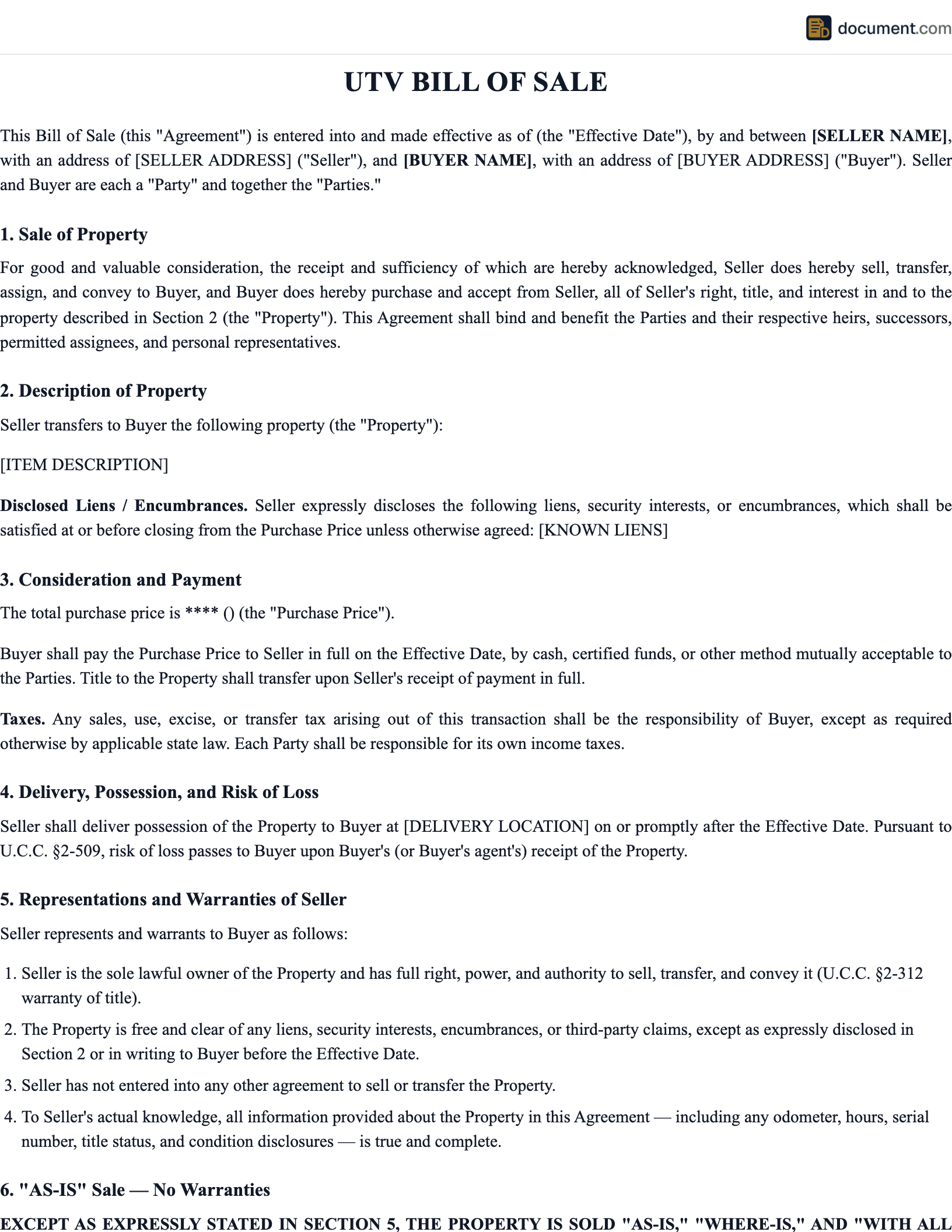
Sample UTV Bill of Sale
Here is a preview of what the completed UTV bill of sale looks like. Your final document will include all fields required by your state's OHV office.
UTV BILL OF SALE
Side-by-Side Off-Highway Vehicle Transfer
This UTV Bill of Sale is entered into on[Date]between:
SELLER:
Name: [Seller Name]
Address: [Seller Address]
BUYER:
Name: [Buyer Name]
Address: [Buyer Address]
1. UTV DESCRIPTION
Year: [Year] Make: [Polaris] Model: [RZR Pro R]
VIN: [Frame VIN]
Engine: [CC] Color: [Color]
2. HOUR METER
Engine hours: [Hours]
☐ Reading is accurate ☐ Reading is not actual
3. INCLUDED ACCESSORIES
[Winch, cab, doors, etc.]
4. SALE PRICE
$[Amount]([Amount in Words] Dollars)
5. AS-IS CLAUSE
The UTV described above is sold AS-IS, with no warranties express or implied. Buyer has inspected the machine and accepts it in its current condition.
Frequently Asked Questions
The most common questions buyers and sellers ask about UTV bills of sale, OHV registration, and side-by-side ownership.
Official Resources
Authoritative resources for UTV registration, safety, and trail access.
- Specialty Vehicle Institute of America (SVIA): Industry safety standards and rider education for ATVs and ROVs.
- Recreational Off-Highway Vehicle Association (ROHVA): The industry body for side-by-side manufacturers; publishes the ROHVA operator certification course.
- U.S. Forest Service OHV Program: Federal trail rules, spark-arrestor requirements, and route maps.
- Bureau of Land Management OHV Page: Designated routes and seasonal closures on BLM land.
- Your State OHV Office: Most states administer UTV registration through the parks, natural resources, or motor vehicles department.
Create your Utv Bill of Sale in under 10 minutes.
Answer a few questions and download a compliant, attorney-drafted document ready for your state.