
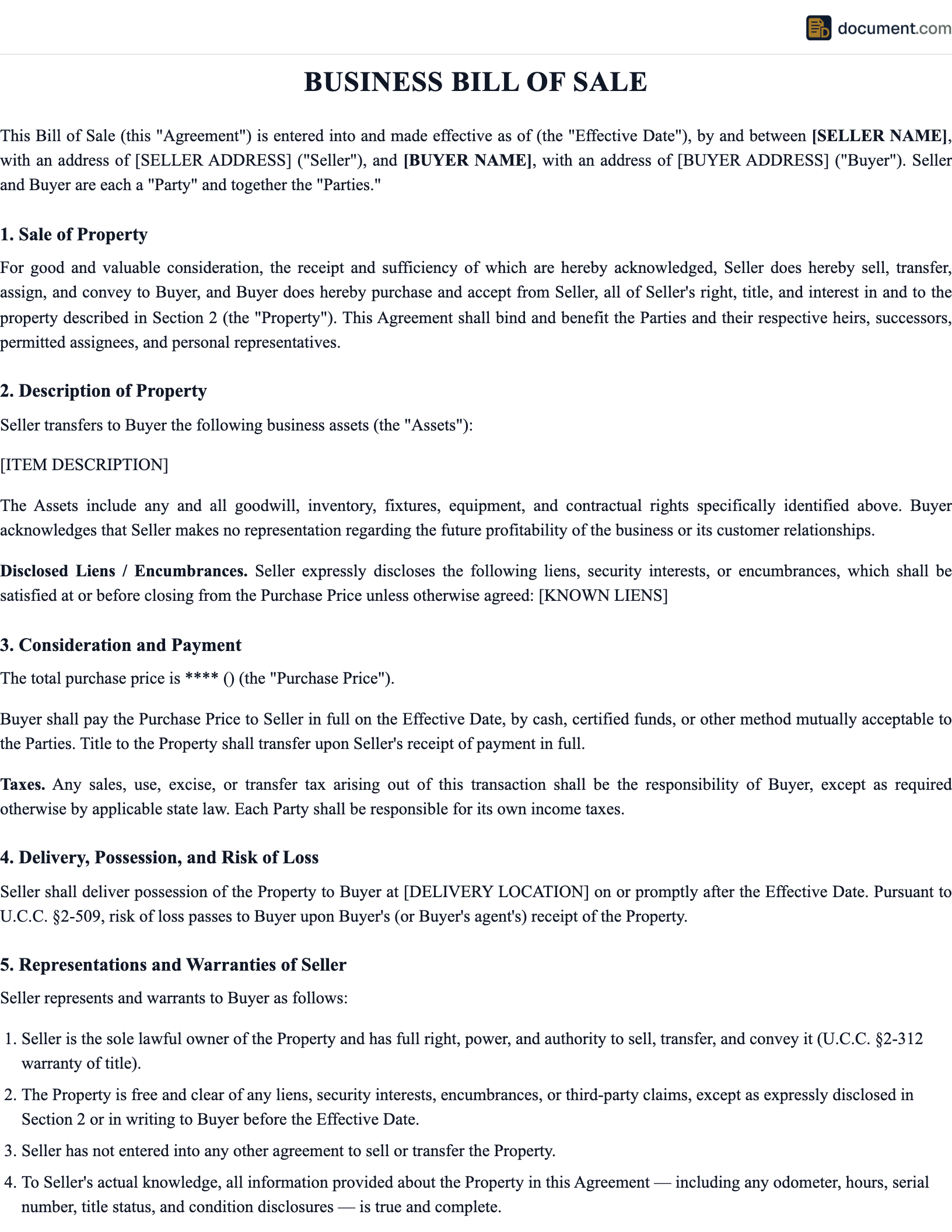



What Is a Business / Equipment Bill of Sale?
A business or equipment bill of sale is a legal document that records the sale and transfer of commercial property from one party to another. Unlike a general bill of sale used for personal items, a business bill of sale addresses the unique complexities of commercial transactions including asset inventories, UCC filings, bulk sale compliance, and tax allocation requirements.
This document is essential when selling or purchasing business equipment such as heavy machinery, restaurant equipment, medical devices, construction equipment, office furniture, inventory stock, or an entire business as a going concern. It provides proof of ownership transfer, documents the condition and value of assets, and serves as a critical record for tax reporting and depreciation purposes.
A properly drafted business bill of sale protects both the buyer and seller by clearly identifying every asset being transferred, disclosing any existing liens or encumbrances (such as UCC-1 financing statements), allocating the purchase price among asset categories, and establishing warranty terms for the equipment being sold.
Asset Inventory
Detailed listing of every item, serial number, condition, and value
UCC Compliance
Lien search guidance and financing statement provisions
Tax Documentation
Purchase price allocation and depreciation schedule support
Business / Equipment Bill of Sale by State
Each state has different requirements for business property transfers, UCC filings, bulk sale laws, sales tax on equipment, and personal property tax obligations. Select your state below for a template that meets your state's specific commercial transaction requirements.
How to Write a Business / Equipment Bill of Sale
A business bill of sale requires more detail than a standard personal property bill of sale. Follow these steps to ensure your document is complete, legally sound, and supports proper tax reporting.
Identify the Parties
Include the full legal names and addresses of both the buyer and seller. For business entities, use the exact legal name as registered with the state (LLC, Corporation, DBA) and include the state of formation, entity type, and the name and title of the authorized representative signing on behalf of the entity. If the seller is a sole proprietor, include their personal name and DBA.
Create a Detailed Asset Inventory
List every piece of equipment, furniture, inventory, or asset being transferred. For each item, include a description, manufacturer, model number, serial number, year of manufacture, current condition (excellent, good, fair, poor), and assigned value. Attach the inventory as an exhibit or schedule to the bill of sale. This inventory is critical for insurance, tax depreciation, and dispute resolution.
Conduct a UCC Lien Search
Before finalizing the sale, conduct a UCC lien search through the seller's state Secretary of State office to determine if any creditors have filed UCC-1 financing statements against the equipment. Existing liens must be satisfied or released before the sale, or the buyer risks losing the equipment to a secured creditor. Include a warranty in the bill of sale that the assets are free and clear of all liens and encumbrances.
Document the Sale Price and Allocation
State the total purchase price and how it is allocated among asset categories: equipment and machinery, furniture and fixtures, inventory, goodwill, intellectual property, and other assets. This allocation affects both parties' tax obligations — the buyer's depreciation deductions and the seller's capital gains vs. ordinary income treatment. Both parties must report the same allocation on IRS Form 8594 (Asset Acquisition Statement).
Address Bulk Sale Requirements
If you're selling a substantial portion of a business's inventory or assets outside the normal course of business, check whether your state has bulk sale laws (UCC Article 6). States that still enforce bulk sale requirements typically require written notice to the seller's creditors before closing. Failure to comply can make the buyer personally liable for the seller's debts.
Sign, Date, and Notarize If Required
Both parties (or their authorized representatives) must sign and date the bill of sale. Keep multiple copies — each party should retain an original. While not all states require notarization for business bills of sale, it is strongly recommended for high-value transactions. If the equipment requires title registration (e.g., heavy trucks, trailers), additional DMV paperwork may be necessary.
Business Property Types
Our business bill of sale templates are designed to handle all types of commercial property transfers. Each type may have specific documentation requirements, depreciation rules, and regulatory considerations.
Heavy Equipment / Machinery
Excavators, bulldozers, forklifts, CNC machines, lathes, industrial presses, and manufacturing equipment
Restaurant Equipment
Commercial ovens, refrigerators, walk-in coolers, fryers, prep tables, POS systems, and exhaust hoods
Medical / Dental Equipment
X-ray machines, dental chairs, imaging equipment, patient monitors, autoclaves, and examination tables
Construction Equipment
Cranes, backhoes, concrete mixers, scaffolding, generators, compressors, and power tools
Office Furniture / Equipment
Desks, chairs, cubicles, copiers, printers, phone systems, servers, and computer equipment
Inventory / Stock
Raw materials, finished goods, wholesale merchandise, retail stock, and work-in-progress inventory
Business as a Whole / Goodwill
Entire business transfers including tangible assets, trade name, customer lists, goodwill, and intellectual property
Agricultural Equipment
Tractors, harvesters, irrigation systems, planting equipment, grain bins, and livestock handling equipment
UCC Filings & Bulk Sale Laws
Understanding UCC (Uniform Commercial Code) filings and bulk sale laws is essential for any business equipment transaction. These laws protect both buyers and creditors in commercial property transfers.
Important: Always Conduct a UCC Lien Search
Before purchasing business equipment, always search for existing UCC-1 financing statements through the state's Secretary of State office. A buyer who purchases equipment subject to an existing security interest may lose the equipment to the secured creditor, even if the buyer paid full price and had no knowledge of the lien.
UCC-1 Financing Statements
- What They Are: A UCC-1 filing puts the world on notice that a creditor has a security interest in specific property — it's like a "lien" on business equipment
- Where to Search: UCC filings are recorded with the Secretary of State in the state where the debtor (seller) is organized or located
- Lien Release: The seller must provide a UCC-3 termination statement from the secured creditor to release any existing liens before the sale
- New Financing: If the buyer is financing the equipment purchase, the lender will file a new UCC-1 against the buyer
Bulk Sale Laws (UCC Article 6)
- Purpose: Bulk sale laws protect creditors when a business sells a large portion of its assets outside the ordinary course of business
- Creditor Notice: States that enforce bulk sale laws typically require the seller to provide a list of creditors and notify them before the sale closes
- State Variation: Many states have repealed UCC Article 6 bulk sale laws, but some (including California, Maryland, and New York) retain modified versions
- Risk of Non-Compliance: If bulk sale laws apply and are not followed, the buyer may become liable for the seller's unpaid debts to creditors
Sample Business / Equipment Bill of Sale
Below is a preview of our business equipment bill of sale template. Your customized document will include all fields required for your state's commercial transaction requirements.
BUSINESS / EQUIPMENT BILL OF SALE
Commercial Property Transfer Document
This Business / Equipment Bill of Sale is entered into on[Date]between:
SELLER:
Business Name: [Legal Entity Name]
Entity Type: [LLC / Corp / Sole Prop]
Address: [Business Address]
Authorized Rep: [Name & Title]
BUYER:
Business Name: [Legal Entity Name]
Entity Type: [LLC / Corp / Sole Prop]
Address: [Business Address]
1. ASSETS BEING TRANSFERRED
See attached Schedule A — Asset Inventory for a complete list of equipment, furniture, inventory, and other assets included in this sale.
2. PURCHASE PRICE & ALLOCATION
Total Price: $[Amount]
Equipment & Machinery: $[Amount]
Furniture & Fixtures: $[Amount]
Inventory: $[Amount]
Goodwill: $[Amount]
3. LIEN DISCLOSURE
Seller warrants that the above assets are free and clear of all liens, security interests, and encumbrances, except: [None / List]
Frequently Asked Questions
Find answers to common questions about business and equipment bills of sale, UCC filings, bulk sale laws, and commercial property transfers.
Create your Business Bill of Sale in under 10 minutes.
Answer a few questions and download a compliant, attorney-drafted document ready for your state.