
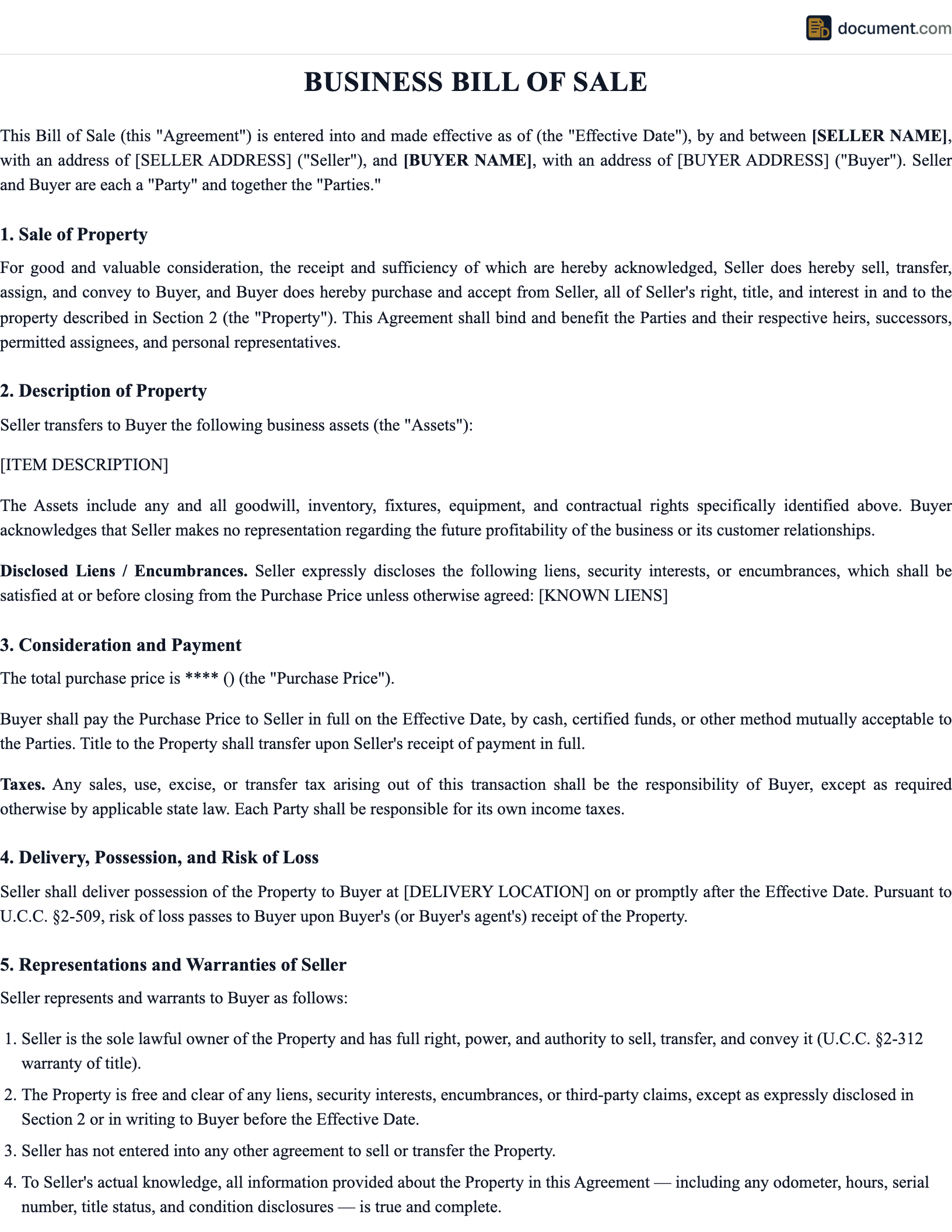



New Hampshire Business / Equipment Bill of Sale Overview
New Hampshire does not impose a state sales tax on business equipment transactions, which can provide significant savings on large equipment purchases. Business equipment transfers in New Hampshire are governed by the state's adoption of the Uniform Commercial Code for secured transactions. New Hampshire requires annual personal property tax assessment on business equipment through the local assessor's office. Businesses must report all equipment acquisitions and dispositions. Buyers should conduct a UCC lien search through the New Hampshire Secretary of State before completing any significant equipment purchase to verify the assets are free of security interests.
Whether you are purchasing heavy machinery, restaurant equipment, medical devices, office furniture, or an entire business operation in New Hampshire, a properly executed bill of sale with a detailed asset inventory protects both the buyer and seller. Our New Hampshire-specific template addresses NH sales tax requirements, UCC filing procedures, and local business property regulations.
0%
Sales tax rate
Yes
UCC filing available
No
Bulk sale notice req.
Yes
Personal property tax
New Hampshire Business Equipment Transfer Requirements
Transferring business equipment in New Hampshire involves several important steps to ensure legal compliance and protect both parties. Here is what you need to know:
Important: Conduct a UCC Lien Search First
Before purchasing any business equipment in New Hampshire, search for existing UCC-1 financing statements through the New Hampshire Secretary of State. A buyer who purchases equipment subject to an existing security interest may lose the equipment to the secured creditor, regardless of whether the buyer knew about the lien.
What the Seller Must Provide
- Bill of Sale: A completed bill of sale with detailed asset inventory listing every item being transferred with descriptions, serial numbers, condition, and values
- Lien Clearance: UCC-3 termination statements from any secured creditors, or written confirmation that no liens exist on the equipment
- Warranty Documentation: Any remaining manufacturer warranties, extended warranty policies, or explicit as-is disclaimers for each asset
- Tax Documentation: Original purchase receipts, depreciation schedules, and sales tax exemption certificates if applicable
What the Buyer Must Handle
- UCC Search: Conduct a UCC lien search through the New Hampshire Secretary of State before closing
- Sales Tax: Pay applicable New Hampshire sales tax on the equipment purchase (no state sales tax, but verify local requirements)
- Insurance: Obtain commercial property or inland marine insurance for the equipment before or immediately after transfer
- Property Tax Registration: Register the equipment with the local tax assessor for personal property tax purposes
How to Fill Out a New Hampshire Business Equipment Bill of Sale
Follow these steps to properly complete your New Hampshire business equipment bill of sale. Our template guides you through each field to ensure compliance with NH commercial transaction requirements.
Enter Seller Information
Include the seller's full legal business name as registered in New Hampshire, entity type (LLC, Corporation, Sole Proprietorship), NH business address, and the name and title of the authorized representative signing on behalf of the business. If the seller is a sole proprietor, include both their personal name and DBA.
Enter Buyer Information
Include the buyer's full legal business name, entity type, New Hampshire business address, and authorized representative. If the buyer is an individual purchasing equipment for personal use or a new business, include their full legal name and address. The buyer's NH sales tax account number may be required for exemption claims.
Create the Asset Inventory
List every piece of equipment being transferred with: description, manufacturer, model number, serial number, year of manufacture, current condition (excellent, good, fair, poor), and assigned value. Attach as Schedule A to the bill of sale. This inventory is critical for New Hampshire tax reporting, insurance, and dispute resolution.
State the Purchase Price and Allocation
Document the total purchase price and allocate it among asset categories: equipment and machinery, furniture and fixtures, inventory, goodwill, and other assets. This allocation is required for IRS Form 8594 and affects both parties' New Hampshire and federal tax obligations including depreciation deductions and capital gains treatment.
Disclose Liens and Encumbrances
The seller must warrant that all equipment is free and clear of liens, security interests, and encumbrances, or disclose any existing UCC-1 filings. Reference the New Hampshire UCC lien search results. If liens exist, document how they will be satisfied before or at closing.
Sign, Date, and Execute
Both parties (or their authorized representatives) must sign and date the bill of sale. Keep multiple original copies. While New Hampshire does not require notarization for most business equipment sales, notarization is recommended for high-value transactions. Ensure the authorized signers have proper authority from their respective entities.
New Hampshire UCC & Bulk Sale Requirements
UCC Article 9 — Secured Transactions
New Hampshire follows the Uniform Commercial Code Article 9 for secured transactions involving business equipment. Creditors who have financed equipment purchases file UCC-1 financing statements with the New Hampshire Secretary of State to perfect their security interest. Before purchasing any business equipment, buyers should search for these filings to ensure the equipment is not encumbered.
UCC Article 6 — Bulk Sales
New Hampshire has repealed UCC Article 6 governing bulk sales. There is no statutory requirement to notify the seller's creditors before a bulk transfer of business assets in New Hampshire. However, New Hampshire's fraudulent transfer statutes remain in full effect and can be used to challenge transfers made with intent to defraud creditors. Buyers should still conduct thorough due diligence, including UCC lien searches through the New Hampshire Secretary of State's office.
Personal Property Tax Implications
New Hampshire imposes an annual personal property tax on business equipment, machinery, furniture, and fixtures. Businesses must file a personal property tax return with the county or municipal assessor, listing all business assets with their original cost and acquisition dates. The assessor applies depreciation schedules to determine the assessed value, and the applicable tax rate (mill levy or percentage) is applied. Tax rates and assessment ratios vary by jurisdiction within New Hampshire. Contact your local assessor's office for specific filing deadlines and requirements.
Depreciation & Tax Considerations
New Hampshire does not have a state income tax, so there are no state-level income tax depreciation considerations for business equipment. For federal tax purposes, buyers can depreciate equipment using standard MACRS schedules, claim Section 179 immediate expensing (up to applicable limits), and potentially use bonus depreciation. For personal property tax purposes, New Hampshire assessors use their own depreciation schedules to determine the taxable value of business equipment, which may differ from federal depreciation methods.
New Hampshire Business Equipment Taxes & Fees
Here is a breakdown of the taxes and fees you can expect when transferring business equipment in New Hampshire. Rates and fees are subject to change — verify current amounts with the relevant New Hampshire agencies.
| Fee / Tax | Amount |
|---|---|
| State Sales Tax | None (0%) |
| Local Sales Tax | 0-7.5% (varies by locality) |
| UCC-1 Filing Fee | $15-$50 (Secretary of State) |
| UCC-3 Amendment/Termination | $15-$30 |
| UCC Search Fee | $10-$25 per debtor name |
| Business License | Varies by jurisdiction |
| Notarization | $2-$10 per signature |
Sample New Hampshire Business Equipment Bill of Sale
Below is a preview of our New Hampshire-specific business equipment bill of sale. Your customized document will include all fields required for NH commercial transactions.
STATE OF NEW HAMPSHIRE
BUSINESS / EQUIPMENT BILL OF SALE
Commercial Property Transfer Document
SELLER:
Business Name: [Legal Entity Name]
Address: [New Hampshire Address]
Entity Type: [LLC / Corp / Sole Prop]
BUYER:
Business Name: [Legal Entity Name]
Address: [New Hampshire Address]
ASSETS TRANSFERRED
See attached Schedule A for complete asset inventory.
Total Purchase Price: $[Amount]
NH Sales Tax: $[Amount]
New Hampshire Business Equipment Bill of Sale FAQ
Answers to common questions about New Hampshire business equipment bills of sale, UCC filings, and commercial property transfers.
Official New Hampshire Resources
Use these official New Hampshire resources to conduct UCC searches, verify tax rates, and access government forms for your business equipment transaction.
Other New Hampshire Bill of Sale Templates
Need a different type of bill of sale for New Hampshire? We offer state-specific templates for every type of property transfer.
New Hampshire Vehicle Bill of Sale
Cars, trucks, and SUVs
New Hampshire Boat Bill of Sale
Boats, jet skis, and watercraft
New Hampshire Motorcycle Bill of Sale
Motorcycles, scooters, and mopeds
New Hampshire Trailer Bill of Sale
Utility, travel, and cargo trailers
New Hampshire Firearm Bill of Sale
Handguns, rifles, and shotguns
New Hampshire General Bill of Sale
Furniture, electronics, and personal property
New Hampshire ATV Bill of Sale
ATVs, UTVs, and off-road vehicles
New Hampshire Horse Bill of Sale
Horses, cattle, and livestock
New Hampshire Mobile Home Bill of Sale
Manufactured and mobile homes
Create your New Hampshire Business Bill of Sale in under 5 minutes.
Answer a few questions and download a New Hampshire-compliant document, ready for the state agency.