



What Is a Livestock Bill of Sale?
A livestock bill of sale is the written record of a private transfer of farm animals — cattle, sheep, goats, swine, poultry, bison, or other food- and fiber-producing livestock — from one owner to another. It is the foundational document for virtually every livestock transaction in the United States. It proves ownership at brand-inspection stations, satisfies USDA Animal Disease Traceability (ADT) requirements, supports tax deductions, and resolves disputes when animals get sick or die shortly after delivery.
Unlike a car or tractor, livestock move through a complex regulatory web. Every animal must be individually or group-identified — by ear tag, brand, ear notch, tattoo, microchip, or RFID — and every interstate movement requires a Certificate of Veterinary Inspection (CVI) from a USDA- accredited veterinarian. Seventeen states require brand inspections before cattle can change hands or cross state lines. The bill of sale ties all of these documents together in a single evidentiary package.
For breeding stock, the bill of sale also carries warranties that have real legal weight — 'heifers guaranteed open,' 'cows guaranteed bred to Registered Angus bull,' 'bulls guaranteed fertile per BSE exam.' These clauses create enforceable contract rights and should be drafted carefully, with a specific remedy (refund, replacement, price adjustment) and a clear time window.
Whether you are selling 50 feeder steers out of a drylot, buying a registered Angus bull at a production sale, moving a flock of Katahdin sheep to a neighboring farm, or transferring NPIP- certified poultry breeding stock, our livestock bill of sale template captures the identification, health, and warranty fields needed for a clean transfer.
Animal Identification
Ear tags, brands, RFID, scrapie, NPIP
Health Certificates
CVI, Bangs, TB, trich test, vaccinations
Breeding Warranties
Open/bred/fertile guarantees with remedies
How to Write a Livestock Bill of Sale
Identify Buyer and Seller
Full legal names, mailing addresses, farm or ranch names, phone numbers, and premises identification numbers (PIN) if enrolled in USDA Premises ID.
List Each Animal or Lot
For breeding stock, list each animal individually with species, breed, sex, age, weight, color, and ID tags. For market animals, document count and average weight ('47 head Black Angus feeder steers, 650 lb avg').
Record All Identification
840 RFID ear tag numbers, visual tags, brand registration number, scrapie flock ID, ear notches, tattoos, microchip numbers, and breed association registration numbers.
Document Health Status
CVI number and issuing veterinarian, current vaccinations, deworming, any recent treatments, Bangs/TB/trich test results with dates, and NPIP status for poultry.
State Warranties and Pregnancy
If breeding stock: 'open' or 'bred' guarantees with remedies. For bulls: BSE exam results. For dairy: DHIA milk records and somatic cell count.
Record Price, Payment, and Sign
Total price (per head × count, or lump sum), payment method, and 'as-is' vs. warranted language. Both parties sign and date; include brand inspection certificate number if required.
Key Components
| Field | Description |
|---|---|
| Buyer & Seller | Names, addresses, farm names, PIN |
| Species / Breed | Cattle (Angus), Sheep (Suffolk), Goat (Boer), Swine (Yorkshire) |
| Sex & Age | Cow, bull, steer, heifer, ewe, ram, doe, buck, boar, barrow |
| Count & Weight | Individual or group count + average weight |
| 840 RFID Tag | USDA Animal Disease Traceability tag |
| Visual Ear Tag | Farm/ranch identification number |
| Brand | Hot iron or freeze brand with registration # |
| Scrapie / NPIP | Flock ID for sheep/goats or poultry |
| CVI Number | Certificate of Veterinary Inspection + vet name |
| Vaccinations | Most recent vaccines and dewormer with dates |
| Pregnancy | Open / bred / calving window |
| Breeding Warranty | Guarantees with remedy and time window |
| Price | Per head or lump sum, payment method |
| Signatures | Buyer, seller, notary if required |
Types of Livestock Covered
Beef Cattle
Angus, Hereford, Charolais, Simmental, Brangus, Wagyu, Limousin. Typically sold by head with weight, breed, age, and pregnancy status documented.
Dairy Cattle
Holstein, Jersey, Brown Swiss, Guernsey, Ayrshire. Sold with milk production records (DHIA), lactation number, and somatic cell count.
Sheep
Suffolk, Dorper, Katahdin, Hampshire, Merino, Targhee, Rambouillet. Sold as ewes, rams, wethers, or market lambs with scrapie tags.
Goats
Boer, Kiko, Spanish, Nubian, Alpine, LaMancha, Nigerian Dwarf. Sold as does, bucks, or wethers for meat, dairy, or fiber production.
Swine / Hogs
Yorkshire, Duroc, Hampshire, Berkshire, Pietrain, Landrace, and feeder pigs. Documentation includes PQA Plus and farm biosecurity status.
Poultry
Chickens, turkeys, ducks, geese, guinea fowl. Large flock sales require NPIP (National Poultry Improvement Plan) certification.
Bison / Elk / Alternative Livestock
Bison, farmed elk, and red deer are regulated as alternative livestock in most states and require specific permits, brand inspections, and TB / brucellosis testing.
Rabbits / Small Stock
Meat rabbits (New Zealand, Californian, Rex), breeding stock from ARBA-registered herds. Sold individually or in colony lots.
Cattle vs. Sheep vs. Goats vs. Swine
| Factor | Cattle | Sheep | Goats | Swine |
|---|---|---|---|---|
| Primary ID | 840 RFID + brand | Scrapie tag | Scrapie tag/tattoo | Ear notch / tag |
| CVI Required | Yes (interstate) | Yes | Yes | Yes |
| Brand Inspection | 17 states | No | No | No |
| Key Health Test | Bangs / TB | Scrapie / OPP | CAE / CL / Johne's | PRRS / PEDv |
| Typical Unit Price | $1,200 – $4,000 | $200 – $550 | $200 – $600 | $60 – $300 feeder |
| Typical Lot Size | 1–200 head | 5–500 head | 5–200 head | 10–2,000 head |
Brands, Ear Tags & Health Certificates
Three documentation layers must align for a clean livestock transfer: identification (brand, tag, RFID), state brand inspection (in 17 western states), and health certification (CVI, Bangs, TB, trich). The bill of sale is the connective tissue that references all three.
- 840 RFID Tag: USDA APHIS Animal Disease Traceability identification — required for breeding cattle/bison 18+ months interstate.
- Brand Inspection: Required in AZ, CA, CO, ID, KS, MT, NE, NV, NM, ND, OK, OR, SD, TX, UT, WA, WY.
- CVI (Health Certificate): Issued by USDA-accredited veterinarian, usually valid 30 days.
- Scrapie Program: Mandatory for sheep and goats in interstate movement.
- NPIP: National Poultry Improvement Plan certification for breeding poultry.
Form Preview
Section 1: Parties and farm information
Section 2: Animal identification (individual or lot)
Section 3: Health certificate (CVI) and tests
Section 4: Vaccination and treatment history
Section 5: Breeding status and warranties
Section 6: Brand inspection reference
Section 7: Price, payment, and signatures
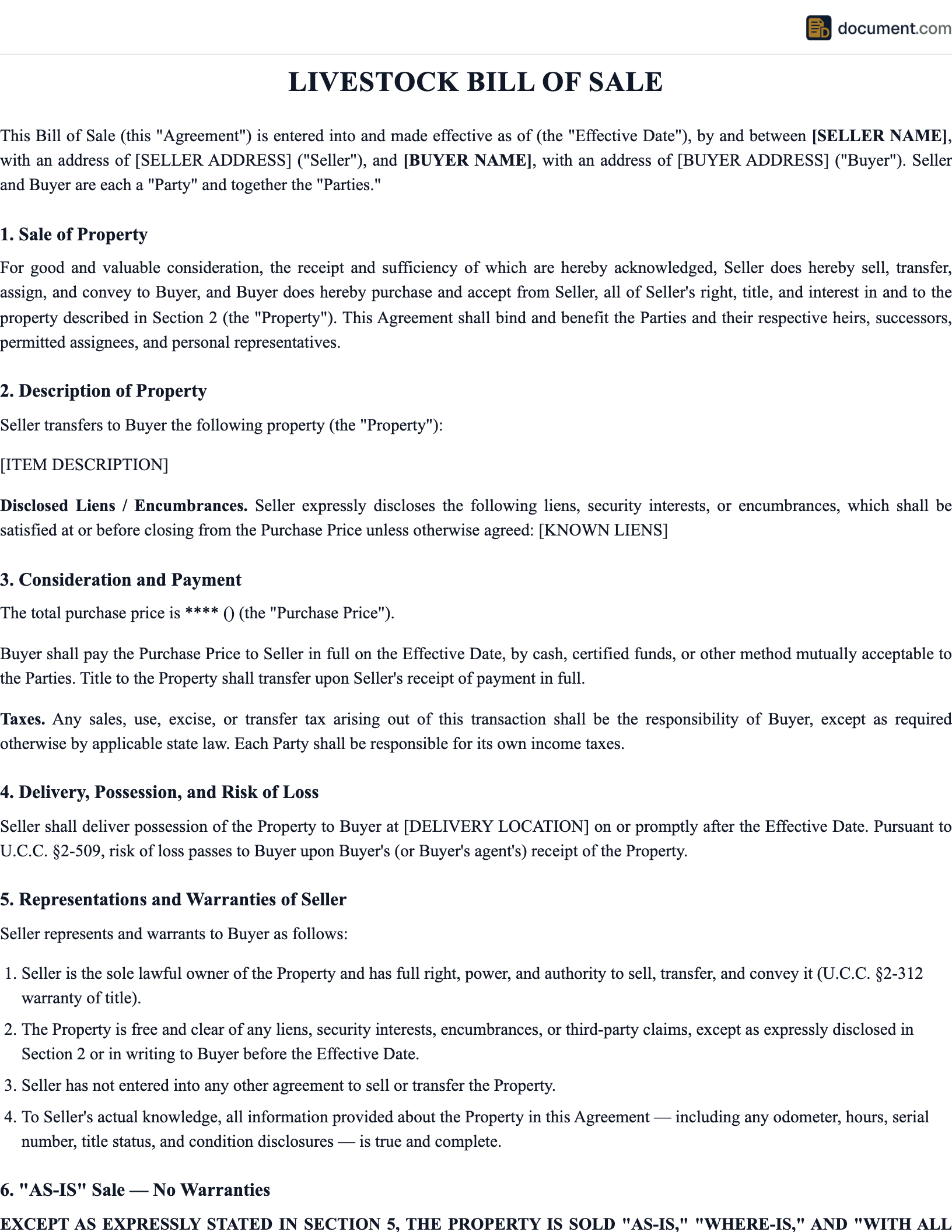
Sample Livestock Bill of Sale
LIVESTOCK BILL OF SALE
Private Farm Animal Transfer
Dated [Date]
SELLER:
Farm/Ranch: [Name]
BUYER:
Farm/Ranch: [Name]
1. ANIMALS
Species: [Cattle/Sheep/Goat/Swine]
Breed: [Breed]
Count: [#] head Avg Weight: [lb]
840 RFID: [Tag #s]
2. HEALTH
CVI #: [Number]
Veterinarian: [Name, DVM]
3. BREEDING STATUS
☐ Open ☐ Bred ☐ N/A
4. PRICE
$[per head] × [#] head = $[Total]
Official Resources
Frequently Asked Questions
Create your Livestock Bill of Sale in under 10 minutes.
Answer a few questions and download a compliant, attorney-drafted document ready for your state.