



What Is a Notarized Bill of Sale?
A notarized bill of sale is a standard bill of sale that has been signed in the presence of a state-commissioned notary public, who verifies the signers' identities and applies their official seal. The notary's involvement adds a layer of legal credibility that makes the document significantly stronger as evidence in court, harder to forge or dispute, and compliant with state requirements that mandate notarization for certain property transfers.
The document itself is identical to a regular bill of sale — it contains all the same information about the buyer, seller, property description, price, and terms. The difference is the addition of a notary acknowledgment block at the bottom, where the notary certifies that the signers appeared before them, presented valid identification, and signed the document voluntarily. This block includes the notary's printed name, signature, commission number, commission expiration date, and official seal.
Several states legally require notarized bills of sale for vehicle title transfers, boat registrations, and other property transactions. Even in states where notarization is optional, it is advisable for high-value transactions, sales between strangers, and any situation where one party might later dispute the transaction. The small cost and effort of notarization can prevent thousands of dollars in legal expenses if a dispute arises.
Official Notary Seal
State-commissioned verification of signer identity
Court-Ready
Stronger evidentiary weight if disputes reach court
State Compliant
Meets mandatory requirements in states that require it
When Notarization Is Required
Notarization requirements depend on your state, the type of property being sold, and the circumstances of the transfer. Here are the most common situations where a notarized bill of sale is either required or strongly recommended.
State-Mandated Vehicle Transfers
Several states require notarized bills of sale for vehicle title transfers. In these states, the DMV will not process your title application without a notarized document. The requirement exists to prevent title fraud and protect both buyers and sellers from forged signatures on vehicle transfer documents.
High-Value Transactions
For any sale involving thousands of dollars — vehicles, boats, heavy equipment, jewelry, art — notarization is strongly recommended even when not legally required. The notary's independent verification of identity and witnessing of signatures provides crucial protection against later claims of fraud, forgery, or coercion.
Sales Between Strangers
When the buyer and seller do not know each other — as in most online marketplace transactions — notarization adds a safety net. The notary verifies that both parties are presenting real government-issued identification, which deters scammers and provides a verified record of who was involved in the transaction.
States Requiring Notarized Bills of Sale
The following states require notarization for vehicle or property bills of sale in certain circumstances:
Louisiana
Required for all vehicle bills of sale and most property transfers over certain thresholds
Montana
Notarization required for all motor vehicle title transfers and boat registrations
Nebraska
Vehicle and boat bills of sale must be notarized for title transfer at the county treasurer
West Virginia
All vehicle bills of sale must be notarized to process title and registration transfers
Maryland
Vehicle gift transfers and certain title transactions require notarization
New Hampshire
Vehicle bills of sale must be notarized when the transaction exceeds certain thresholds
How to Write a Notarized Bill of Sale
A notarized bill of sale is prepared like any bill of sale, with the critical addition of a notary acknowledgment block. The key rule: do not sign the document until you are in front of the notary.
Complete the Bill of Sale (Unsigned)
Fill in all fields of the bill of sale — buyer and seller information, property description, price, terms, and condition. Leave the signature lines blank. The notary must witness the actual signing. If you sign before appearing before the notary, they cannot notarize the document (unless your state allows acknowledgments of previously signed documents).
Appear Before a Notary with Valid ID
All signers must appear before the notary with unexpired, government-issued photo identification. The notary will verify each person's identity by comparing their appearance to their photo ID and confirming their name matches the document. Banks, UPS stores, law offices, and mobile notary services are common locations.
Sign in the Notary's Presence
Sign the bill of sale while the notary watches. The notary may ask each signer to confirm they are signing voluntarily and understand the contents of the document. This is the witnessed act that gives the notarization its legal significance.
Notary Completes the Acknowledgment
After witnessing the signatures, the notary fills in the acknowledgment block — recording the date, the state and county, the names of the signers, and their own commission information. The notary signs, affixes their official seal (stamp or embossed seal), and records the transaction in their notary journal.
Distribute Copies
Each party should receive a copy of the notarized bill of sale. If you need additional notarized copies (for the DMV, insurance company, or lender), ask the notary to notarize multiple originals at the same time. Photocopies of a notarized document may not be accepted — verify with the receiving agency whether they need an original.
Key Components of a Notarized Bill of Sale
A notarized bill of sale includes all standard bill of sale elements plus the notary acknowledgment section.
| Component | Description |
|---|---|
| Buyer & Seller Names | Full legal names, addresses, and identification details |
| Property Description | Detailed description with identifiers (VIN, serial #, HIN) |
| Sale Price | Amount in numbers and words, payment method |
| Terms & Conditions | As-is disclaimer, warranty terms, lien statement |
| Signature Lines | Dated signatures of all parties |
| Notary Acknowledgment | State, county, date, signer identity confirmation |
| Notary Signature & Seal | Notary's signature, printed name, and official seal |
| Commission Information | Notary commission number and expiration date |
The Notarization Process
Understanding the notarization process helps you prepare properly and avoid common mistakes that can delay your transaction.
Critical: Do Not Sign Before the Notary
The most common mistake people make is signing the document before appearing before the notary. If the notary did not witness the actual signing, they cannot notarize the document in most states. You would need to start over with a new unsigned copy. Complete the bill of sale but leave all signature lines blank until you are in the notary's presence.
- Find a Notary: Banks, credit unions, UPS stores, FedEx offices, law firms, title companies, and mobile notary services
- Bring Valid ID: Unexpired government photo ID for every person who needs to sign
- All Signers Present: Everyone named on the bill of sale must appear before the notary
- Unsigned Document: Bring the completed but unsigned bill of sale — sign only in front of the notary
- Payment: Bring cash or check for the notary fee (typically $2 to $15 per signature depending on state)
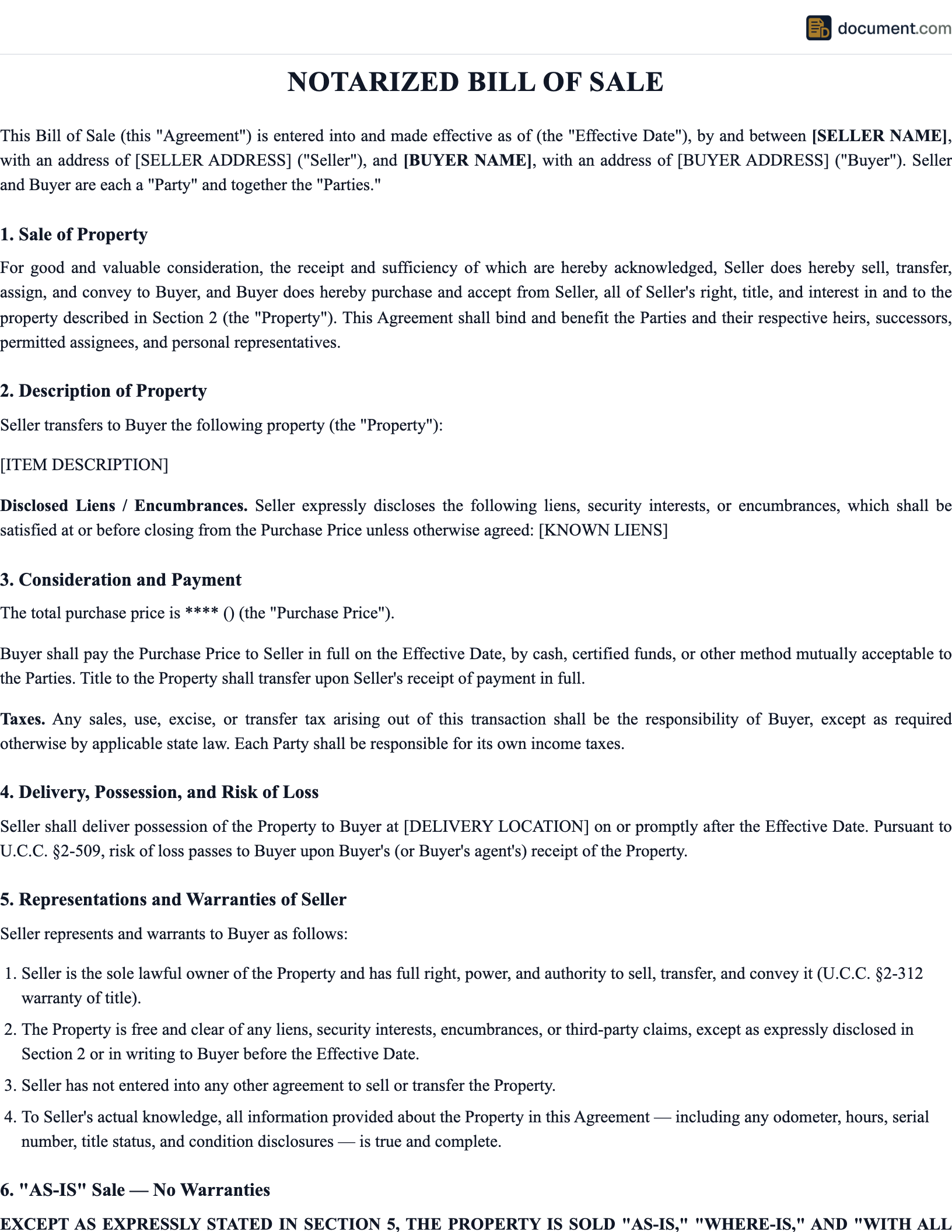
Sample Notarized Bill of Sale
Below is a preview of our notarized bill of sale template. Your customized document will include the appropriate notary acknowledgment format for your state.
NOTARIZED BILL OF SALE
Notary-Verified Transfer Document
This Bill of Sale is entered into on[Date]between:
SELLER:
Name: [Seller Name]
Address: [Seller Address]
BUYER:
Name: [Buyer Name]
Address: [Buyer Address]
1. PROPERTY DESCRIPTION
Description: [Property]
Identifier: [VIN/Serial/HIN]
2. SALE PRICE
$[Amount]([Amount in Words] Dollars)
NOTARY ACKNOWLEDGMENT
State of [State], County of [County]
On this [Date], before me personally appeared the above-named individuals...
Notary Signature: [Seal]
Official Notary Resources
Use these resources to find notaries, understand requirements, and verify notary commissions.
Frequently Asked Questions
Find answers to common questions about notarized bills of sale, the notarization process, and state requirements.
Create your Notarized Bill of Sale in under 10 minutes.
Answer a few questions and download a compliant, attorney-drafted document ready for your state.