
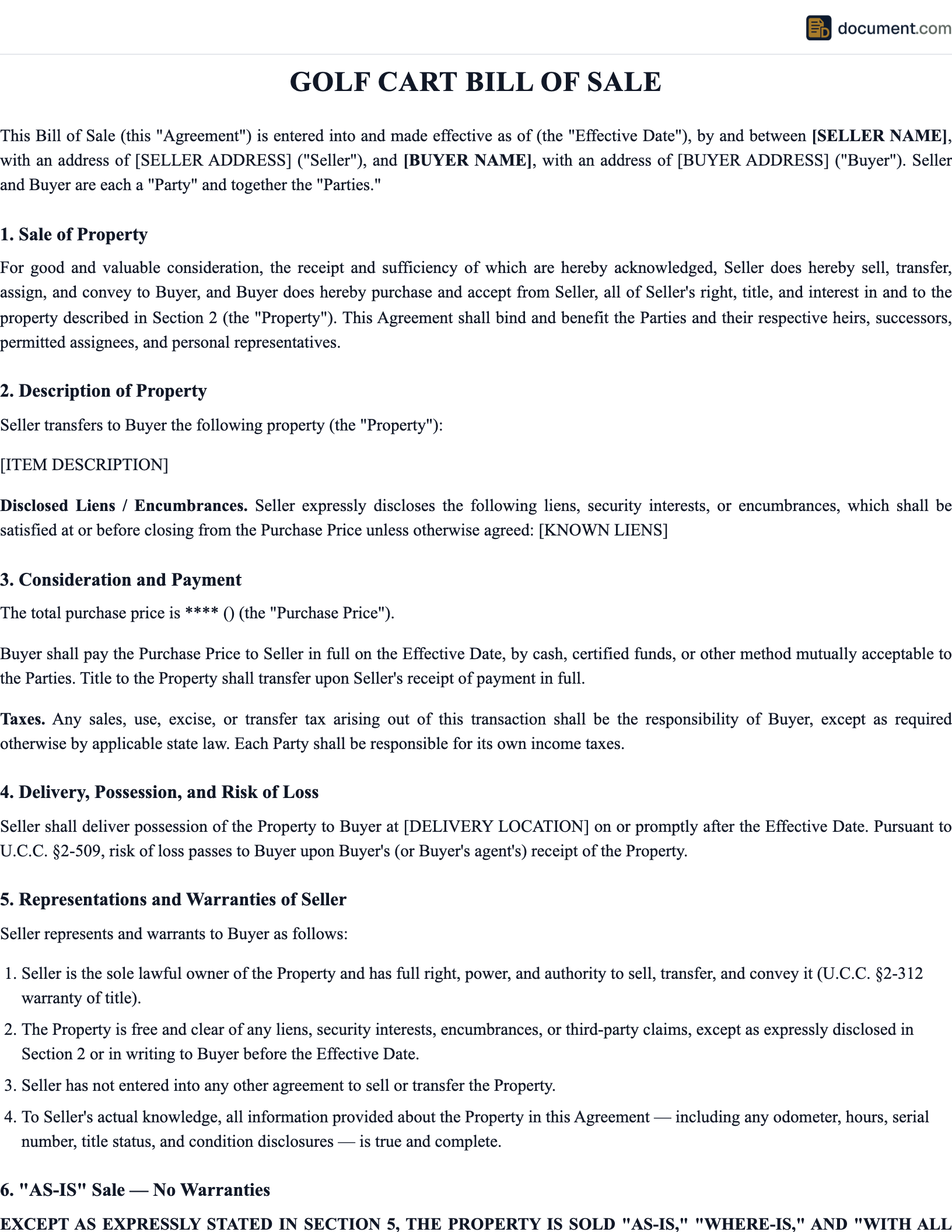



What Is a Golf Cart Bill of Sale?
A golf cart bill of sale is a written record of the private transfer of a golf cart from one owner to another. Golf carts sit in an unusual legal category: they are not motor vehicles in the federal sense, they are not usually titled by the state, and yet they can cost $15,000 or more when lifted, custom-painted, and lithium-converted. The bill of sale is often the only document that proves ownership, which gives it unusually high importance compared to the paperwork for a licensed car.
The three major manufacturers — Club Car, E-Z-GO, and Yamaha — assign their own serial numbers rather than federally issued VINs, and those serial numbers are what you capture on the bill of sale. If the cart has been converted to meet Federal Motor Vehicle Safety Standard 500 (FMVSS 500) and qualifies as a low-speed vehicle (LSV), it will have a proper 17-character VIN and is titled like any other car in nearly every state.
Golf cart sales are common in retirement communities, beach towns, large neighborhoods, and golf-course planned developments — The Villages in Florida, Peachtree City in Georgia, Sun City in Arizona, and Hilton Head in South Carolina are the best-known. Each of these communities has its own registration, insurance, and operating rules that sit on top of state law. A clean bill of sale is the starting point for the buyer to enroll in any of those programs.
Whether you are buying a basic used Club Car for $3,000 or selling a fully-loaded lifted lithium Yamaha for $18,000, a detailed bill of sale protects both parties. It captures the serial number, battery or engine configuration, accessories, LSV status, and any warranty details, and it serves as the foundation for insurance, community registration, and future resale.
Gas or Electric
Works for Club Car, E-Z-GO, Yamaha, and aftermarket carts
Battery Disclosure
Captures pack voltage, chemistry, age, and charger type
LSV Ready
Optional FMVSS 500 street-legal conversion fields
Golf Cart vs LSV vs NEV
The classification determines everything — whether the machine is titled, whether it needs a VIN, whether it can be driven on public roads, and whether it needs auto insurance.
| Class | Top Speed | Street Legal? |
|---|---|---|
| Traditional Golf Cart | Under 20 mph | No (private property, community streets) |
| Low-Speed Vehicle (LSV) | 20–25 mph | Yes, on roads ≤35 mph (most states) |
| Neighborhood EV (NEV) | 20–25 mph | Same as LSV (state-specific label) |
| Medium-Speed Vehicle (MSV) | 25–35 mph | Yes in some states (e.g., MT, WA) |
How to Create a Golf Cart Bill of Sale
Six steps cover every requirement for a clean golf cart transfer.
Find the Manufacturer Serial Number
Club Car serial numbers sit above the accelerator pedal or on the glove-box cowl. E-Z-GO numbers are on a sticker above the driver-side foot tray or stamped on the frame rail. Yamaha numbers are stamped into the frame below the driver's seat. Photograph the plate and write the full string on the bill of sale — the year and model can be decoded from the serial number in most cases.
Record Battery or Engine Details
For electric carts, capture the pack voltage (36V, 48V, 72V), chemistry (flooded lead-acid, AGM, lithium), the build date of the current pack, and the charger type. Batteries are the single biggest wear item on an electric cart. For gas carts, record the engine make, displacement, fuel type, and approximate hours of use if known.
Document LSV Status
If the cart has been converted to meet FMVSS 500, note it explicitly. List the 17-character VIN assigned to the converted cart, and confirm the presence of DOT-required lighting, mirrors, reflectors, seat belts, parking brake, and windshield. A buyer planning to register the cart as a street-legal LSV needs this information to succeed at the DMV.
List Accessories and Modifications
Itemize the lift kit, wheels and tires, rear seat kit, enclosure, stereo, lighting upgrades, custom paint or wrap, and any performance controllers or high-speed motors. Lifted and lithium carts can easily double the price of an unmodified model, and the itemized accessory list protects both parties from later disputes.
State the Price and As-Is Terms
Write the sale price in numbers and words. Include a clear as-is clause and disclose any known defects — weak battery cells, a slipping drive belt, a cracked frame, a controller fault code. Disclosed defects are not grounds for a lawsuit; concealed ones are.
Sign, Transfer Keys and Documents
Both parties sign and date. The seller hands over the keys, the charger, the manuals, any service records, the warranty paperwork for an aftermarket lithium pack, and the community registration sticker if applicable. The buyer takes the bill of sale to their insurance company to add the cart to a policy.
Key Components
Every field below should appear on a golf cart bill of sale.
| Component | Description |
|---|---|
| Buyer & Seller | Names, addresses, phone numbers |
| Year, Make, Model | E.g., 2022 Club Car Onward 4-passenger |
| Serial Number | Manufacturer-assigned serial string |
| Power Type | Gas or electric; voltage and chemistry if electric |
| Battery Age | Build date of current pack (electric only) |
| LSV Status | Yes/No plus 17-char VIN if FMVSS 500 compliant |
| Accessories | Lift, wheels, enclosure, stereo, lighting |
| Sale Price | Numerals and words, payment method |
| As-Is Clause | No-warranty language and disclosed defects |
| Signatures | Dated; notarized in select states |
Street-Legal Conversions and FMVSS 500
A traditional golf cart becomes a legal low-speed vehicle when it meets every requirement of FMVSS 500. Once it qualifies, the state DMV will issue it a VIN and title, and it can be driven on most roads with a posted speed limit of 35 mph or less. States that are particularly friendly to LSV use include Arizona, Florida, Georgia, South Carolina, and Texas.
Buyer Tip: Don't Assume Street-Legal Status
Many sellers market carts as "street legal" when they only meet a subset of FMVSS 500. Verify the 17-character VIN, confirm every required lighting and safety element is present, and ask for the conversion paperwork. A non-compliant cart cannot be registered as an LSV.
- Headlights and Taillights: DOT-approved front and rear lamps
- Turn Signals: Front and rear amber/red indicators
- Mirrors: Driver's side exterior plus interior or passenger side
- Windshield: Must meet ANSI Z26.1 glazing standard
- Seat Belts: Type 1 or Type 2 belts at every designated seating position
- VIN: 17-character identifier assigned during the conversion
Sample Golf Cart Bill of Sale
Preview of the completed golf cart bill of sale.
GOLF CART BILL OF SALE
Golf Cart Transfer Document
This Golf Cart Bill of Sale is entered into on[Date]between:
SELLER:
Name: [Seller Name]
Address: [Seller Address]
BUYER:
Name: [Buyer Name]
Address: [Buyer Address]
1. GOLF CART DESCRIPTION
Year: [Year] Make: [Club Car] Model: [Onward 4P]
Serial #: [Serial]
2. POWERTRAIN
☐ Gas ☐ Electric
If electric — Voltage: [48V] Chemistry: ☐ Lead-acid ☐ AGM ☐ Lithium
Battery build date: [Date]
3. LSV STATUS
Converted to LSV (FMVSS 500): ☐ Yes ☐ No
If Yes — VIN: [17-char VIN]
4. SALE PRICE
$[Amount]([Amount in Words] Dollars)
Frequently Asked Questions
The most common questions buyers and sellers ask about golf cart bills of sale, serial numbers, LSV classification, and community rules.
Official Resources
Authoritative resources for golf cart ownership, LSV conversion, and safety.
- NHTSA FMVSS 500: Federal low-speed vehicle equipment standard defining what qualifies as a street-legal LSV.
- 49 CFR 571.500: The Code of Federal Regulations text that enumerates the LSV requirements.
- Club Car, E-Z-GO, and Yamaha Owner Resources: Manufacturer serial number lookup and service manuals.
- Your State DMV: LSV registration, titling, and insurance rules vary by state.
- Your Community HOA / Municipality: Cart-specific registration, insurance, and operating rules in places like The Villages and Peachtree City.
Create your Golf Cart Bill of Sale in under 10 minutes.
Answer a few questions and download a compliant, attorney-drafted document ready for your state.