



What Is an Even Trade Bill of Sale?
An even trade bill of sale is a legal document that records the exchange of two items of agreed equal value between two parties, with no cash changing hands. Unlike a standard bill of sale where one party pays money for goods, an even trade bill of sale documents a swap — each party gives up one item and receives another, and both agree that the exchanged items have the same fair market value.
Even trades are most common with vehicles, where two private parties swap cars, trucks, or motorcycles of comparable value. However, even trade bills of sale are also used for boats, ATVs, farm equipment, construction machinery, and other personal property. The key legal requirement is that both items are fully described, both parties acknowledge the equal value, and both sign to confirm the exchange occurred voluntarily.
Without a written bill of sale, an even trade creates serious documentation problems. Neither party can prove they legally acquired the other's property, title transfers at the DMV become complicated without proof of the transaction, and disputes about the terms of the trade become impossible to resolve. The bill of sale transforms a handshake deal into an enforceable legal record.
Equal Value Exchange
Documents the swap with no cash changing hands
Fair Market Value
Records the agreed value for tax and title purposes
Title Transfer Ready
Accepted by DMVs for vehicle and boat title changes
When to Use an Even Trade Bill of Sale
An even trade bill of sale is appropriate any time two parties exchange property of equal value without cash. Here are the most common scenarios.
Vehicle-for-Vehicle Trades
The most common even trade scenario is swapping one car for another. Two owners agree their vehicles are worth roughly the same amount and exchange them directly. Both vehicles need title transfers at the DMV, and each owner needs a bill of sale to prove how they acquired the other person's vehicle. Without it, the DMV may refuse the transfer or assess taxes based on the full book value.
Equipment and Machinery Swaps
Businesses and individuals sometimes trade equipment rather than buying and selling separately. A farmer might swap a tractor for a combine, or a contractor might trade a skid steer for an excavator. The bill of sale documents the exchange, establishes the fair market value for depreciation purposes, and provides a clear ownership trail for insurance and liability.
Recreational Vehicle and Boat Trades
Trading a motorcycle for an ATV, a boat for a jet ski, or an RV for a travel trailer are all common even trade scenarios. These items typically require title and registration transfers, making the bill of sale essential for completing the paperwork with the DMV, wildlife agency, or marine registration office.
Collectibles and High-Value Items
Collectors frequently trade items of comparable value — firearms, vintage watches, art, sports memorabilia, and similar collectibles. An even trade bill of sale documents the exchange, establishes provenance for the items, and creates a paper trail for insurance and estate planning purposes.
How to Write an Even Trade Bill of Sale
An even trade bill of sale is structured differently from a standard bill of sale because both parties are simultaneously buyers and sellers. Follow these steps to create a complete document.
Identify Both Parties
List both parties as "Party A" and "Party B" (rather than "buyer" and "seller") since each person is both a buyer and a seller. Include full legal names, current addresses, phone numbers, and driver's license numbers for each party.
Describe Party A's Item
Provide a detailed description of the first item being traded. For vehicles, include year, make, model, VIN, mileage, and color. For other property, include manufacturer, model, serial number, and condition. State the agreed fair market value of this item.
Describe Party B's Item
Provide the same level of detail for the second item. State the agreed fair market value, which should match Party A's item if this is a true even trade. If the values differ and cash is involved, note the cash amount as "boot" — but at that point, consider using separate standard bills of sale instead.
State the Even Trade Terms
Include a clear statement that both parties agree the items are of equal value, that no cash is being exchanged, and that the trade is made as-is (if applicable). Each party should confirm their item is free of liens and that they have full authority to trade it.
Sign, Date, and Transfer Titles
Both parties sign and date the document. Each party should receive a copy. For titled property, each party signs over their title to the other and both visit the DMV or registration agency to complete the transfers. Some parties go to the DMV together to process both transfers simultaneously.
Key Components of an Even Trade Bill of Sale
An even trade bill of sale includes all standard bill of sale elements plus specific trade-related provisions. Every component below should be present.
| Component | Description |
|---|---|
| Party A & Party B | Full legal names and addresses of both trading parties |
| Item A Description | Detailed description of Party A's item (VIN, serial #, etc.) |
| Item B Description | Detailed description of Party B's item (VIN, serial #, etc.) |
| Agreed Fair Market Value | Equal value both parties agree to for each item |
| Even Trade Statement | "No cash exchanged — items traded at equal value" |
| Condition / As-Is | Condition of each item, as-is disclaimers if applicable |
| Lien Statements | Each party confirms their item is free of liens |
| Date of Trade | Exact date the exchange occurs |
| Signatures | Both parties sign and date the document |
Tax Implications of an Even Trade
Many people assume an even trade has no tax consequences because no money changes hands. This is a common misconception. Understanding the tax implications protects you from unexpected assessments.
Important: Sales Tax Still Applies
In most states, sales tax is assessed on the fair market value of the item you receive, regardless of whether you paid cash. When you title a traded vehicle in your name, the DMV will typically charge sales tax based on the item's book value or the value stated on the bill of sale, whichever is higher.
- State Sales Tax: Most states assess sales tax on the fair market value of traded vehicles and boats at title transfer
- Capital Gains: If you trade an item for more than you originally paid, the gain may be taxable as a capital gain on your federal return
- Business Equipment: Even trades of business assets may trigger IRS like-kind exchange rules (Section 1031) for real property, though personal property is no longer eligible
- Fair Market Value: The value stated in the bill of sale is the starting point for all tax calculations — do not understate it to reduce taxes
Sample Even Trade Bill of Sale
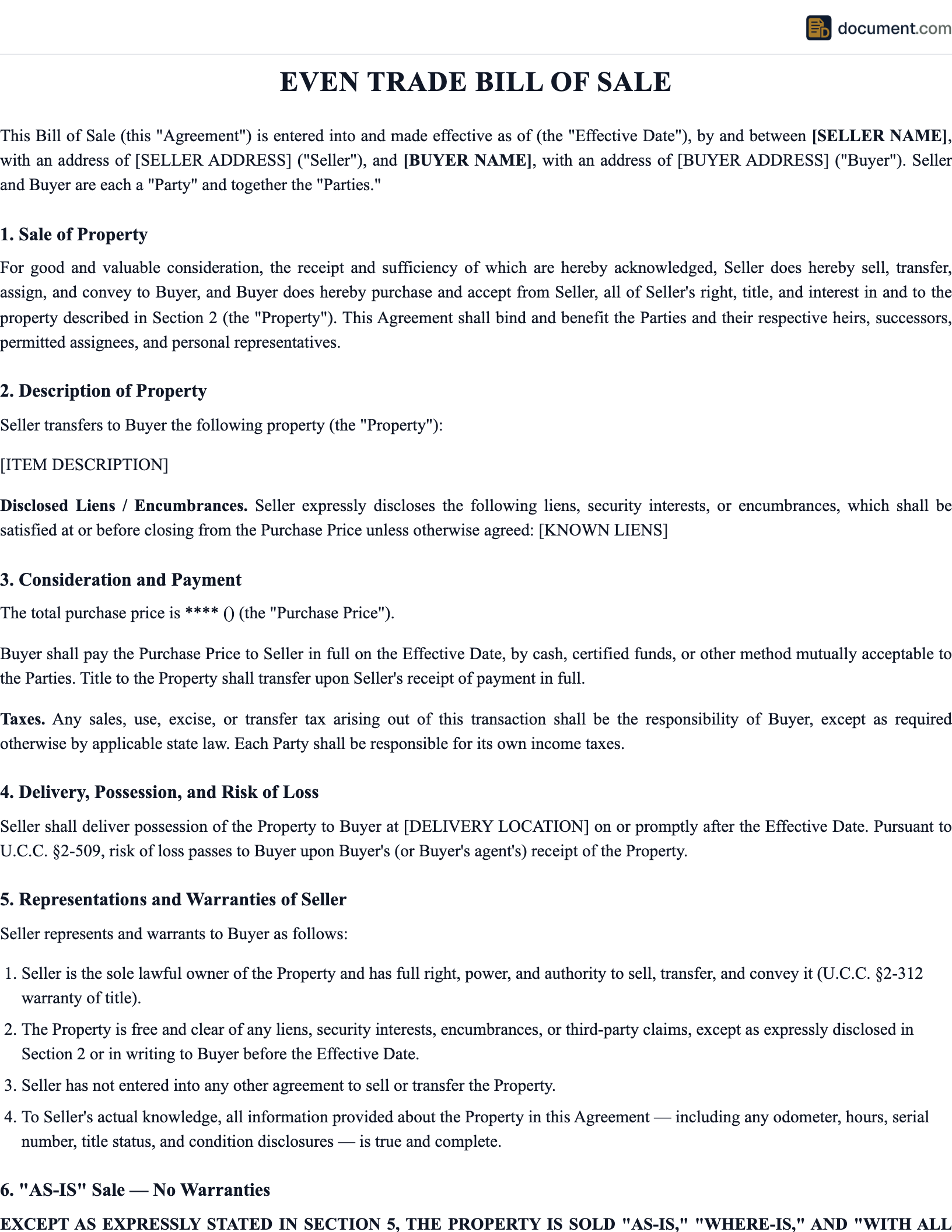
Below is a preview of our even trade bill of sale template. Your customized document will include detailed fields for both items and state-specific trade language.
EVEN TRADE BILL OF SALE
Equal Value Exchange Document
This Even Trade Bill of Sale is entered into on[Date]between:
PARTY A:
Name: [Party A Name]
Address: [Party A Address]
PARTY B:
Name: [Party B Name]
Address: [Party B Address]
1. ITEM A (Traded by Party A)
Description: [Item A]
VIN/Serial: [Number]
Agreed Value: $[Value]
2. ITEM B (Traded by Party B)
Description: [Item B]
VIN/Serial: [Number]
Agreed Value: $[Value]
Both parties agree the above items are of equal value and no cash is exchanged.
Official Resources
Use these official resources for vehicle valuation, title transfer information, and tax guidance.
Frequently Asked Questions
Find answers to common questions about even trade bills of sale, property swaps, and title transfers.
Create your Even Trade Bill of Sale in under 10 minutes.
Answer a few questions and download a compliant, attorney-drafted document ready for your state.