



What Is a Redemption Buy-Sell Agreement?
A redemption buy-sell agreement — sometimes called an entity purchase agreement or stock redemption agreement — is a contract between a closely held company and its owners under which the company itself agrees to repurchase a departing owner's equity interest upon the occurrence of a specified triggering event. The company is a direct party to the agreement and assumes the obligation to buy the departing owner's shares. When the triggering event occurs, the company writes a check (or delivers a promissory note) to the departing owner or their estate, and the shares are retired or held as treasury stock.
Redemption agreements are the simplest buy-sell structure to administer, particularly for businesses with many owners. Instead of each owner maintaining a life insurance policy on every other owner (as in a cross-purchase), the company maintains a single policy on each owner. When someone dies, the company receives the proceeds and handles the redemption directly. This operational simplicity is one of the main reasons redemption structures are popular with companies that have five or more owners, where cross-purchase arrangements become unwieldy.
A redemption buy-sell agreement covers the full ownership transition process. It defines the triggering events, the valuation method, the source and amount of funding, the timing and mechanics of the redemption, transfer restrictions and rights of first refusal, provisions preventing redemptions that would leave the company insolvent, and dispute- resolution procedures. A well-drafted agreement protects the company, the remaining owners, and the departing owner (or their heirs) by ensuring that every foreseeable transition is handled according to rules everyone agreed on at the outset.
The tax treatment of a corporate redemption is more complex than a cross-purchase. Under IRC Section 302, a redemption can be treated either as a sale (generating capital gains) or as a dividend distribution (generating ordinary income) depending on whether the redemption meets certain objective tests. The agreement should be structured — and the redemption executed — in a way that satisfies the sale-treatment tests so that the departing shareholder receives favorable capital gains treatment.
Operational Simplicity
One insurance policy per owner instead of n(n-1) policies, making administration far easier
Company Funding
Corporate cash flow, retained earnings, and company-owned insurance fund the buyout
Scalable to Many Owners
Best suited for companies with 5+ owners where cross-purchase is impractical
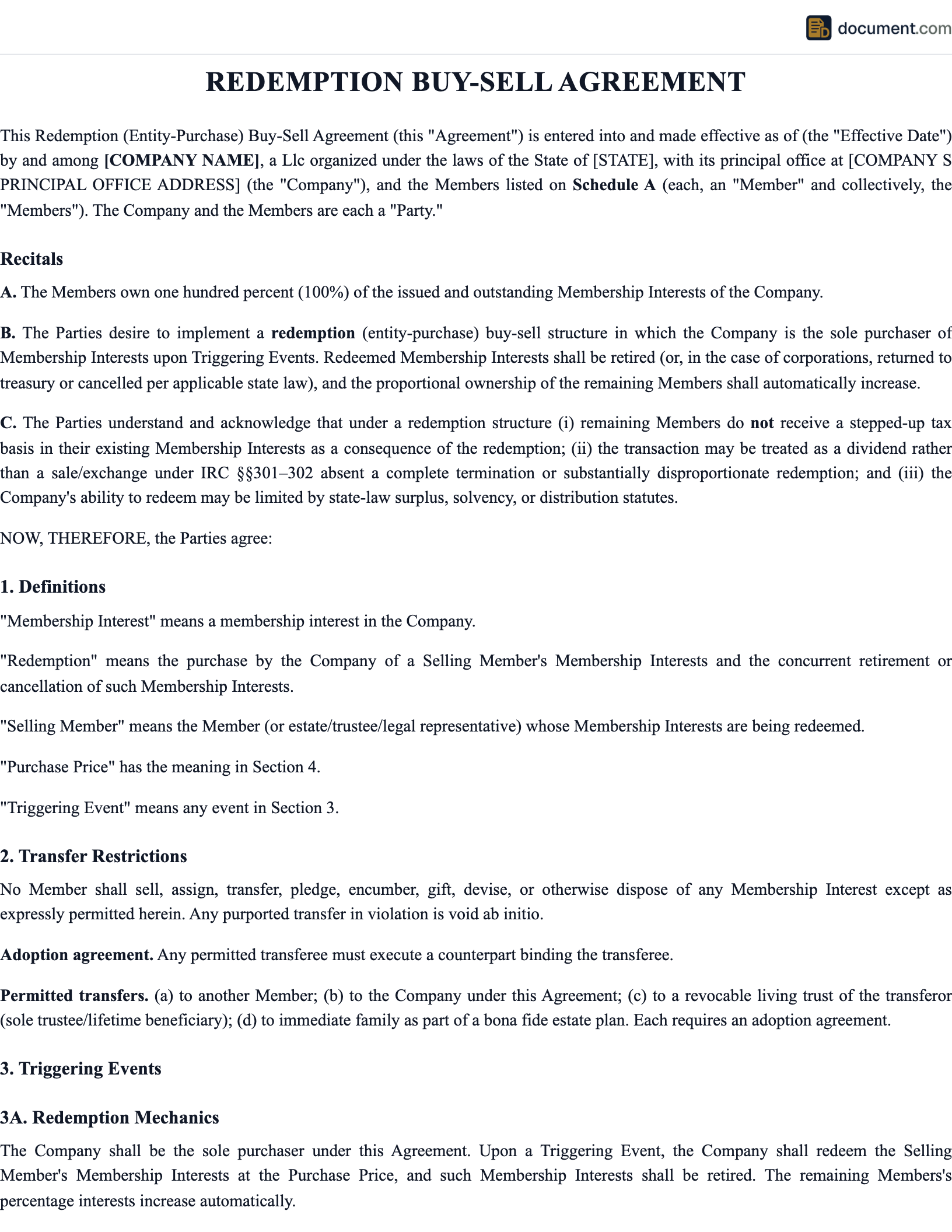
Redemption Agreement Form Preview
Below is a visual preview of the sections included in a standard redemption buy-sell agreement. Your completed document will be fully formatted and customized for your corporation or LLC, ownership structure, and chosen valuation and funding methods.
Stock Redemption Agreement
Entity Purchase Buy-Sell
Section 1: The Parties
Section 2: Triggering Events
Section 3: Valuation
Section 4: Corporate-Owned Life Insurance
The Company shall purchase and maintain a life insurance policy on the life of each shareholder in a face amount sufficient to fund the redemption obligation. The Company shall be the owner and beneficiary of each policy and shall comply with the COLI notice and consent rules under IRC Section 101(j).
Section 5: Execution
Company Officer Signature
Shareholder Signature
How a Redemption Buy-Sell Works
A redemption agreement follows a clear sequence of steps when a triggering event occurs. Understanding these steps helps owners, boards, and advisors anticipate what happens when a buyout is required.
Step 1 — Triggering Event. A qualifying event (death, disability, retirement, etc.) occurs. The departing owner or their estate provides written notice to the company, and the company acknowledges the trigger.
Step 2 — Valuation. The company determines the redemption price using the method specified in the agreement — fixed, formula, or independent appraisal.
Step 3 — Solvency Analysis. The board confirms that the redemption will not violate state-law solvency or capital-impairment restrictions and that funding is available or will be available under installment terms.
Step 4 — Funding. The company draws on its funding source — typically corporate-owned life insurance proceeds for death triggers, disability buy-out insurance for disability triggers, operating cash, sinking fund reserves, or third-party financing for other triggers.
Step 5 — Closing and Retirement of Shares.The company delivers the purchase price (or an installment note) to the departing owner, and the redeemed shares are either retired (reducing the authorized share count) or held as treasury stock. The company's stock ledger is updated, and any required state filings are made. The remaining shareholders' ownership percentages increase proportionally because there are fewer shares outstanding.
Redemption vs Cross-Purchase Agreement
Redemption and cross-purchase are the two main buy-sell structures, each with distinct advantages and trade-offs. The right choice depends on the number of owners, funding preferences, tax considerations, and administrative capacity.
Redemption
- - Company buys back the shares
- - Only n insurance policies needed
- - Best for 5+ owner businesses
- - Simpler administration
- - No basis step-up for remaining owners
- - Section 302 sale-vs-dividend analysis required
- - Subject to state law solvency restrictions
Cross-Purchase
- - Individual owners buy the shares
- - n(n-1) insurance policies required
- - Best for 2-4 owner businesses
- - More complex administration
- - Basis step-up for purchasing owners
- - Clean capital gains treatment for seller
- - Transfer-for-value rule risk on policies
Wait-and-see hybrid: Some agreements preserve the option to elect either a redemption or cross-purchase at the time of the triggering event, letting the parties choose the most tax-advantageous approach given the circumstances.
Triggering Events
A redemption agreement should clearly list every event that activates the buyout obligation and specify how each will be handled. Precise definitions prevent disputes later.
Death of a Shareholder
The corporation uses key-person life insurance proceeds to redeem the deceased shareholder's stock
Permanent Disability
The company redeems the disabled shareholder's interest using disability buy-out insurance
Retirement
Planned exit where the corporation repurchases the retiring shareholder's equity
Divorce
Prevents an ex-spouse from acquiring a direct ownership interest in the company
Bankruptcy or Insolvency
Shields the business from creditors attempting to reach a shareholder's equity
Termination of Employment
Forces redemption when an owner-employee leaves or is terminated
Voluntary Withdrawal
Allows shareholders to exit according to preset terms rather than ad hoc negotiation
Material Breach
Triggers mandatory redemption when a shareholder violates the governing agreements
Valuation Methods
Choosing the right valuation method is critical. An outdated or poorly chosen method can produce unfair results and lead to litigation.
Fixed Price (Agreed Value)
The board sets and updates a specific per-share redemption price, usually annually. Simple but dangerous if not updated — an outdated fixed price is one of the most common causes of buy-sell disputes.
Formula-Based
A formula such as a multiple of EBITDA, multiple of revenue, or book value plus capitalized earnings. Updates automatically with financial performance but may not account for changes in business character.
Independent Appraisal
A qualified business appraiser determines fair market value at the time of the triggering event. Most accurate but also the most expensive and time-consuming method.
Hybrid Method
Combines two or more methods, such as a fixed price that falls back to formula or appraisal if not updated within a specified period.
Funding the Redemption
Adequate funding is essential. Without it, the company may be unable to honor the redemption obligation — and state law may actually prohibit the redemption if it would render the company insolvent.
- Corporate-Owned Life Insurance (COLI): The company owns and is the beneficiary of a life insurance policy on each shareholder. Tax-free proceeds fund the redemption on death. COLI notice and consent rules under IRC Section 101(j) must be followed to preserve the tax-free treatment of the death benefit.
- Disability Buy-Out Insurance: Corporate-owned policies that pay the company a lump sum or installments if a shareholder becomes permanently disabled, providing the liquidity needed for a disability-triggered redemption.
- Sinking Fund: The company sets aside cash or marketable securities over time to build up reserves for future redemptions, particularly for retirement-triggered buyouts.
- Installment Payments: For triggers that cannot be insured or when the full redemption price exceeds available cash, the agreement may provide for installment payments over 5 to 10 years with interest and a promissory note secured by the redeemed shares.
- Third-Party Financing: The company borrows from a bank or SBA lender to fund the redemption when other sources are insufficient.
Section 101(j) COLI Notice and Consent
Under IRC Section 101(j), enacted as part of the Pension Protection Act of 2006, the death benefit proceeds from employer-owned life insurance are taxable as ordinary income unless specific notice and consent requirements are met. Before a policy is issued, the employee must be notified in writing that the company intends to purchase the policy, must consent in writing, and must be notified of the maximum face amount and that the company will be the beneficiary. Failure to comply means the death benefit over the amount of premiums paid becomes taxable.
How to Create a Redemption Agreement
Drafting a comprehensive redemption buy-sell agreement requires attention to corporate law, tax planning, insurance, and business continuity. Follow these steps.
Identify the Company and All Owners
List the company's legal name, state of formation, entity type, and every owner with their respective ownership interest and class of stock. Confirm that this information matches the corporate records.
Define the Triggering Events
Decide which events will activate the redemption obligation and define each precisely. Make sure 'disability' has an objective standard (e.g., 180 consecutive days of inability to perform material duties as certified by a qualified physician).
Choose a Valuation Method
Select a method that the company can reliably update. Include fallback provisions if the primary method fails (e.g., appraisal if fixed price has not been updated within 12 months).
Establish Corporate-Owned Funding
Arrange corporate-owned life insurance, disability buy-out insurance, and any sinking fund reserves. Comply with Section 101(j) COLI notice and consent requirements for any new employer-owned policies.
Address Section 302 Sale Treatment
Structure the redemption so that it will qualify as a sale under IRC Section 302 rather than a dividend. Consider complete termination of interest safe harbors and attribution rules.
Include Solvency Protections
Add provisions addressing what happens if the redemption cannot occur due to state-law solvency restrictions, including installment payment fallbacks and conversions to cross-purchase obligations.
Add Transfer Restrictions and First Refusal
Prohibit unauthorized transfers and include a right of first refusal giving the company the chance to match any third-party offer before a shareholder can sell to an outsider.
Include Non-Compete and Confidentiality
Protect the company from competitive harm by departing owners through post-termination non-compete, non-solicitation, and confidentiality clauses.
Get Corporate and Shareholder Approvals
The board must authorize the agreement and the company's execution of it. All shareholders must sign to be bound. Corporate resolutions should document the approvals.
Review and Update Annually
Schedule an annual review to update valuations, insurance coverage, and compliance with current tax law. Document each review with board minutes or written consents.
Key Components
A comprehensive redemption buy-sell agreement contains several critical sections, each playing an essential role in ensuring the agreement works when needed.
- Recitals: Background statements identifying the company, shareholders, and purpose of the agreement.
- Definitions: Precise definitions of critical terms including "disability," "fair market value," and "triggering event."
- Ownership Schedule: Current ownership of every shareholder.
- Transfer Restrictions: Prohibitions on unauthorized transfers with exceptions for permitted transferees.
- Right of First Refusal: Company's right to match third-party offers.
- Redemption Obligation: The company's commitment to repurchase shares upon triggering events.
- Valuation Mechanism: The method for determining the redemption price.
- Funding Provisions: COLI, sinking fund, installment payments, and backup funding.
- Solvency Carveouts: Provisions addressing inability to redeem due to state-law restrictions.
- Non-Compete and Confidentiality: Post-termination restrictive covenants.
- Dispute Resolution: Arbitration, mediation, or litigation procedures.
- Amendment and Termination: Procedures for modifying or ending the agreement.
Tax Implications
Redemption agreements raise a distinct set of tax issues that don't apply to cross-purchase arrangements. Understanding these is essential to structuring a workable agreement.
Section 302 Sale vs Dividend Analysis
Under IRC Section 302, a corporate redemption is treated as a sale (generating capital gains) only if it meets one of several tests: complete termination of the shareholder's interest, substantially disproportionate reduction, or not essentially equivalent to a dividend. If none of these tests is met, the redemption is taxed as a dividend — ordinary income without any basis recovery. Family attribution rules under Section 318 complicate the analysis for closely held companies with related shareholders.
Accumulated Earnings Tax
C-corporations that accumulate earnings beyond the reasonable needs of the business face a 20% accumulated earnings tax. Funding a buy-sell redemption obligation is generally a reasonable business need, but documentation is important. S-corporations are not subject to this tax.
COLI Tax Treatment
Life insurance death benefits to the company are generally tax-free, but only if Section 101(j) notice and consent requirements are met. Premium payments are not deductible. Increases in cash value are generally not currently taxable but may affect AMT or the corporate AMT for large corporations.
No Basis Step-Up
Unlike a cross-purchase, a redemption does not give the remaining shareholders a basis step-up. When they eventually sell their (proportionally larger) interest, their capital gain will be higher than it would be under a cross-purchase structure. This is the primary tax disadvantage of redemption.
Sample Redemption Agreement
Below is a condensed preview of our redemption buy-sell agreement template. Your completed document will be fully customized for your company, shareholders, and chosen valuation and funding methods.
STOCK REDEMPTION AGREEMENT
Entity Purchase Buy-Sell
This Stock Redemption Agreement ("Agreement") is entered into as of[Effective Date]by and between [Company Name], a [State] [Entity Type](the "Company"), and the undersigned shareholders (collectively, the "Shareholders").
1. PURPOSE
The Company and the Shareholders wish to provide for the orderly redemption of a departing Shareholder's shares upon specified triggering events, to establish a fair method for determining the redemption price, and to provide adequate funding through corporate-owned life insurance and other sources.
2. TRIGGERING EVENTS
The Company shall redeem all shares held by a Shareholder (the "Departing Shareholder") upon the occurrence of any of the following events:
- Death of the Shareholder
- Permanent disability as defined herein
- Retirement at or after age 65
- Termination of employment for any reason
- Personal bankruptcy or insolvency
- Material breach of this Agreement
3. REDEMPTION PRICE
The redemption price shall be determined by[Valuation Method], updated at least annually by resolution of the Board of Directors.
4. CORPORATE-OWNED LIFE INSURANCE
The Company shall apply for and maintain a life insurance policy on each Shareholder in a face amount sufficient to fund the redemption obligation. The Company shall be the owner and beneficiary of each policy and shall comply with the notice and consent requirements of IRC Section 101(j)...
5. CLOSING
Closing shall occur within[Number]days after the triggering event. At closing, the Company shall pay the redemption price and the Departing Shareholder (or estate) shall deliver the share certificates duly endorsed for transfer and cancellation.
6. SOLVENCY CARVEOUT
Notwithstanding any other provision of this Agreement, the Company shall not be required to redeem shares to the extent such redemption would be prohibited under applicable state law due to insolvency or capital impairment. In such case, the redemption shall be deferred or paid in installments as permitted by law...
7. TRANSFER RESTRICTIONS
No Shareholder shall sell, pledge, or otherwise transfer any shares except as expressly permitted by this Agreement. Any attempted transfer in violation of this Agreement shall be void ab initio...
8. NON-COMPETE
For [Period]following the closing, the Departing Shareholder shall not engage in any business that competes with the Company within[Geographic Area]...
Frequently Asked Questions
Find answers to common questions about redemption buy-sell agreements, corporate funding, tax treatment, and state-law restrictions.
Official Resources
For additional information on redemption buy-sell agreements, corporate tax provisions, and succession planning, consult these official and reputable resources.
IRC Section 302 - Cornell Law
Statutory rules for sale vs dividend treatment of corporate redemptions
IRC Section 318 - Attribution Rules
Constructive ownership rules that affect Section 302 analysis
IRC Section 101 - Life Insurance
Income tax treatment of life insurance proceeds including Section 101(j)
IRS - Corporations
IRS guidance on corporate tax compliance and distributions
SBA - Succession Planning
Small Business Administration resources on business transitions
ABA Business Law Section
American Bar Association resources on corporate and business law
IRC Section 531 - Accumulated Earnings
Accumulated earnings tax applicable to C-corporations
Uniform Law Commission
Uniform business entity acts adopted by many states
Create your Redemption Buy Sell Agreement in under 10 minutes.
Answer a few questions and download a compliant, attorney-drafted document ready for your state.