
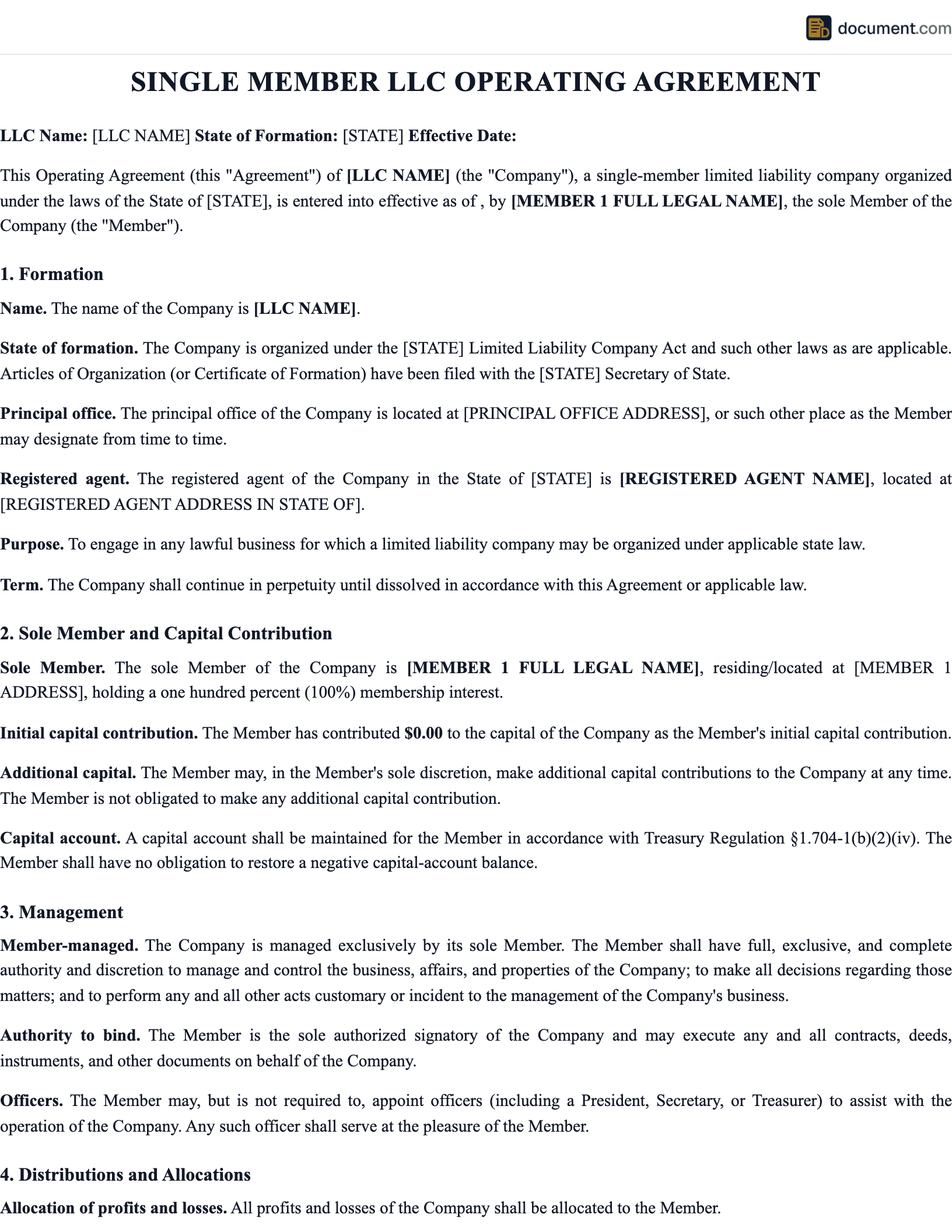



What Is a Single-Member LLC Operating Agreement?
A single-member LLC (SMLLC) operating agreement is a written document adopted by the sole owner of a limited liability company that establishes the rules, procedures, and legal framework for operating the business. Because there is only one member, the agreement is not a contract among multiple parties — it is more accurately described as a self-imposed governance document that formalizes the relationship between the individual owner and the LLC as two separate legal entities. Even though no one is "on the other side" of the document, having a written operating agreement is one of the most important things a single-member LLC owner can do to protect the limited liability that is the entire purpose of forming an LLC.
Limited liability means that the owner of the LLC is not personally liable for the debts and obligations of the business. If the LLC is sued, goes bankrupt, or is unable to pay its creditors, the owner's personal assets — house, car, personal savings, investment accounts — are protected. Creditors can only reach the assets of the LLC itself. This protection is the single biggest reason to form an LLC instead of operating as a sole proprietorship. But this protection is not automatic or unconditional. It depends on the owner actually treating the LLC as a separate legal entity — using separate bank accounts, keeping separate books, signing contracts in the LLC's name, and following the formalities of a business. Courts and plaintiffs can "pierce the corporate veil" — that is, disregard the LLC's separate existence and hold the owner personally liable — if they can show that the LLC is a mere alter ego of the owner.
Single-member LLCs are especially vulnerable to veil-piercing claims because there is no one else to check the owner's behavior. In a multi-member LLC, the presence of other members creates natural pressure to maintain separation between business and personal finances. In a single-member LLC, the owner can do whatever they want, and there is often no written record of the decisions made. A written operating agreement counters this problem by creating a documentary record of the LLC's independent existence — its purpose, its capital, its management structure, its tax classification, and its operating rules. Courts look favorably on single-member LLCs that have adopted operating agreements and treat them as strong evidence that the LLC is a legitimate separate entity.
Beyond veil-piercing protection, a single-member operating agreement serves other practical purposes. Banks almost always require one before opening a business bank account in the LLC name. Commercial landlords, lenders, and vendors often ask for a copy before entering into contracts with the LLC. The agreement documents initial capital contributions, which is important for calculating tax basis in the LLC interest. It establishes succession planning by specifying what happens to the LLC on the owner's death or incapacity — without this, many states automatically dissolve a single-member LLC when the sole member dies, which can disrupt an ongoing business. And the agreement makes it easier to add new members in the future, because the foundational document already exists and can be amended rather than drafted from scratch.
Our attorney-reviewed single-member LLC operating agreement template is streamlined specifically for the needs of solo entrepreneurs, consultants, freelancers, and small business owners. It includes every section needed to establish a legitimate single-member LLC — formation and member identification, purpose and powers, capital contribution, management authority, distributions, tax treatment, record-keeping, liability protection, and succession — without the unnecessary complexity of multi-member provisions on voting, transfers, and buy-sell. The result is a professional document of about 10 to 15 pages that can be completed in minutes and signed by the sole member.
Liability Shield
Reinforce the separation that protects personal assets from business liabilities
Bank Ready
Satisfy bank, lender, and vendor requirements for a formal operating document
Succession Plan
Prevent automatic dissolution and ensure the business continues after death or incapacity
Single-Member Agreement Form Preview
Below is a visual preview of our single-member LLC operating agreement. The completed document will be fully formatted and customized for your state, business type, and tax election.
Operating Agreement
Single-Member LLC
Section 1: LLC Information
Section 2: Sole Member
Section 3: Tax Election
Section 4: Succession
Execution
Sole Member Signature
Date
Key Sections of a Single-Member Agreement
A well-drafted single-member LLC operating agreement covers nine core sections. Each plays a specific role in establishing the LLC's legal legitimacy and protecting the sole member's limited liability.
Formation & Member Identification
Identifies the sole member, the LLC, and the state of formation
Purpose and Powers
States the business purpose and confirms broad authority to conduct lawful activities
Capital Contribution
Documents the member's initial capital contribution and any additional contributions
Management Authority
Confirms the sole member has full authority to manage and bind the LLC
Distributions
All profits and losses flow to the single member and distributions are made as desired
Tax Treatment
Default disregarded-entity treatment and option to elect S corporation or C corporation status
Record-Keeping
Annual meeting requirements, minute book, and separation of personal and LLC finances
Liability Protection
Provisions reinforcing the legal separation between the member and the LLC
Succession and Dissolution
What happens to the LLC on the member's death, incapacity, or voluntary dissolution
Is a Single-Member LLC Right for You?
A single-member LLC is the right choice for most solo entrepreneurs who want limited liability protection without the complexity and double taxation of a corporation. Below are the situations where an SMLLC is typically the best fit.
"I'm starting a consulting business and want liability protection."
A single-member LLC is ideal. It shields your personal assets from client lawsuits and business debts while allowing pass-through taxation on Schedule C. Much simpler than a corporation.
"I want to buy rental property and protect myself from tenant lawsuits."
A single-member LLC is a popular structure for holding rental real estate. Each property can be held in a separate SMLLC for additional asset protection. Disregarded entity status keeps tax filing simple.
"I'm freelancing and want to look more professional to clients."
A single-member LLC gives your freelance business a formal legal structure and allows you to invoice and contract under a business name. It also provides liability protection against client disputes and third-party claims.
"I earn over $60,000 in net self-employment income."
Consider a single-member LLC with an S corporation tax election. The S corp election allows you to pay yourself a reasonable salary and take the remainder as distributions not subject to self-employment tax, potentially saving thousands annually.
"I'm an independent contractor for multiple clients."
An SMLLC can help you establish independence from any one client (a factor in worker classification) and provides liability protection. Also allows you to deduct business expenses cleanly.
SMLLC vs Sole Proprietorship vs Corporation
Solo entrepreneurs typically choose among three business structures: sole proprietorship, single-member LLC, and corporation. Here is how they compare.
| Feature | Sole Prop | Single-Member LLC | Corporation |
|---|---|---|---|
| Limited liability | No | Yes | Yes |
| Formation cost | $0 | $50 - $500 | $100 - $800 |
| Annual filings | None | Yes | Yes (more) |
| Tax filing | Schedule C | Schedule C (default) | Form 1120 or 1120-S |
| Self-employment tax | Full | Full (can elect S corp) | On salary only |
| Formalities required | None | Moderate | Significant |
| Credibility with clients | Lower | Higher | Highest |
How to Create Your Single-Member LLC
Follow these steps to form your single-member LLC and adopt a protective operating agreement.
Choose a State of Formation
For most single-member LLCs, form in your home state to avoid double filing fees and dual-state compliance. Consider Delaware or Wyoming only if you have specific reasons.
Pick and Reserve a Name
Check name availability with your Secretary of State's business entity database. The name must include 'LLC,' 'L.L.C.,' or 'Limited Liability Company.' Reserve the name if needed.
File Articles of Organization
Submit Articles of Organization to the Secretary of State with the required filing fee. Online filing is typically fastest. This officially creates the LLC.
Obtain an EIN from the IRS
Apply for a free EIN at IRS.gov. Even single-member LLCs should obtain an EIN to avoid using the owner's SSN and to open a business bank account.
Draft and Sign the Operating Agreement
Use our template to create a single-member operating agreement covering formation, capital, management, tax treatment, and succession. Sign and keep in your records.
Open a Business Bank Account
Open a separate bank account in the LLC's name using the EIN and operating agreement. NEVER commingle personal and business funds.
Register for State and Local Taxes
Register for state income tax, sales tax (if applicable), and any local licenses or permits. Obtain business insurance as appropriate.
Maintain Ongoing Compliance
File annual reports with the state, pay any franchise taxes, keep accurate records, and maintain the separation between LLC and personal finances.
Avoiding Piercing the Corporate Veil
Piercing the corporate veil is the legal doctrine that allows a court to disregard the LLC's separate existence and hold the owner personally liable for LLC debts. Single-member LLCs are especially vulnerable because there is no one else to check the owner's behavior.
The Alter Ego Test
Courts generally pierce the veil of a single-member LLC when: (1) the owner has not maintained separation between personal and LLC finances (commingling); (2) the LLC is undercapitalized relative to its business risks; (3) the owner has not followed basic formalities like maintaining records or an operating agreement; (4) the LLC is a mere instrumentality or alter ego of the owner; and (5) allowing the owner to hide behind the LLC would promote injustice or fraud.
Veil-Piercing Prevention Checklist
- Separate Bank Account: Open and use a dedicated bank account in the LLC name. Never deposit personal funds or pay personal expenses from the LLC account.
- Written Operating Agreement: Adopt and sign a written operating agreement. This is one of the strongest pieces of evidence that the LLC is a separate entity.
- Adequate Capitalization: Contribute enough capital to cover the LLC's reasonably anticipated expenses and liabilities. Don't systematically drain the LLC.
- Sign in LLC Name: Sign all contracts as "[LLC Name], by [Your Name], Member/Manager" — never just your personal name.
- Maintain Records: Keep a minute book, tax returns, bank statements, and records of major decisions. Document capital contributions and distributions.
- File Annual Reports: Stay in good standing with the state. A suspended or administratively dissolved LLC loses its limited liability protection.
- Use LLC Branding: Use LLC letterhead, business cards, signage, email signatures, and website copy that identifies the business as an LLC.
- Carry Insurance: Maintain appropriate business insurance. Insurance provides a first line of defense and shows the LLC is being operated as a legitimate business.
Single-Member LLC Tax Treatment
The tax treatment of a single-member LLC is one of its most attractive features. By default, the LLC is treated as a disregarded entity for federal tax purposes, meaning it is invisible to the IRS and the sole member reports LLC income directly on their personal tax return. However, the sole member can elect to be taxed as a corporation if it would be advantageous.
The S Corp Election for SMLLCs
A single-member LLC can elect to be taxed as an S corporation by filing Form 2553 with the IRS. Under this election, the sole member becomes an employee of the LLC and pays themselves a reasonable salary (subject to payroll taxes). The remaining profits are distributed to the member as dividends, which are NOT subject to self-employment tax. For a solo consultant earning $150,000 in net income, this strategy can save $5,000 to $10,000 annually in self-employment tax. However, it adds payroll complexity, requires a separate corporate tax return (Form 1120-S), and requires paying a reasonable salary even if the business has a bad year.
Tax Classification Options
- Disregarded Entity (Default): LLC is invisible for federal tax. Sole member reports income on Schedule C (business), Schedule E (rental), or Schedule F (farming). All earnings subject to self-employment tax.
- S Corporation Election (Form 2553): LLC is taxed as an S corp. Sole member is an employee earning a salary. Remaining profits are distributions not subject to self-employment tax. Good for high-income solo businesses.
- C Corporation Election (Form 8832): LLC is taxed as a C corp, subject to entity-level tax at 21% federal rate plus state corporate tax. Rarely beneficial for solo businesses due to double taxation.
- State Tax Variations: Some states follow federal classification; others impose separate taxes. California charges an $800 minimum franchise tax on all LLCs regardless of classification.
State Legal Requirements
Each state's LLC Act applies equally to single-member and multi-member LLCs. Some states have specific provisions affecting SMLLCs, particularly regarding required operating agreements, dissolution on death, and charging order protection.
Key State Considerations
- California: Requires all LLCs to pay an $800 minimum franchise tax regardless of income. California LLCs with gross receipts above $250,000 pay an additional LLC fee. Requires operating agreements within a reasonable time.
- Delaware: Most flexible LLC statute. Charging order is the exclusive remedy against a single-member LLC interest, providing strong asset protection. Many sophisticated owners form in Delaware even for solo businesses.
- Wyoming: Strong charging order protection (exclusive remedy), anonymous ownership possible, no state income tax, low annual fees ($60/year). Popular for asset protection SMLLCs.
- Nevada: Similar advantages to Wyoming — strong charging order protection, no state income tax, and enhanced privacy. Higher annual fees than Wyoming ($350+).
- New York: Requires written operating agreement within 90 days of formation. Also requires newspaper publication of the LLC formation (expensive in NYC — can exceed $1,000). Many NYC businesses form in Delaware instead.
- Texas: Uses the term "company agreement" instead of operating agreement. No state income tax. Franchise tax applies only above certain revenue thresholds.
Sample Single-Member Agreement
Below is a condensed preview of our single-member LLC operating agreement template. Your completed agreement will be fully customized for your state, business, and tax election.
OPERATING AGREEMENT OF [LLC NAME]
A Single-Member Limited Liability Company
This Operating Agreement (the "Agreement") of[LLC Name], a [State]limited liability company (the "Company"), is adopted by the undersigned Sole Member as of [Date].
ARTICLE I: FORMATION
The Company was formed as a single-member limited liability company under the laws of the State of [State]by filing Articles of Organization with the Secretary of State on[Date].
ARTICLE II: SOLE MEMBER
The Sole Member of the Company is[Member Name], who owns 100% of the membership interests in the Company.
ARTICLE III: CAPITAL CONTRIBUTION
The Sole Member has contributed $[Amount]in initial capital to the Company. The Sole Member may, but is not required to, make additional capital contributions at any time.
ARTICLE IV: MANAGEMENT
The Company shall be managed by the Sole Member, who shall have full authority and control over all aspects of the Company's business, including the power to enter into contracts, incur obligations, buy and sell property, hire employees, and take any other action necessary or desirable to conduct the business of the Company.
ARTICLE V: DISTRIBUTIONS AND TAX TREATMENT
All profits, losses, and distributions of the Company shall be allocated to the Sole Member. Distributions shall be made at such times and in such amounts as the Sole Member determines. The Company shall be treated as a[disregarded entity / S corporation / C corporation]for federal income tax purposes.
ARTICLE VI: LIABILITY PROTECTION
The Sole Member shall not be personally liable for any debts, obligations, or liabilities of the Company solely by reason of being the Sole Member, except as required by applicable state law. The Company is a separate legal entity distinct from the Sole Member...
ARTICLE VII: SUCCESSION
In the event of the Sole Member's death or incapacity, the Company shall not dissolve and shall continue its existence. The membership interest shall pass to [Successor]or as directed by the Sole Member's will or estate plan.
ARTICLE VIII: RECORDS AND FORMALITIES
The Sole Member shall maintain separate books and records for the Company, shall not commingle personal and Company funds, and shall sign all contracts and documents in the name of the Company to preserve the Company's separate legal existence and limited liability protection.
Frequently Asked Questions
Answers to the most common questions about single-member LLC operating agreements.
Official Resources
Government and industry resources for single-member LLC formation, taxation, and operation.
IRS - Single-Member LLC
IRS guidance on single-member LLC tax treatment and disregarded entities
IRS - Apply for EIN Online
Free EIN application for single-member LLCs
IRS - Form 2553 S Corp Election
Election form to have the SMLLC taxed as an S corporation
IRS - Schedule C
Profit or loss from business for disregarded SMLLCs
Delaware Division of Corporations
Delaware LLC formation information
Wyoming Secretary of State
Wyoming LLC formation, annual reports, and filings
SBA - Choose a Business Structure
Compare sole proprietorship, LLC, and corporation structures
Nolo - Single-Member LLC Guide
Legal encyclopedia on forming and operating a single-member LLC
Create your Single Member Llc Operating Agreement in under 10 minutes.
Answer a few questions and download a compliant, attorney-drafted document ready for your state.