



What Is an LLC Operating Agreement Amendment?
An LLC operating agreement amendment is a written document that modifies one or more provisions of an existing limited liability company operating agreement. The operating agreement is the foundational contract that governs the relationship among the members of an LLC and between the members and the LLC itself. When circumstances change — members join or leave, ownership percentages shift, management structures evolve, or business needs require updated procedures — the operating agreement must be formally amended so that the written contract accurately reflects how the business is actually being run.
Unlike a Certificate of Amendment to Articles of Organization (which is a public filing with the Secretary of State that updates basic registration information about the LLC), an operating agreement amendment is typically an internal document. It is not filed with any state agency. The original operating agreement plus all subsequent amendments should be kept together in the LLC's minute book or records binder so that members, managers, accountants, and attorneys can always reference the current complete terms of the member agreement. Amendments that also change information in the Articles of Organization (such as switching from member-managed to manager-managed in states where that is listed publicly) require a separate state filing.
The approval procedure for an amendment is governed first by whatever the current operating agreement says, and second by state law defaults if the operating agreement is silent. Most well-drafted operating agreements include an explicit amendment clause that specifies the required approval threshold — commonly unanimous consent for fundamental changes, majority in interest for routine changes, or a tiered system where different types of amendments require different thresholds. If the operating agreement is silent, most state LLC acts default to requiring unanimous member consent for any amendment, which can create difficulty when a single member is opposed.
Common reasons to amend an LLC operating agreement include admitting a new member, documenting the departure or buyout of an existing member, reallocating ownership percentages following a capital contribution or transfer, changing the LLC's management structure, naming a new manager, modifying profit and loss allocations, adjusting distribution rights, adding new capital contribution obligations, updating voting thresholds, revising transfer restrictions, adopting new tax elections, adding dispute resolution procedures, changing the LLC's fiscal year, or updating indemnification provisions for managers and members.
Our attorney-reviewed amendment templates provide the proper structure and language required for a valid amendment: an introductory recital identifying the original operating agreement, a statement of the reason for the amendment, a clear description of exactly what is being changed, a statement that all other provisions remain in effect, and signature blocks for every member whose consent is required. Templates are customized for member-managed or manager-managed structures and for single-member or multi-member LLCs.
Flexible Updates
Adapt your LLC to ownership changes, new members, and evolving business needs
Liability Protection
Maintain corporate formalities to preserve member limited liability and entity separation
Dispute Prevention
Document changes clearly to avoid misunderstandings and future litigation among members
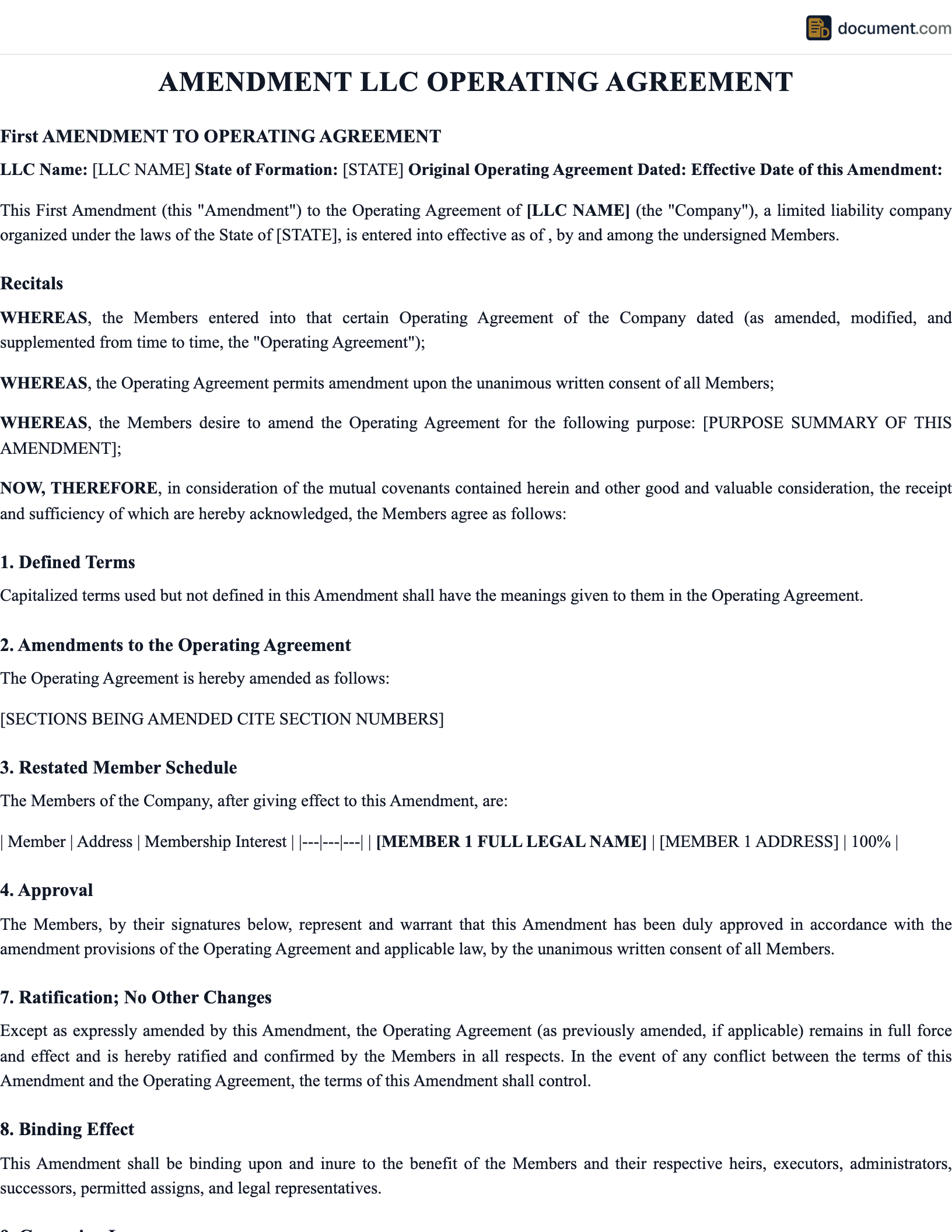
Amendment Form Preview
Below is a visual preview of our LLC operating agreement amendment template. The completed amendment will include the specific language needed for your type of change, with signature blocks for every member whose consent is required.
First Amendment
to the Operating Agreement of
[LLC Name], LLC
Section 1: Identification
Section 2: Reason for Amendment
Section 3: Text of Amendment
Section 4: Member Consent & Execution
Member 1 Signature
Date
Member 2 Signature
Date
Member 3 Signature
Date
Common LLC Amendment Types
LLCs amend their operating agreements for many different reasons. Below are the nine most common amendment types, each supported by a specific template in our library.
Adding a New Member
Formally admit a new member and allocate ownership interest, capital contributions, and voting rights
Removing a Member
Document the withdrawal, buyout, or expulsion of a member and redistribute their interest
Changing Ownership Percentages
Reallocate membership interests, capital accounts, and profit/loss distributions among members
Management Structure Change
Switch between member-managed and manager-managed, or change named managers
Capital Contribution Amendment
Document additional capital contributions, adjust capital accounts, or change contribution obligations
Distribution Policy Amendment
Change how profits and losses are allocated and distributed among members
Voting Rights Amendment
Modify voting thresholds, quorum, super-majority requirements, or member voting classes
Transfer Restrictions Amendment
Update rules on transferring membership interests, rights of first refusal, and approval requirements
Dissolution Provisions Amendment
Change events triggering dissolution and procedures for winding up the LLC
When You Need an Amendment
Not every operational change requires a formal amendment. Changes in physical office location, minor process tweaks, or the adoption of new accounting software do not need formal amendments. But any change affecting the rights, economics, ownership, or governance of members should be amended in writing.
"We're bringing in a new investor who will own a piece of the LLC."
You need an Admission of New Member amendment. The document should allocate ownership interest, document the capital contribution, and reflect any changes to voting rights or management powers.
"A member is leaving and selling their interest back to the LLC."
You need a Withdrawal/Removal amendment that documents the buyout terms, redistributes the departing member's interest, and releases the departing member from ongoing obligations.
"Our partnership split is changing from 50/50 to 60/40."
You need an Ownership Percentage amendment that updates each member's percentage interest, capital account, and profit/loss allocation. This often has tax implications — consult a CPA.
"We want to hire a professional manager and become manager-managed."
You need a Management Structure amendment plus (in most states) an amendment to the Articles of Organization filed with the Secretary of State.
"We need each member to contribute more capital."
You need a Capital Contribution amendment that documents the new required contributions, the deadline for payment, and the consequences of non-payment.
Amendment vs Restated Operating Agreement
LLCs have two ways to update their operating agreement: a targeted amendment or a full restatement. Both approaches are legal; the right choice depends on how much is changing and how complicated the existing agreement has become.
| Feature | Amendment | Restated Agreement |
|---|---|---|
| Document length | 2 - 4 pages | 20 - 40 pages |
| References original | Yes | No (supersedes it) |
| Best for | 1-3 specific changes | Major overhaul |
| Effort required | Low | High |
| Clarity after 3+ changes | Can become cluttered | Clean single document |
| Member approval required | Yes | Yes |
How to Amend an LLC Operating Agreement
Follow these steps to properly amend your LLC operating agreement and avoid future disputes or liability issues.
Review the Existing Operating Agreement
Read the amendment clause of the current agreement to determine the required approval threshold (unanimous, majority, supermajority) and any notice or procedural requirements.
Identify the Specific Change
Pinpoint the exact section or provision being amended and draft the new language. Be precise — vague amendments lead to disputes later.
Discuss with Members
Hold a meeting or discussion with all members to explain the proposed amendment, answer questions, and confirm support.
Draft the Amendment Document
Use a template to create a written amendment that includes recitals identifying the original agreement, the reason for the amendment, the exact language change, and signature blocks.
Obtain Required Approvals
Circulate the amendment for signature by the number of members required by the operating agreement (or by state law default if the agreement is silent).
File With Internal Records
Attach the signed amendment to the original operating agreement in the LLC minute book or records binder. Provide a copy to each member.
Update Related Documents
If the amendment changes information in the Articles of Organization (name, agent, management structure), file a separate amendment with the Secretary of State. Update banking, tax, and insurance records as needed.
Key Components of an Amendment
Every well-drafted amendment includes certain essential components. Our templates include all of these as a matter of course.
Title and Amendment Number
A clear title (e.g., 'First Amendment,' 'Second Amendment') that identifies the amendment sequentially.
Identifying Recitals
Recitals that identify the LLC, the original operating agreement, and the reason for the amendment.
Reference to Existing Provision
Specific reference to the article, section, or subsection being amended.
New or Replacement Language
The exact text being added, deleted, or replacing the original language.
Non-Affected Clause
A statement that all provisions not specifically amended remain in full force and effect.
Effective Date and Signatures
The effective date of the amendment and signature lines for all approving members or managers.
Member Approval Requirements
The threshold for amending an LLC operating agreement depends first on what the existing agreement says, and second on the default rule under state law. The default rule varies significantly by state, making the amendment clause one of the most important provisions in the original operating agreement.
The Unanimous Consent Default
Under the Revised Uniform Limited Liability Company Act (RULLCA) — adopted in whole or in part by more than 15 states — the default rule is that amendments to the operating agreement require unanimous consent of all members. The same is true in most other states. This means that if the operating agreement is silent on the amendment threshold, a single dissenting member can block any change. To avoid this, the original operating agreement should specify an explicit amendment threshold, such as majority in interest or two-thirds supermajority.
Common Approval Thresholds
- Unanimous Consent: Required for fundamental changes such as altering member economic rights, adding new members, requiring additional capital contributions, or changing the purpose of the LLC.
- Supermajority (66-75% in Interest): Appropriate for significant structural changes such as switching between member-managed and manager-managed, modifying management powers, or changing the distribution waterfall.
- Majority in Interest: Suitable for routine amendments such as updating officer titles, changing the principal office address, or documenting administrative matters.
- Manager Consent (Manager-Managed LLCs): Some manager-managed LLCs allow managers to make certain amendments without member approval, particularly those affecting operational or administrative matters.
- Written Consent in Lieu of Meeting: Most operating agreements allow amendments to be approved by written consent of the required member threshold, without holding a formal meeting.
Tax Implications of Amendments
Most LLCs with multiple members are taxed as partnerships under subchapter K of the Internal Revenue Code. Partnership tax rules are detailed and technical, and many operating agreement amendments have tax consequences that can surprise members who were not expecting them.
Substantial Economic Effect
Under section 704(b) of the Internal Revenue Code, allocations of partnership items (income, gain, loss, deduction, credit) must have "substantial economic effect" or they will be disregarded and replaced with allocations in accordance with the members' overall economic interests. When amending the allocation provisions of an operating agreement, members must ensure the new allocations continue to have substantial economic effect — which generally requires maintaining capital account bookkeeping in accordance with Treasury regulations and providing for a deficit restoration obligation or a qualified income offset.
Amendments With Tax Impact
- Adding a New Member: Admitting a new member who contributes property (rather than cash) can trigger section 704(c) allocations and may require adjustments to capital accounts. If the new member acquires their interest by purchase from an existing member, the new member takes a cost basis; if by contribution to the LLC, the rules are different.
- Removing a Member: A departing member must recognize gain or loss on the disposition of their interest. If the LLC redeems the interest, complex distribution rules under section 731 apply. Hot asset rules under section 751 may convert capital gain into ordinary income.
- Changing Profit/Loss Allocations: Must meet the substantial economic effect test. Retroactive changes are generally disregarded under the varying interest rule of section 706.
- Creating Preferred Returns or Waterfalls: Multi-tier distribution waterfalls (common in real estate and private equity LLCs) require detailed allocation provisions to match the distribution tiers.
- Electing S Corporation Tax Treatment: If the LLC wants to be taxed as an S corporation, the operating agreement must be reviewed to ensure there is only one class of stock-equivalent economic interest.
State Legal Requirements
Each state's LLC Act contains default rules for operating agreement amendments. Most states allow members to vary the default rules by specifying their own amendment procedure in the operating agreement, but certain mandatory provisions cannot be waived.
Key State Variations
- Delaware LLC Act §18-302: The most flexible LLC statute in the country. Almost everything can be varied by the operating agreement, including the amendment threshold. Default rule: unanimous written consent of all members.
- California RULLCA (Corp. Code §17701.10): Operating agreements cannot waive certain mandatory provisions including fiduciary duties of care and loyalty (though duty of care can be modified but not eliminated), and member rights to information.
- New York LLC Law §417: Operating agreements are required within 90 days of formation and can be amended by the procedure specified in the agreement. If silent, amendment requires unanimous member consent.
- Texas BOC §101.052-054: Company agreement (Texas's term for operating agreement) can be amended as provided in the agreement itself. Default rule is unanimous consent.
- Florida Revised LLC Act §605.0105: Operating agreements may be amended as specified in the agreement. Cannot waive duty of loyalty, duty of care, duty of good faith and fair dealing, or certain other mandatory provisions.
Sample LLC Amendment
Below is a condensed preview of our LLC operating agreement amendment template. Your completed amendment will be customized for your specific change, state, and membership structure.
FIRST AMENDMENT TO OPERATING AGREEMENT
of [LLC Name], LLC
This First Amendment (the "Amendment") to the Operating Agreement of[LLC Name], a [State]limited liability company (the "Company"), is made effective as of[Date], by the undersigned Members.
RECITALS
WHEREAS, the Members entered into an Operating Agreement dated[Original Date](the "Operating Agreement") governing the affairs of the Company; and
WHEREAS, the Members desire to amend the Operating Agreement as set forth below for the reason of [Reason for Amendment]; and
WHEREAS, Section [##] of the Operating Agreement authorizes amendments by [Required Approval]consent of the Members;
NOW, THEREFORE, the Operating Agreement is hereby amended as follows:
1. AMENDMENT
Section [##] of the Operating Agreement is hereby deleted in its entirety and replaced with the following:
"[New provision text]"
2. NO OTHER CHANGES
Except as expressly amended by this Amendment, all other provisions of the Operating Agreement shall remain in full force and effect.
3. GOVERNING LAW
This Amendment shall be governed by and construed in accordance with the laws of the State of [State].
4. COUNTERPARTS
This Amendment may be executed in counterparts, each of which shall be deemed an original, but all of which together shall constitute one and the same instrument.
IN WITNESS WHEREOF, the undersigned Members have executed this Amendment as of the date first written above.
Frequently Asked Questions
Answers to the most common questions about amending LLC operating agreements.
Official Resources
Authoritative resources for LLC governance, partnership taxation, and amendment procedures.
IRS - Limited Liability Company (LLC)
IRS guidance on LLC tax classification and partnership taxation
IRS - Form 1065 Instructions
Partnership tax return instructions covering allocations and distributions
ULC - Revised Uniform LLC Act
The model LLC statute adopted by many states
Delaware Division of Corporations
Delaware LLC formation and filing information
State Business Entity Search
State directories for LLC records and filings
SBA - Choose a Business Structure
Small Business Administration guide to LLC and other entity structures
ABA Business Law Section
LLC committees, model acts, and practitioner resources
Nolo - LLC Operating Agreement Guide
Legal information on LLC operating agreements and amendments
Create your Amendment Llc Operating Agreement in under 10 minutes.
Answer a few questions and download a compliant, attorney-drafted document ready for your state.