



What Is a Multi-Member LLC Operating Agreement?
A multi-member LLC operating agreement is the foundational contract that governs a limited liability company owned by two or more members. It is the internal rulebook that defines how the LLC is owned, operated, and managed, and it establishes the rights and obligations of each member toward the LLC and toward one another. While the Articles of Organization create the LLC as a legal entity with the state, the operating agreement is the document that actually makes the LLC function as a business — and in a multi-member context, where multiple people have committed capital and effort to a shared venture, the operating agreement is essential.
Unlike a single-member LLC operating agreement (which is primarily a document that reinforces the entity separation required to protect the sole owner's limited liability), a multi-member operating agreement is a true multi-party contract with legally enforceable rights and obligations. It answers every critical question about how the business will operate: Who are the members? What did each member contribute? What are their ownership percentages? How are profits and losses allocated? How are distributions paid? Who runs the business day to day? What decisions require a vote, and what is the vote threshold? Can a member sell their interest? What happens if a member dies, becomes disabled, or wants to leave? How are disputes resolved? What causes the LLC to dissolve?
Without a written operating agreement, a multi-member LLC is governed entirely by the default rules of its state's LLC Act. These default rules are designed to fill gaps when members have not thought through the issues themselves, and they rarely match what any particular group of members would actually want. For example, many state defaults allocate profits and losses per capita (equally among all members) rather than in proportion to capital contributions — meaning a member who contributed $90,000 might receive the same share of profits as a member who contributed $10,000. Many state defaults also require unanimous consent for routine decisions, give members unlimited information rights, fail to restrict transfers of interest, and provide no mechanism for buying out a departing member. A written operating agreement lets the members override these defaults with terms that make sense for their specific business.
For tax purposes, the default federal tax classification of a multi-member LLC is a partnership, taxed under subchapter K of the Internal Revenue Code. Partnership taxation is elegant in principle — the LLC does not pay entity-level tax, and profits and losses flow through to the members according to the allocation provisions of the operating agreement — but it is complex in practice. The allocation provisions must meet the "substantial economic effect" test of section 704(b), which requires maintaining capital accounts in accordance with Treasury regulations, providing for liquidations in accordance with capital account balances, and either a deficit restoration obligation or a qualified income offset. Well-drafted operating agreements include the specific tax boilerplate required to satisfy these rules.
Our attorney-reviewed multi-member LLC operating agreement template is a comprehensive document that addresses every major issue that typically arises in a multi-member LLC. It includes provisions for formation and members, capital contributions, profits and losses, distributions, management (both member-managed and manager-managed options), voting and quorum, transfer restrictions with right of first refusal, buy-sell provisions triggered by death, disability, divorce, and voluntary departure, dispute resolution, and dissolution. Each provision is customizable for the number of members, the state of formation, the management structure, and the specific economics of the deal.
Partnership Clarity
Clearly define roles, contributions, and expectations between all members from day one
Liability Protection
Reinforce limited liability by documenting the LLC as a separate legal entity
Dispute Prevention
Buy-sell and deadlock provisions prevent disputes from destroying the business
Multi-Member LLC Agreement Preview
Below is a visual preview showing the structure of our multi-member operating agreement template. The completed document will be customized for your specific members, capital, allocations, and governance preferences.
Operating Agreement
Multi-Member LLC
Schedule A: Members & Capital
| Member | Contribution | % |
|---|---|---|
| Elena R. Varga | $150,000 | 50% |
| Javier M. Okafor | $90,000 | 30% |
| Priya S. Ramanathan | $60,000 | 20% |
Management Structure
Voting Thresholds
Member Signatures
Elena R. Varga
Date
Javier M. Okafor
Date
Priya S. Ramanathan
Date
Key Sections of a Multi-Member Operating Agreement
Every well-drafted multi-member operating agreement includes nine core sections that together cover the full lifecycle of a partnership. Below is an overview of each section and what it accomplishes.
Formation and Members
Identifies each founding member, their initial capital contributions, and ownership percentages
Capital Contributions
Documents initial and additional capital requirements, deadlines, and consequences of default
Profits, Losses, and Distributions
Allocates income, loss, and cash distributions among members based on ownership or custom formulas
Management Structure
Member-managed or manager-managed with authority, duties, voting, and removal provisions
Voting Rights
Decision-making thresholds, quorum, voting classes, and protected matters requiring supermajority
Transfer Restrictions
Right of first refusal, drag-along, tag-along, and approval requirements for transferring interests
Buy-Sell Provisions
Triggers and valuation methods for buyouts on death, disability, divorce, or voluntary departure
Dispute Resolution
Mediation, arbitration, and deadlock-breaking procedures to resolve disagreements among members
Dissolution and Winding Up
Events causing dissolution and the procedure for winding up, paying creditors, and distributing assets
Choosing a Management Structure
One of the first and most important decisions in drafting a multi-member operating agreement is whether the LLC will be member-managed or manager-managed. The right choice depends on the number of members, how involved each member will be, and whether there are passive investors.
"All of us are co-founders actively running the business together."
Choose a member-managed LLC. Each member has day-to-day authority and decisions are made collectively by majority vote (or whatever threshold you prefer). This is the simplest structure and works well for small partnerships of 2 to 5 active founders.
"Some of us are investing money but won't be involved in operations."
Choose a manager-managed LLC. Centralize authority in one or more managers who run the business, while passive investor-members have economic rights but no day-to-day authority. This structure resembles a corporation and is common in real estate and venture-backed LLCs.
"One founder has deep operational experience and the others want to defer to them."
Consider a manager-managed LLC with that founder as the sole manager, or a member-managed LLC where the operating agreement grants that founder the authority to make day-to-day decisions up to a certain financial threshold.
"We're 50/50 partners and want equal say on everything."
Use a member-managed LLC with equal voting rights, but include a deadlock-breaking provision (mediation/arbitration or buy-sell) to handle disputes. Without a deadlock mechanism, a 50/50 LLC can become paralyzed if the members disagree.
Multi-Member vs Single-Member LLC
Multi-member LLCs have fundamentally different legal and tax implications than single-member LLCs, even though they use the same underlying state LLC Act. Below are the key differences.
| Feature | Multi-Member LLC | Single-Member LLC |
|---|---|---|
| Default tax classification | Partnership (Form 1065) | Disregarded entity (Schedule C) |
| Number of owners | 2 or more | 1 |
| Operating agreement complexity | High | Low |
| Allocation rules (704(b)) | Apply | N/A |
| Buy-sell provisions needed | Essential | Not applicable |
| Risk of disputes | Moderate to high | None |
| Separate tax return | Yes (Form 1065) | No (flows to owner) |
How to Create a Multi-Member Operating Agreement
Follow these steps to create a comprehensive operating agreement for your multi-member LLC.
File Articles of Organization
Form the LLC by filing Articles of Organization with the Secretary of State. You need the official LLC to exist before the operating agreement can take effect.
Agree on Ownership & Contributions
Before drafting, all members should agree on ownership percentages, capital contributions, and any non-cash contributions (property, services, IP). This is the most important substantive decision.
Choose Management Structure
Decide whether the LLC will be member-managed or manager-managed. Identify who the managers will be (if any) and what their authority will be.
Define Voting Thresholds
Decide what votes are required for routine decisions, significant decisions, and fundamental decisions. Think through deadlock scenarios and include tie-breaking provisions.
Draft Allocation and Distribution Provisions
Specify how profits and losses will be allocated among members and how distributions will be paid. Comply with section 704(b) rules for substantial economic effect.
Include Transfer Restrictions and Buy-Sell
Add provisions restricting the transfer of membership interests and providing for buyouts on triggering events (death, disability, divorce, voluntary departure, expulsion).
Add Dispute Resolution and Dissolution
Include mediation/arbitration clauses and events that cause dissolution. Define the procedure for winding up and distributing assets.
All Members Sign and Keep in Records
Every member must sign the operating agreement. Keep the signed original in the LLC's records and provide copies to all members and their attorneys.
Capital Contributions and Distributions
The capital and distribution provisions are the economic heart of the operating agreement. They determine how much each member invests, how profits flow back to members, and how the final value of the business is distributed on dissolution.
Capital Accounts
Every member has a capital account that tracks their economic stake in the LLC. The capital account is increased by the member's contributions and allocated share of profits, and decreased by distributions and allocated share of losses. Capital accounts must be maintained in accordance with Treasury Regulation §1.704-1(b)(2)(iv) for allocations to have substantial economic effect. Our template includes the required capital account maintenance language.
Distribution Structures
- Pro-Rata Distributions: The simplest structure. Distributions are made in proportion to ownership percentages. A 40% owner gets 40% of every distribution. Works well for partnerships of equals.
- Preferred Return (Hurdle): One class of member receives a specified return (e.g., 8% annually on contributed capital) before any other member receives distributions. Common in real estate and investor-operator structures.
- Return of Capital First: Members first receive distributions in an amount equal to their contributed capital, then share in additional profits according to a different formula (often including a "promote" to the operator).
- Waterfall Distributions: Multi-tier distribution structure with different allocation percentages at each tier. Common in private equity and real estate: first tier pays back capital, second tier pays preferred return, third tier splits excess profits between capital partners and operators.
- Tax Distributions: Mandatory distributions to members to cover the income tax on their allocated share of LLC income. Essential for LLCs that reinvest cash flow rather than distributing it.
Voting Rights and Deadlock
Voting provisions determine how decisions are made in the LLC. A well-drafted voting clause balances the need for efficient decision-making with protection for minority members and provides mechanisms to break deadlocks.
The Deadlock Problem
In a 50/50 LLC without a deadlock-breaking provision, a single disagreement between the two members can paralyze the business — and neither member has the votes to break the tie. This is the most common reason multi-member LLCs end up in litigation and judicial dissolution. Every 50/50 LLC and every LLC with a potential for deadlock should include explicit deadlock-breaking provisions in the operating agreement.
Protected Matters Requiring Supermajority
- Admission of new members or issuance of new membership interests
- Additional capital calls or capital contributions
- Sale of substantially all the assets of the LLC
- Incurring indebtedness above a specified threshold
- Amendments to the operating agreement
- Dissolution of the LLC or filing for bankruptcy
- Changing the LLC's tax classification or making major tax elections
- Entering into transactions with an affiliate of a member
Buy-Sell Provisions
Buy-sell provisions specify what happens when certain triggering events affect a member. They are among the most important provisions in a multi-member operating agreement because they address the predictable life events that can destabilize a partnership.
Common Triggering Events
Death of a Member
LLC or remaining members have the right (or obligation) to purchase the deceased member's interest from the estate
Disability
Long-term disability of a member can trigger a buyout, typically after a waiting period of 6-12 months
Divorce
Transfer to a spouse in a divorce triggers a purchase option so the non-member spouse does not become a member
Voluntary Withdrawal
A member who wants to leave the LLC can be required to offer their interest to the LLC or other members
Bankruptcy
Personal bankruptcy of a member triggers a buyout to prevent the bankruptcy trustee from becoming a member
Expulsion for Cause
Misconduct such as fraud, conviction, or material breach can trigger involuntary removal of a member
Valuation Methods
- Fixed Price: Members agree on a specific price, updated annually. Simple but often outdated.
- Formula: Multiple of earnings, book value, or other objective measure. Predictable but may not reflect true value.
- Appraisal: Independent appraiser determines fair market value at the time of the triggering event. Most accurate but most expensive.
- Insurance-Funded: Life insurance on each member funds the buyout upon death. Provides certainty and liquidity.
State Legal Requirements
Every state has its own LLC Act that governs multi-member LLCs. While the statutes are broadly similar (most are based on the Revised Uniform Limited Liability Company Act or the original ULLCA), the details vary significantly.
Key State Variations
- Delaware LLC Act: The gold standard for LLC flexibility. Almost every default rule can be varied by the operating agreement, and Delaware courts have a well-developed body of LLC case law. Many investors and venture capital firms prefer Delaware LLCs.
- California RULLCA: Adopted in 2014. Imposes mandatory fiduciary duties of care and loyalty that cannot be waived (though duty of care can be modified). Also imposes an $800 annual franchise tax on all California LLCs regardless of income.
- New York LLC Law: Requires a written operating agreement within 90 days of formation and a newspaper publication requirement for new LLCs. Default voting rules require majority in interest.
- Texas Business Organizations Code: Very flexible statute similar to Delaware. Texas LLCs are popular for real estate holdings and family businesses. Uses the term "company agreement" instead of "operating agreement."
- Florida Revised LLC Act: Adopted in 2015. Imposes mandatory provisions that cannot be waived, including fiduciary duties and the implied covenant of good faith and fair dealing.
Sample Multi-Member Agreement
Below is a condensed preview of our multi-member LLC operating agreement template. Your completed agreement will be fully customized for your members, capital, allocations, and governance preferences.
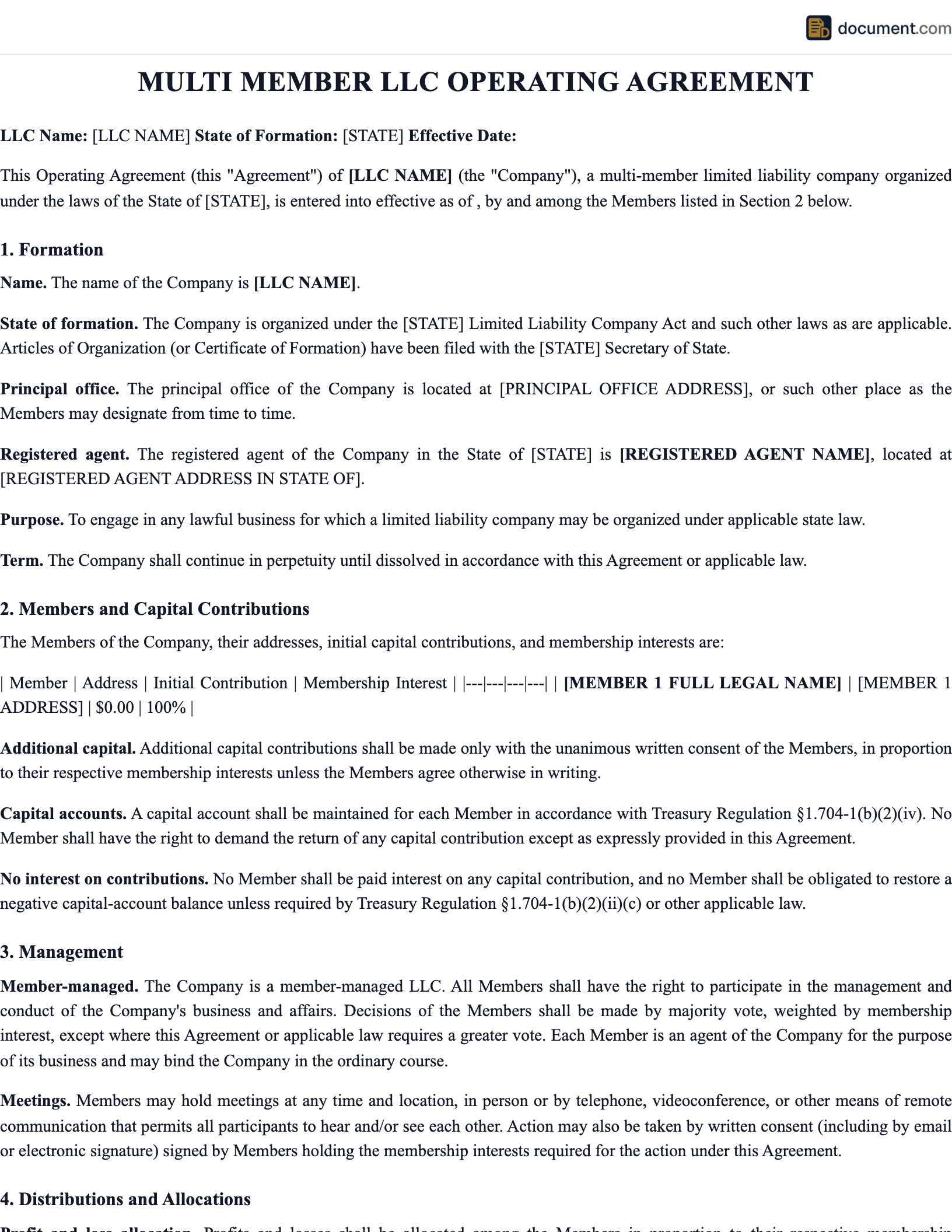
OPERATING AGREEMENT OF [LLC NAME]
A Multi-Member Limited Liability Company
This Operating Agreement (the "Agreement") of[LLC Name], a [State]limited liability company (the "Company"), is effective as of[Date].
ARTICLE I: FORMATION
The Members have formed the Company as a limited liability company under the laws of the State of [State]. The Company's Articles of Organization were filed with the Secretary of State on [Date].
ARTICLE II: MEMBERS AND CAPITAL
The names, addresses, capital contributions, and percentage interests of the Members are set forth in Schedule A attached hereto. Each Member's initial capital contribution shall be made no later than[Date].
ARTICLE III: ALLOCATIONS AND DISTRIBUTIONS
Profits and losses shall be allocated among the Members in proportion to their Percentage Interests, subject to the special allocations required by Treasury Regulation §1.704-1(b)(2)(ii)(d). Distributions shall be made at such times as the Members (or Manager, if manager-managed) determine appropriate...
ARTICLE IV: MANAGEMENT
The Company shall be [member-managed / manager-managed]. Day-to-day decisions shall be made by a majority in interest of the Members. The following Protected Matters shall require approval by Members holding at least [75]% of the Percentage Interests...
ARTICLE V: TRANSFERS AND BUY-SELL
No Member shall transfer all or any part of their Membership Interest without the prior written consent of the other Members. Upon the occurrence of a Triggering Event (including death, disability, divorce, voluntary withdrawal, or bankruptcy), the Company shall have the option to purchase the affected Member's interest at the Fair Market Value determined by independent appraisal...
ARTICLE VI: DISSOLUTION
The Company shall dissolve upon the earliest of: (a) the written consent of Members holding at least 75% of Percentage Interests; (b) the sale of substantially all assets; or (c) any event requiring dissolution under the State LLC Act...
ARTICLE VII: DISPUTE RESOLUTION
Any dispute arising out of or relating to this Agreement shall first be submitted to non-binding mediation. If mediation fails, the dispute shall be resolved by binding arbitration administered by the American Arbitration Association under its Commercial Arbitration Rules...
Frequently Asked Questions
Answers to the most common questions about multi-member LLC operating agreements.
Official Resources
Government and industry resources for LLC formation, partnership taxation, and operating agreement drafting.
IRS - Limited Liability Company
Federal tax classification and filing requirements for LLCs
IRS - Form 1065 Partnership Instructions
Instructions for the partnership tax return filed by most multi-member LLCs
IRS - Form 8832 Entity Classification
Form to elect C corporation tax treatment for an LLC
Delaware Division of Corporations
Delaware LLC formation and filing information
Uniform Law Commission - RULLCA
Revised Uniform Limited Liability Company Act and state adoption
SBA - Choose a Business Structure
Compare LLC, corporation, partnership, and sole proprietorship structures
ABA - LLC Committee
American Bar Association committee on LLCs and unincorporated entities
Nolo - LLC Operating Agreements
Free legal encyclopedia on LLC operating agreement drafting
Create your Multi Member Llc Operating Agreement in under 10 minutes.
Answer a few questions and download a compliant, attorney-drafted document ready for your state.