



What Is an Investment Letter of Intent?
An investment letter of intent is a preliminary document that formalizes the principal terms under which an investor proposes to invest capital in a private company in exchange for equity securities, convertible instruments, or debt instruments. The investment LOI occupies a critical position in the capital-raising process: it signals serious investor intent, establishes a valuation framework, outlines the economic and governance terms of the proposed investment, and creates the structure for negotiating definitive legal documents. For founders, the LOI represents validation of their business and a concrete step toward closing capital. For investors, it secures a negotiating position and — through exclusivity provisions — prevents the company from using the offer to shop for competing bids during the documentation period.
The investment LOI differs from a business purchase LOI in several important respects. Rather than acquiring the entire business, the investor is purchasing newly issued securities, which means the analysis focuses on capitalization tables, security types, liquidation waterfalls, and governance rights rather than asset inventories and liability assumptions. The securities law dimension adds significant complexity: the transaction must qualify for an exemption from SEC registration (typically Regulation D Rule 506(b) or 506(c)), investors must meet accreditation requirements, securities bear transfer restrictions, and the company must comply with state blue sky laws. These regulatory considerations shape the structure of the LOI and the conditions precedent to closing.
From a practical standpoint, the investment LOI serves as a negotiation anchor for the definitive documents — which in a typical preferred stock financing include a stock purchase agreement, amended and restated certificate of incorporation, investors' rights agreement, right of first refusal and co-sale agreement, and voting agreement. These documents can take 4-8 weeks to negotiate and execute, during which the company needs operating capital certainty and the investor needs protection against adverse changes. The LOI establishes the economic baseline that these definitive documents will formalize, reducing the scope of negotiation at the documentation stage and accelerating the path to closing.
Valuation Framework
Establishes pre-money and post-money valuation with ownership percentage calculations.
Investor Protections
Outlines anti-dilution, liquidation preferences, governance rights, and information access.
SEC Compliance
Addresses Regulation D exemptions, accreditation, and securities transfer restrictions.
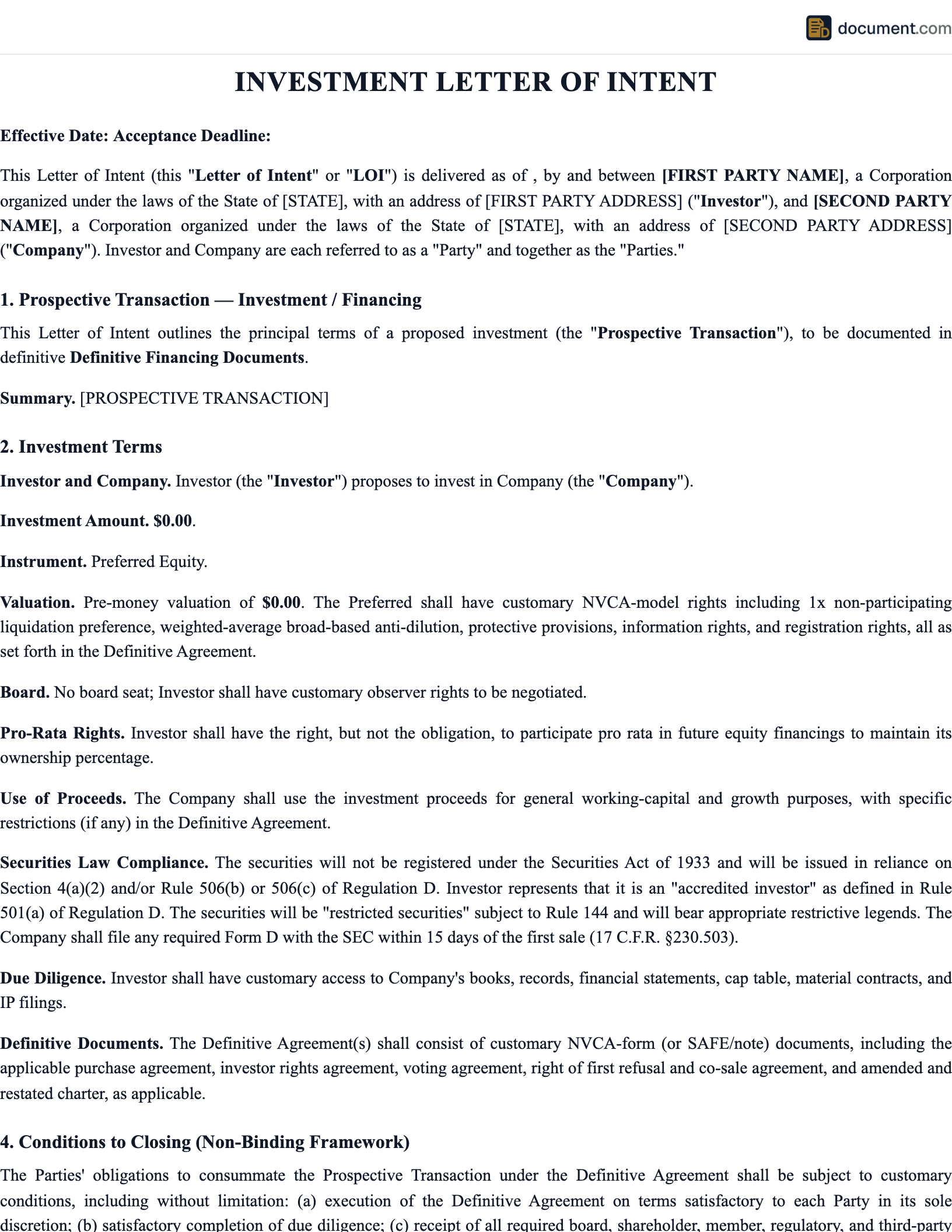
Investment LOI Form Preview
Investment Letter of Intent
Proposed Equity Investment
1. PARTIES
This Letter of Intent sets forth the principal terms under which ("Investor") proposes to invest in ("Company").
2. INVESTMENT TERMS
Investment Amount: $ Pre-Money Valuation: $ Security Type:
3. INVESTOR RIGHTS
Investor shall receive: board representation, information rights, pro-rata participation rights, and anti-dilution protections as further detailed in the definitive agreements.
INVESTOR
COMPANY
Key Components
An investment LOI must address the economic, governance, and regulatory elements that will be formalized in the definitive investment documents:
| Component | Purpose | Key Details |
|---|---|---|
| Valuation & Price | Determines ownership economics | Pre-money valuation, post-money valuation, price per share, fully diluted capitalization basis |
| Security Type | Defines the investment instrument | Preferred stock, convertible note, SAFE, common stock, or mezzanine debt; conversion terms |
| Liquidation Preference | Sets distribution priority | 1x non-participating (standard), participating, multiple preferences, participation caps |
| Anti-Dilution | Protects against down rounds | Broad-based weighted average (standard), narrow- based, full ratchet, pay-to-play provisions |
| Governance Rights | Provides investor oversight | Board seat, protective provisions, consent rights over major decisions, voting agreements |
| Information Rights | Enables ongoing monitoring | Quarterly financials, annual audit, budget, cap table updates, material event notifications |
| Preemptive & Pro-Rata Rights | Maintains ownership percentage | Right to participate in future rounds, super pro-rata options, pay-to-play requirements |
| Exclusivity & Conditions | Secures the deal process | No-shop period, due diligence timeline, regulatory filings, legal opinion requirements |
How to Create an Investment Letter of Intent
Establish the Valuation and Investment Amount
State the proposed pre-money valuation, the total investment amount (including any co-investors), the resulting post-money valuation, and the investor's pro-forma ownership percentage on a fully diluted basis. Specify how 'fully diluted' is calculated — typically including all outstanding shares, options, warrants, and the unissued option pool. If an option pool increase is expected before closing (common in VC transactions), specify whether it is included in the pre-money or post-money valuation, as this significantly impacts founder dilution.
Define the Security Type and Economic Terms
Specify the type of security being offered (Series A Preferred Stock, convertible note, SAFE, etc.), the price per share, dividends (cumulative vs. non-cumulative, the rate, and whether they accrue or are paid currently), the liquidation preference (1x non-participating is market standard for most VC rounds), and conversion rights (automatic conversion upon qualified IPO, optional conversion at investor election). For convertible instruments, specify the interest rate, maturity date, valuation cap, and discount rate.
Outline Investor Protections
Detail the anti-dilution mechanism (broad-based weighted average is standard), protective provisions requiring investor consent (new equity issuances, debt above a threshold, asset sales, mergers, charter amendments, executive compensation changes, related-party transactions), and right of first refusal and co-sale rights. Specify whether these protections belong to the entire investor class or to specific investors meeting an ownership threshold.
Address Governance and Information Rights
Specify board composition (common structure: 2 founder seats, 1 investor seat, and 1-2 independent seats), board observer rights, information delivery obligations (monthly financial reports, quarterly board packages, annual audited financials and budget), and management rights that qualify the investment as a VCOC (Venture Capital Operating Company) or SBIC for ERISA purposes if the investor manages pension fund capital.
Draft the Exclusivity and Due Diligence Provisions
Include a binding no-shop clause (typically 30-60 days for investment transactions, shorter than acquisition LOIs because the company may need the flexibility to pursue alternative financing if the deal falls through). Define the due diligence scope, including legal review of corporate documents, intellectual property analysis, financial review, customer reference checks, and technical assessment. Specify the investor's right to terminate without penalty based on diligence findings.
Identify Conditions Precedent to Closing
List the conditions that must be satisfied before the investment closes: satisfactory due diligence, negotiation and execution of definitive legal documents, delivery of legal opinions, updated capitalization table reflecting the investment, board and stockholder approvals, regulatory filings (Form D, state blue sky notices), compliance with securities law exemptions, and any company-specific milestones (product launch, revenue target, key hire). Specify whether conditions can be waived and by whom.
Designate Binding and Non-Binding Provisions
Clearly separate binding provisions (exclusivity, confidentiality, expenses, governing law, dispute resolution) from non-binding provisions (valuation, investment terms, governance rights, conditions). Include an express statement that the LOI does not obligate either party to consummate the investment and that binding obligations arise only upon execution of definitive agreements. Specify the LOI's expiration date (typically 15-30 days) to prevent indefinite open-ended negotiations.
Equity vs Debt Structure
The investment LOI should clearly identify whether the proposed investment takes the form of equity, debt, or a hybrid instrument, as the choice fundamentally affects the rights of both parties. Equity investments (preferred stock, common stock) give the investor an ownership stake with potential upside participation but no guaranteed return and subordinate priority in a liquidation event. The investor benefits from capital appreciation if the company succeeds but bears the risk of total loss if the company fails. The tax treatment differs significantly: equity gains may qualify for long-term capital gains rates and potentially Qualified Small Business Stock (QSBS) exclusion under IRC Section 1202 if holding period and other requirements are met.
Debt instruments (convertible notes, venture debt, revenue- based financing) provide the investor with contractual repayment obligations, interest income, and creditor priority in bankruptcy or dissolution. Convertible notes bridge the gap between debt and equity by providing downside protection (principal repayment at maturity) with upside participation (conversion into equity at a discount to the next round's price, often with a valuation cap). SAFEs (Simple Agreements for Future Equity) occupy a middle ground: they are not debt (no maturity date, no interest), but they are not equity until a conversion event — making their accounting and tax treatment a subject of ongoing debate among practitioners.
Securities Compliance
All private securities offerings must comply with federal and state securities laws. The most common exemption — Regulation D Rule 506(b) — limits sales to accredited investors (individuals with $200K+ income or $1M+ net worth excluding primary residence) and prohibits general solicitation. Rule 506(c) permits general solicitation but requires the company to take reasonable steps to verify accredited investor status. The company must file Form D with the SEC within 15 days of the first sale and comply with applicable state blue sky notice filings. Failure to comply can void the exemption and create rescission rights for investors.
Frequently Asked Questions
Official Resources
Authoritative resources on private investment transactions, securities regulations, and venture capital documentation.
SEC - Exempt Offerings
SEC guidance on Regulation D, Regulation A+, Regulation Crowdfunding, and other exemptions from securities registration.
NVCA Model Legal Documents
National Venture Capital Association model term sheet, stock purchase agreement, and investor rights agreement templates.
SEC Form D Filing
Electronic filing portal for Form D notice of exempt offering required within 15 days of first sale under Regulation D.
Y Combinator - SAFE Documents
Standard SAFE (Simple Agreement for Future Equity) templates for early-stage investment transactions.
SBA - Investment Capital Programs
Small Business Administration resources on SBIC programs, venture capital, and equity investment for small businesses.
Securities Act Section 4 - Exemptions
Full text of Securities Act exemptions including Section 4(a)(2) private placement and Regulation D safe harbors.
Create Your Investment LOI
Structure your investment with a professionally drafted letter of intent covering valuation, investor rights, governance, and regulatory compliance.
Create DocumentNo account required. Free to create and preview.