
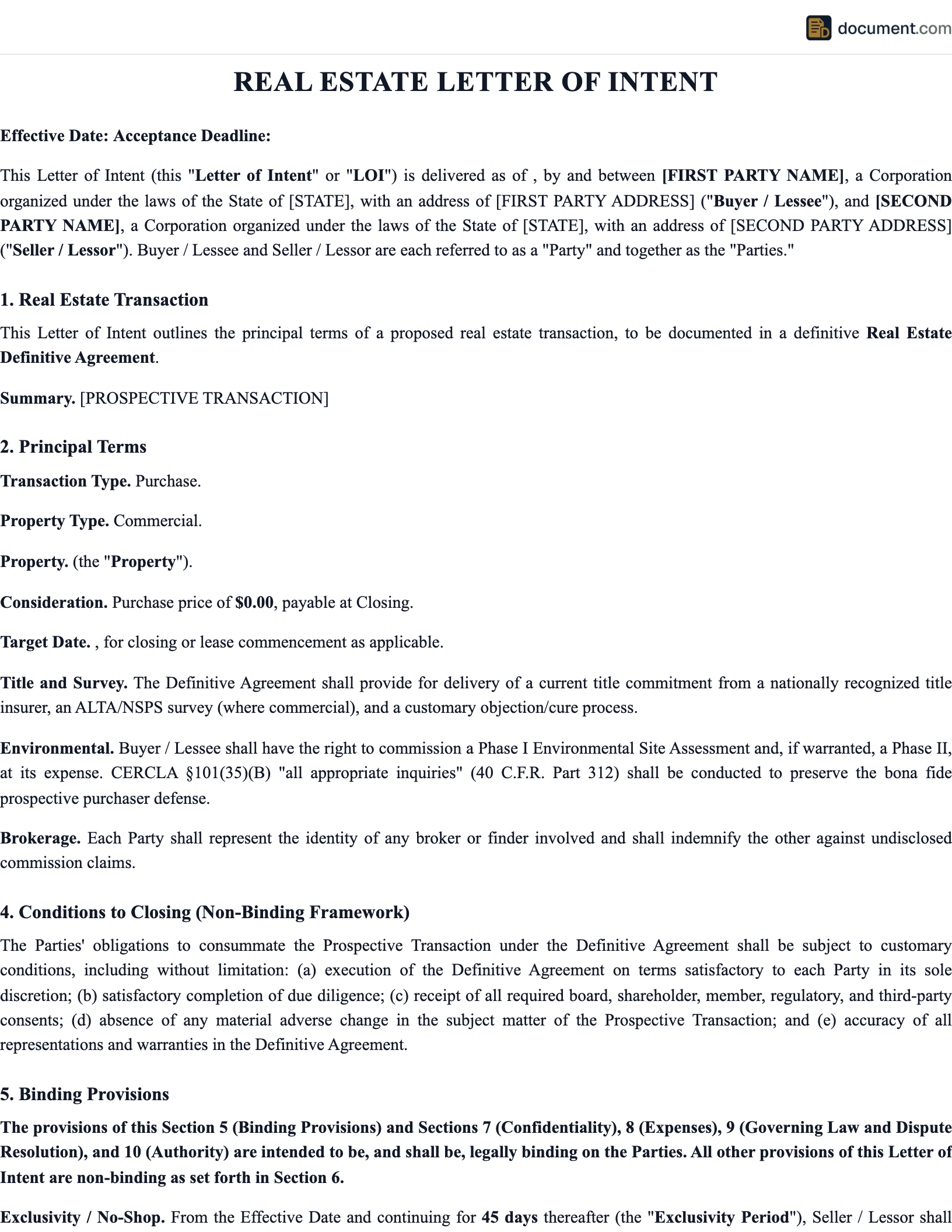



What Is a Residential Purchase Letter of Intent?
A residential purchase letter of intent is a preliminary document that expresses a buyer's serious interest in acquiring a residential property and outlines the proposed terms of the transaction. The LOI bridges the gap between casual interest and a formal purchase offer, giving both parties an opportunity to explore whether they can agree on fundamental terms — price, financing, contingencies, and timeline — before either side commits to the time and expense of a formal contract negotiation.
Residential purchase LOIs are most commonly used in situations where the standard purchase offer process is not ideal. Off-market purchases, where the property is not publicly listed, benefit from the LOI format because the seller may not have engaged a listing agent and may not be prepared for a formal offer. Estate sales and probate transactions often involve multiple decision-makers (executors, beneficiaries, courts) who need to review proposed terms before authorizing a formal agreement. For-sale-by-owner transactions lack the standardized forms that real estate agents typically provide, making the LOI a useful tool for structuring initial negotiations. New construction contracts frequently begin with an LOI that establishes the lot selection, base price, upgrade selections, and construction timeline before the builder prepares a detailed construction purchase agreement.
The strategic advantage of a residential purchase LOI is flexibility. Unlike a binding offer, which commits the buyer to purchase if the seller accepts, the non-binding LOI allows the buyer to negotiate terms, conduct preliminary due diligence, and assess financing options without the pressure of contractual deadlines. This is particularly valuable for buyers who are selling their current home contingent on purchasing the new property, buyers who need to secure specialized financing (construction loans, renovation loans, bridge financing), or investors evaluating multiple properties simultaneously. The LOI signals seriousness to the seller while preserving the buyer's ability to refine or withdraw the proposal as circumstances evolve.
Offer Structure
Proposes purchase price, earnest money, and financing terms for the acquisition.
Inspection Rights
Reserves the right to conduct home inspections and environmental testing.
Closing Framework
Establishes target closing date, contingencies, and cost allocation.
Residential Purchase LOI Form Preview
Letter of Intent
Proposed Purchase of Residential Property
1. PROPERTY AND BUYER
This Letter of Intent sets forth the terms under which ("Buyer") proposes to purchase the property located at from ("Seller").
2. PURCHASE PRICE
Buyer proposes a purchase price of $ with earnest money of $ deposited within business days of acceptance.
3. FINANCING
Buyer intends to finance the purchase with a mortgage with approximately % down payment.
BUYER
SELLER
Key Components
A residential purchase LOI should address these essential elements:
| Component | Purpose | Key Details |
|---|---|---|
| Purchase Price | Establishes offer amount | Proposed price, basis for valuation, price adjustments for repairs or credits |
| Earnest Money | Demonstrates buyer commitment | Deposit amount (1-3%), escrow holder, refundability conditions, deposit timeline |
| Financing Terms | Outlines funding source | Loan type (conventional, FHA, VA), down payment, pre-approval status, cash purchase |
| Inspection Contingency | Protects buyer from defects | Inspection period (7-14 days), specialized inspections, repair negotiation rights |
| Appraisal Contingency | Protects against overpayment | Lender appraisal requirement, gap coverage amount, renegotiation rights |
| Closing Timeline | Sets transaction schedule | Target closing date (30-60 days), possession date, extension provisions |
| Seller Disclosures | Ensures material information | Property condition, lead paint, HOA docs, natural hazard disclosures, material defects |
How to Draft a Residential Purchase Letter of Intent
Identify the Property and Parties
Provide the complete property address, legal description (if available), and tax parcel number. Identify yourself as the buyer with your full legal name. If purchasing with a co-buyer (spouse, partner, or investment partner), include their name and specify the intended form of ownership — joint tenancy, tenants in common, or community property where applicable. Identify the seller by name and note whether the property is listed with a real estate agent or is being sold directly by the owner. If you are represented by a buyer's agent, include their name and brokerage.
Propose Purchase Price and Earnest Money
State the purchase price you are proposing, whether you are offering full asking price or a different amount, and the basis for your valuation (comparable sales, appraisal data, property condition). Specify the earnest money amount you will deposit, when the deposit will be made, and the escrow holder. Address whether the earnest money becomes non-refundable at any point or remains fully refundable through all contingency periods. If you are making a cash offer, include a proof-of-funds reference and note any premium or discount you are requesting based on the cash payment advantage.
Outline Financing Terms
Specify whether you intend to pay cash or obtain mortgage financing. For financed purchases, identify the loan type (conventional, FHA, VA, USDA, jumbo), the approximate down payment percentage, and your pre-approval status. Include a financing contingency with a specified deadline for obtaining a mortgage commitment. If you have been pre-approved by a lender, reference the pre-approval letter (attached or forthcoming). For cash offers, state your willingness to provide proof of funds and note that no financing contingency is required, which strengthens the offer.
Include Contingency Provisions
List all contingencies you want to include: home inspection (with timeframe), appraisal (if financed), financing commitment, title review, HOA document review, sale of existing home (if applicable), and any property-specific contingencies (well water test, septic inspection, survey). For each contingency, specify the deadline for satisfaction or waiver, the process for raising objections, and the remedies available if the contingency is not satisfied (termination with refund, price renegotiation, seller repair). The fewer contingencies you include, the stronger your offer appears to the seller — but removing contingencies increases your financial risk.
Establish Closing Timeline and Costs
Propose a target closing date — typically 30 to 60 days from acceptance for financed purchases and 14 to 30 days for cash transactions. Specify the desired possession date (usually at closing, though sellers sometimes request a post-closing possession period). Address closing cost allocation: which party pays for title insurance, transfer taxes, recording fees, and HOA transfer fees per local custom. If you are requesting the seller to contribute toward your closing costs (a seller concession), state the amount or percentage. Include any requests for specific items to be included in the sale — appliances, window treatments, fixtures, or equipment.
Add Non-Binding Language and Expiration
Include a clear statement that the LOI is non-binding and that no purchase obligation arises until a formal purchase agreement is executed by both parties. Set an expiration date for the LOI — typically 3 to 7 days — after which the proposal is automatically withdrawn if the seller has not responded. Propose next steps: signing a formal purchase agreement using the applicable state-specific contract form, opening escrow, scheduling inspections, and beginning the financing process. Provide your contact information and express your willingness to discuss terms at the seller's convenience.
Common Contingencies in Residential Purchase LOIs
Contingencies are protective provisions that allow the buyer to terminate the transaction and receive a refund of their earnest money if specified conditions are not met. Understanding which contingencies to include — and which to waive strategically — is essential for crafting a competitive residential purchase LOI.
The inspection contingency is the most fundamental buyer protection and should rarely be waived. A qualified home inspector will examine the property's structural components, roof, HVAC systems, plumbing, electrical, appliances, and visible defects, providing a detailed report that informs the buyer's decision to proceed, renegotiate, or terminate. In addition to the general inspection, buyers should consider specialized inspections based on property characteristics: radon testing (particularly in states with high radon levels like Iowa, Pennsylvania, and Colorado), termite and wood-destroying organism inspections (standard in southern and coastal states), well water quality testing and flow rate testing, septic system inspection and pumping records, mold testing in humid climates, and pool/spa inspection for properties with these amenities.
The financing contingency protects buyers who need mortgage approval to complete the purchase. This contingency typically specifies the loan type, maximum interest rate, and deadline by which the buyer must obtain a mortgage commitment. If the buyer cannot obtain financing on the specified terms by the deadline, they can terminate the agreement and receive their earnest money back. In competitive markets, buyers sometimes waive the financing contingency or shorten the contingency period to make their offer more attractive — but this strategy is risky because the buyer could lose their earnest money if financing falls through. A strong pre-approval letter from a reputable lender can provide the seller with confidence in the buyer's ability to close even when the financing contingency remains in place.
Waiving Contingencies
In competitive markets with multiple offers, buyers may be tempted to waive inspection, appraisal, or financing contingencies to make their offer more attractive. While this strategy can succeed, it carries substantial risk: without an inspection contingency, the buyer assumes responsibility for all defects discovered after closing; without an appraisal contingency, the buyer must cover any gap between the appraised value and purchase price with additional cash; without a financing contingency, the buyer may lose their earnest money if their loan is denied. Consult with your real estate agent and attorney before waiving any contingency to fully understand the financial exposure.
Frequently Asked Questions
Official Resources
Authoritative resources on residential real estate purchases, home buying, and consumer protections.
CFPB - Owning a Home
Consumer Financial Protection Bureau tools and resources for home buyers including mortgage comparison, closing cost estimation, and buyer rights.
HUD - Buying a Home
U.S. Department of Housing and Urban Development guidance on the home buying process, FHA loans, and homebuyer assistance programs.
NAR - Research and Statistics
National Association of Realtors market data, home price statistics, and housing affordability analysis.
EPA - Lead Paint Disclosure
Federal requirements for lead-based paint disclosure in residential property transactions for pre-1978 homes.
IRS Publication 523
Tax guidance on selling your home, capital gains exclusions, and reporting requirements for residential real estate transactions.
ALTA - Homebuyer Resources
American Land Title Association consumer resources on title insurance, closing procedures, and property ownership protection.
Create your Real Estate Residential Purchase Letter of Intent in under 10 minutes.
Answer a few questions and download a compliant, attorney-drafted document ready for your state.