
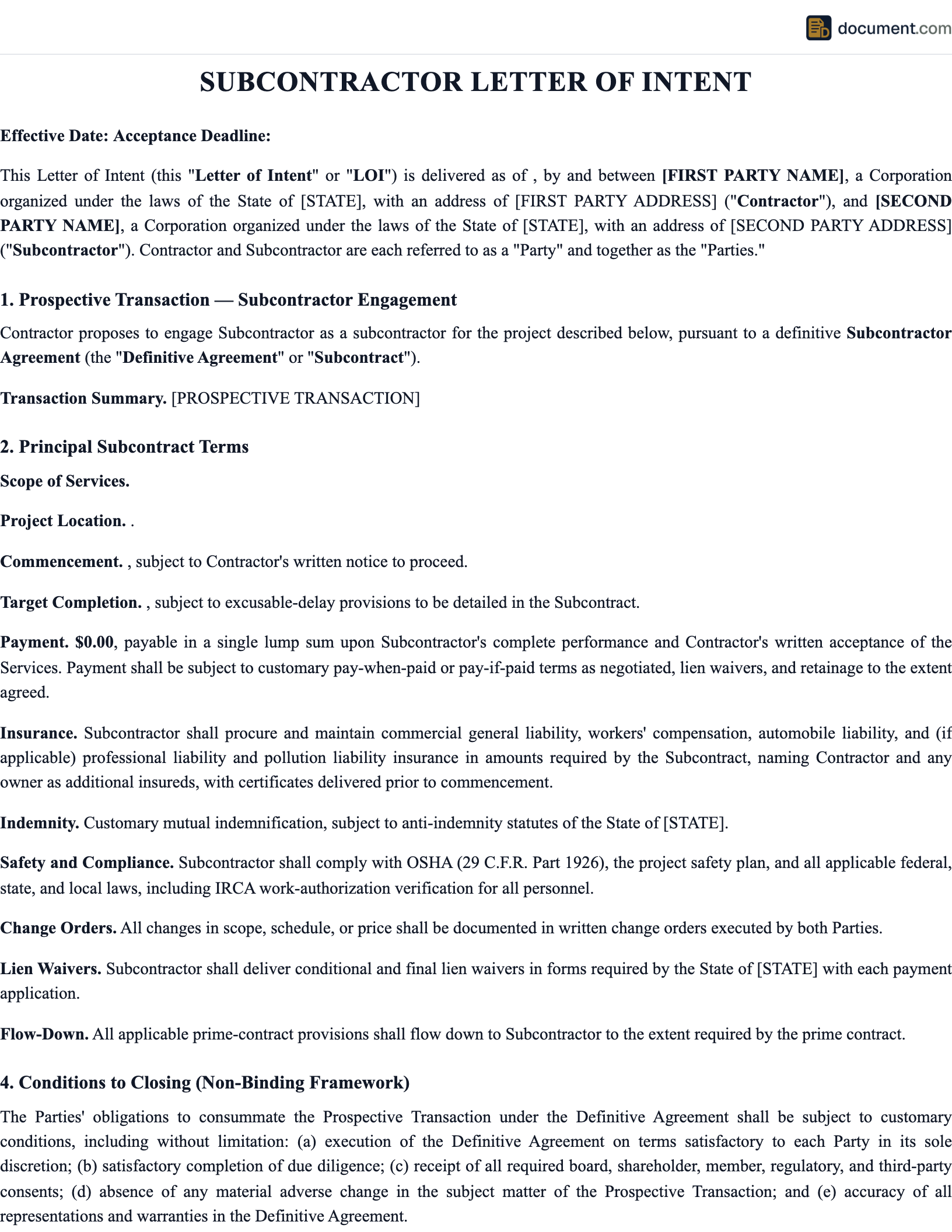



What Is a Subcontractor Letter of Intent?
A subcontractor letter of intent is a preliminary agreement between a general contractor (or prime contractor) and a subcontractor that formalizes the GC's intent to award a specific scope of work on a construction project. The LOI bridges the critical gap between bid submission and formal subcontract execution — a period that can span weeks or months while the prime contract is finalized, project financing is secured, and the GC's legal team negotiates the subcontract terms. During this interval, the project cannot afford to stand still: long-lead materials must be ordered, shop drawings must be prepared and submitted for approval, crews must be scheduled, and equipment must be mobilized. The LOI authorizes the subcontractor to begin these critical-path activities while the formal subcontract is finalized.
The construction industry's reliance on subcontractor LOIs reflects the economic reality that most construction projects involve multiple tiers of contractors, each dependent on the tier above for contract authorization and the tier below for workforce and materials. A typical commercial construction project may involve 20 to 50 subcontractors, each performing a specialized trade — structural steel, mechanical (HVAC), electrical, plumbing, fire protection, drywall, painting, flooring, roofing, elevator, and many others. The GC cannot execute formal subcontracts with all of these trades simultaneously, so LOIs provide a practical mechanism for prioritizing the most time-sensitive subcontractors while the remaining subcontracts are negotiated.
From a legal perspective, subcontractor LOIs occupy a particularly complex space because construction law involves overlapping statutory frameworks — licensing requirements, mechanics lien and bond claim statutes, prompt payment acts, prevailing wage laws, OSHA regulations, and building codes — that the LOI must acknowledge even if the detailed compliance provisions are reserved for the formal subcontract. A subcontractor who begins work under an LOI still has mechanics lien rights in most jurisdictions, still must comply with prevailing wage requirements on public projects, and still must maintain required licenses and insurance coverages. The LOI should reference these obligations to prevent compliance gaps during the pre-subcontract period.
Scope Definition
Identifies the specific trade work, drawings, specifications, and exclusions for the subcontract.
Schedule Integration
Establishes mobilization dates, milestone deadlines, and critical path coordination requirements.
Risk Allocation
Addresses insurance, bonding, indemnification, and compliance obligations before work begins.
Subcontractor LOI Form Preview
Subcontractor Letter of Intent
Pre-Contract Award Commitment
1. PROJECT AND PARTIES
This Letter of Intent confirms that ("General Contractor") intends to award the scope on the project to ("Subcontractor").
2. SUBCONTRACT PRICE
The proposed subcontract price is $ based on the documents dated , subject to formal subcontract execution.
3. AUTHORIZED PRE-CONTRACT WORK
Subcontractor is authorized to proceed with not to exceed $ pending subcontract execution.
GENERAL CONTRACTOR
SUBCONTRACTOR
Key Components
An effective subcontractor LOI addresses these critical elements to protect both the general contractor and the subcontractor during the pre-subcontract period:
| Component | Purpose | Key Details |
|---|---|---|
| Project Identification | Defines which project is covered | Project name, location, owner, architect, prime contract number, bid date reference |
| Scope of Work | Defines what work is included | Specification sections, drawing references, inclusions, exclusions, bid clarifications, alternates |
| Price | Sets the contract value | Lump sum, unit prices, allowances, price basis (plans dated), accepted alternates, value engineering |
| Schedule | Establishes timing requirements | Mobilization date, duration, milestones, substantial completion, coordination with other trades |
| Insurance Requirements | Ensures risk coverage | CGL, auto, workers' comp, umbrella, additional insured, waiver of subrogation, certificate requirements |
| Bonding | Guarantees performance and payment | Performance bond, payment bond, dual obligee rider, surety qualifications, bond cost allocation |
| Pre-Contract Authorization | Permits early-start activities | Authorized activities, NTE cost cap, procurement approvals, shop drawings, mobilization |
How to Draft a Subcontractor LOI
Identify the Project and Parties
Include the project name, physical address, project number, project owner's name, architect or engineer of record, and the date of the bid documents on which the subcontract price is based. Identify the general contractor by legal name, license number, and contact information, and identify the subcontractor similarly. Reference the prime contract number if known and note that the LOI is contingent on the GC receiving the prime contract award.
Define the Scope of Work Precisely
Reference the specific specification sections (Division numbers under CSI MasterFormat), drawing sheets, and addenda that define the subcontractor's scope. List all inclusions and exclusions explicitly — particularly for scope items that could be attributed to more than one trade (blocking, backing, fire stopping, caulking, painting of exposed work, temporary protection). Attach the subcontractor's original bid form or proposal as an exhibit, incorporating their bid clarifications and qualifications by reference.
Establish the Price and Payment Framework
State the agreed subcontract price and whether it is a lump sum, guaranteed maximum price, unit price, or cost-plus arrangement. Identify the plan date on which the price is based and address how plan revisions, addenda, or owner-directed changes after that date will be handled (through the change order process). Establish the retainage percentage, progress payment application schedule, and general payment terms. Reference applicable prompt payment statutes that set maximum payment timelines.
Set Schedule Requirements
Specify the anticipated mobilization date, the estimated duration of the subcontractor's on-site work, key milestone dates (first pour, topping out, dry-in, substantial completion), and the overall project completion date. Address the subcontractor's obligation to coordinate with the master project schedule and with other trades working in the same areas. Note that the detailed schedule will be included in the formal subcontract and that the subcontractor agrees to comply with reasonable schedule revisions directed by the GC.
Specify Insurance and Bonding Requirements
List the minimum insurance coverages and limits required: commercial general liability (per-occurrence and aggregate), commercial auto, workers' compensation (statutory limits), employer's liability, and umbrella/excess liability. Specify additional insured requirements, waiver of subrogation endorsements, and certificate requirements. If performance and payment bonds are required, state the bond amounts (typically 100% of the subcontract price for each), the surety's minimum rating (A.M. Best rating of A- or better, Treasury listed), and who bears the bond premium cost.
Authorize Pre-Contract Work with Cost Caps
If the subcontractor needs to begin procurement, shop drawings, or mobilization before the subcontract is executed, the LOI should specify exactly which activities are authorized, establish a not-to-exceed cost cap for LOI-phase work (separate from the total subcontract price), require the subcontractor to track and document LOI-phase costs separately, and confirm that LOI-phase costs will be credited toward the first progress payment under the formal subcontract. This prevents scope creep during the LOI period and protects both parties if the subcontract is not ultimately executed.
Include Standard Compliance Obligations
Reference the subcontractor's obligation to maintain all required state and local contractor licenses, comply with applicable prevailing wage and labor requirements (Davis-Bacon Act for federal projects, state prevailing wage laws), follow OSHA safety regulations, adhere to the GC's site-specific safety plan, participate in required safety orientations, and comply with equal employment opportunity and affirmative action requirements if applicable. These obligations apply from the moment the subcontractor begins any work under the LOI, not just after the formal subcontract is signed.
Bonding and Insurance
Construction bonds and insurance represent the primary risk transfer mechanisms in the subcontracting relationship, and the LOI should address both comprehensively. Performance bonds guarantee that the subcontractor will complete the work in accordance with the subcontract documents — if the subcontractor defaults, the surety is obligated to either complete the work through a replacement contractor or pay the GC's cost to complete. Payment bonds guarantee that the subcontractor will pay its suppliers, sub-subcontractors, and laborers — protecting the GC and project owner from mechanics liens filed by unpaid parties in the subcontractor's chain.
The LOI's insurance requirements should mirror the prime contract's insurance specifications to ensure seamless risk transfer from the subcontractor through the GC to the project owner. Key insurance provisions include naming the GC and owner as additional insureds on the subcontractor's CGL and umbrella policies, requiring waivers of subrogation on all policies, specifying that the subcontractor's insurance is primary and non- contributory with respect to the GC's and owner's insurance, and requiring 30 days' advance written notice of cancellation or material change. The subcontractor should be required to provide certificates of insurance before beginning any LOI-authorized work.
Mechanics Lien Rights
Work performed under a subcontractor LOI generally preserves the subcontractor's mechanics lien rights, even without a formal subcontract. In most states, lien rights arise when the subcontractor provides labor, materials, or services that improve real property, regardless of the contractual form. The subcontractor should send any required preliminary notices (common in California, Arizona, and other states) within the statutory timeframe from the date they first furnish labor or materials under the LOI, not from the date a formal subcontract is later executed. Missing preliminary notice deadlines can forfeit lien rights entirely.
Frequently Asked Questions
Official Resources
Authoritative resources on construction subcontracting, bonding, insurance, and regulatory compliance.
AGC - Contractor Resources
Associated General Contractors of America resources on subcontracting practices, standard forms, and industry best practices.
OSHA - Construction Industry
Occupational Safety and Health Administration construction safety standards, training requirements, and compliance resources.
SBA - Subcontracting Guide
Small Business Administration resources on subcontracting opportunities, compliance requirements, and dispute resolution.
DOL - Davis-Bacon Act
Department of Labor guidance on prevailing wage requirements for federally funded construction projects affecting subcontractors.
SFAA - Construction Bonding
Surety & Fidelity Association of America resources on performance bonds, payment bonds, and the surety underwriting process.
CSI - MasterFormat
Construction Specifications Institute standard for organizing construction specifications and scope of work definitions by trade division.
Create Your Subcontractor LOI
Secure your subcontractor commitment with a professionally drafted letter of intent covering scope, pricing, schedule, and compliance requirements.
Create DocumentNo account required. Free to create and preview.