



What Is a Mechanic's Lien?
A mechanic's lien is a statutory security interest granted to contractors, subcontractors, laborers, and material suppliers who have contributed labor, materials, or equipment to the improvement of real property but have not been paid. When filed and recorded with the county recorder's office, the lien attaches to the property itself, creating a cloud on the title that prevents the property owner from selling, refinancing, or transferring the property with clear title until the lien is satisfied or released. It is one of the most powerful collection tools available to the construction industry because it transforms an unsecured debt into a secured claim backed by the value of real property.
The mechanic's lien system exists because the construction industry operates on a unique payment structure that creates inherent risk for unpaid parties. A property owner hires a general contractor, who hires subcontractors, who hire sub-subcontractors and purchase materials from suppliers. Payment flows down this chain, and when it stops at any point — whether because the owner fails to pay the general contractor, the general contractor fails to pay a subcontractor, or a subcontractor fails to pay a supplier — the parties at the bottom of the chain are left without recourse. Mechanic's lien laws address this by giving every party in the chain a direct claim against the improved property, regardless of their contractual relationship (or lack thereof) with the property owner.
The term "mechanic's lien" is historical — "mechanic" originally referred to anyone who worked with their hands, including carpenters, masons, and other tradespeople. Today, the term encompasses a much broader range of construction professionals. Different states use different names for the same concept: construction lien (Florida), materialman's lien (some Southern states), artisan's lien, or supplier's lien. Regardless of the name, the underlying principle is the same — if you improve someone's property and are not paid, you have a statutory right to encumber that property to secure your payment.
Mechanic's lien laws are entirely creatures of state statute, meaning they vary significantly from state to state in terms of who can file, what preliminary notices are required, when the lien must be filed, how long you have to enforce it, and what information the lien document must contain. Strict compliance with every procedural requirement is essential — courts enforce mechanic's lien statutes literally, and even minor errors can invalidate an otherwise valid lien. Our templates are specifically designed for each state's statutory requirements, including the correct form, deadlines, notice provisions, and recording procedures.
Payment Security
Converts an unsecured debt into a secured claim backed by the improved property's value
Title Cloud
Prevents property sale or refinancing until the lien is resolved, motivating payment
Foreclosure Right
Allows forced sale of the property to satisfy the lien debt if payment is not received
Mechanic's Lien Form Preview
Below is a visual preview of the sections and fields included in a mechanic's lien form. Your completed document will include the proper statutory language, legal descriptions, and verification for your specific state.
Claim of Mechanic's Lien
Notice of Lien for Labor and/or Materials
Section 1: Lien Claimant
Section 2: Property & Owner
Section 3: Lien Claim
Section 4: Verification
Claimant Signature
State of __________, County of __________. Subscribed and sworn to before me this ____ day of __________, 20___.
Notary Public
Commission Expires: __________
Types of Lien Documents
The mechanic's lien process involves several related documents, each serving a specific function in protecting payment rights and resolving construction payment disputes.
Lien Waiver
A document where a contractor or supplier waives lien rights in exchange for payment, used to protect property owners
Release of Mechanic's Lien
A recorded document that removes a previously filed mechanic's lien from the property after payment is received
Notice Of Intent To Lien
Preliminary notice warning a property owner that a mechanic's lien will be filed if unpaid amounts remain
Who Can File a Mechanic's Lien
Mechanic's lien rights extend to various participants in the construction process, though eligibility varies by state.
General Contractors
The prime contractor who has a direct contract with the property owner. In most states, general contractors have the broadest lien rights and the fewest preliminary notice requirements because of their direct contractual relationship with the owner.
Subcontractors
Trade contractors hired by the general contractor (or by other subcontractors) to perform specific portions of the work — electricians, plumbers, framers, roofers, HVAC contractors, and others. Subcontractors typically must send preliminary notices to preserve lien rights.
Material Suppliers
Companies that provide materials incorporated into the construction project — lumber, concrete, steel, fixtures, and equipment. The materials must be delivered to the project site and actually used in the improvement. Some states require suppliers to send preliminary notices.
Laborers & Workers
Individual workers who perform physical labor on the construction project. Laborers typically have the simplest lien filing requirements and the fewest preliminary notice obligations because they are considered the most vulnerable party in the payment chain.
Mechanic's Lien vs Other Liens
Understanding how mechanic's liens differ from other types of property liens helps clarify their unique power and limitations.
Mechanic's Lien vs Mortgage Lien
Mechanic's Lien
- - Created by statute (involuntary)
- - Secures payment for labor/materials
- - May relate back to date of commencement
- - Must be filed within strict statutory deadlines
- - Expires if not enforced by lawsuit
Mortgage Lien
- - Created by contract (voluntary)
- - Secures a loan from a lender
- - Priority from date of recording
- - No filing deadline — recorded at loan closing
- - Remains until loan is paid or refinanced
Key point:In many states, a mechanic's lien can take priority over a construction mortgage through the "relation back" doctrine, which gives the lien priority from the date construction commenced — potentially before the construction loan was recorded.
Mechanic's Lien vs Judgment Lien
Mechanic's Lien
- - Filed before any lawsuit
- - Specific to the improved property
- - Requires strict statutory compliance
- - Powerful leverage for pre-suit resolution
Judgment Lien
- - Created after winning a lawsuit
- - Attaches to all property in the county
- - Requires successful litigation first
- - Lower priority than mechanic's liens
How to File a Mechanic's Lien: A 7-Step Guide
Filing a mechanic's lien requires strict compliance with your state's statutory procedures. Missing a single step or deadline can invalidate your lien entirely. Follow these seven steps carefully.
Verify Your Lien Rights
Before taking any action, confirm that you are eligible to file a mechanic's lien in your state. Verify that you are properly licensed (if required), that the work you performed qualifies for lien protection, that the property is lienable (public property is generally exempt), and that you have met all preliminary notice requirements. If you failed to send a required preliminary notice, you may have lost your lien rights regardless of whether you are owed money.
Send a Preliminary Notice (If Required)
Approximately 35 states require subcontractors and suppliers to send a preliminary notice to the property owner within a specified period (typically 20-30 days) after first furnishing labor or materials. This notice does not mean you are filing a lien — it simply preserves your right to file one later if needed. Send the notice by certified mail with return receipt requested and keep the proof of mailing. Even in states where preliminary notices are not required, sending one is a best practice that puts the owner on notice and often accelerates payment.
Send a Notice of Intent to Lien
Before filing the actual lien, send a notice of intent to lien to the property owner, general contractor, and any other relevant parties. Give them 10-30 days to resolve the payment issue. This step is required by statute in some states and is a best practice in all states. The notice of intent frequently resolves the dispute without the need to file a lien, saving everyone time, money, and legal exposure. Document the notice and the response (or lack thereof) carefully.
Prepare the Lien Document
Draft the mechanic's lien claim with all information required by your state's statute. This typically includes: the claimant's name, address, and license number; the property owner's name; the property's legal description (available from the county assessor or the title report); the name of the party who hired the claimant; the amount claimed; a description of the work performed or materials supplied; the dates of first and last furnishing; and the verification or oath language required by state law. Our templates include all required fields for your state.
Sign and Notarize the Lien
Most states require the lien claimant (or an authorized agent) to sign the lien document under oath or penalty of perjury, and many require notarization. The verification language confirms that the facts stated in the lien are true and correct to the best of the claimant's knowledge. Filing a false lien can result in civil liability and, in some states, criminal penalties. Ensure all information is accurate before signing.
Record the Lien with the County
File the signed, notarized lien with the county recorder's office (or clerk of court, depending on the state) in the county where the property is located. Pay the recording fee (typically $15-$75 depending on the county). The recording date is critical — it establishes the lien's official filing date for deadline purposes. Keep the recorder's receipt and a conformed (stamped) copy of the recorded lien.
Serve the Lien on the Property Owner
After recording, serve a copy of the lien on the property owner (and in some states, the general contractor and other parties) within the time required by your state's statute — typically 5-30 days after recording. Service is usually by certified mail, personal delivery, or both. Failure to serve the lien within the required timeframe can invalidate it in some states. After service, monitor the enforcement deadline — you must file a lawsuit to foreclose on the lien within the statutory period (typically 6 months to 2 years) or the lien expires automatically.
Key Components of a Mechanic's Lien
A mechanic's lien must contain specific information required by state statute. Omitting any required element can render the lien unenforceable.
| Component | Description |
|---|---|
| Claimant Information | Full legal name, address, phone, and contractor license number of the lien claimant |
| Property Owner | Full legal name and address of the property owner (or reputed owner) |
| Property Description | Legal description of the property (lot, block, subdivision, recording reference) and street address |
| Hiring Party | Name of the party who hired the claimant (general contractor, owner, or other subcontractor) |
| Amount Claimed | The total amount owed, including a breakdown of labor, materials, and any credits or payments received |
| Work Description | Detailed description of the labor performed, materials supplied, or equipment furnished |
| First Furnishing Date | The date the claimant first began providing labor or materials to the project |
| Last Furnishing Date | The date the claimant last provided labor or materials to the project |
| Contract Information | Reference to the contract or agreement under which the work was performed |
| Preliminary Notice Ref | Confirmation that required preliminary notices were sent, with dates and method of delivery |
| Verification / Oath | Sworn statement that the facts in the lien are true and correct, signed under oath or penalty of perjury |
| Notarization | Notary acknowledgment or jurat certifying the claimant's signature and oath |
Critical Deadlines
Mechanic's lien deadlines are the single most important procedural requirement. Missing any deadline — even by one day — permanently extinguishes your lien rights. These deadlines vary by state, by claimant type, and by the triggering event.
Deadline Warning
Courts enforce mechanic's lien deadlines with zero flexibility. There are no extensions, no excuses, and no exceptions. If your state requires filing within 90 days of last furnishing and you file on day 91, your lien is void. Calendar every deadline immediately and build in a safety margin. If you are unsure of the exact deadline in your state, file sooner rather than later.
Typical Deadline Framework
Preliminary Notice
20-30 days after first furnishing labor or materials. Required in approximately 35 states. Must be sent to the property owner and sometimes the general contractor and lender.
Lien Filing
30-120 days after last furnishing labor or materials, project completion, or notice of completion (varies by state). This is the deadline to record the lien with the county.
Service on Owner
5-30 days after recording the lien. The lien claimant must serve a copy on the property owner (and sometimes other parties). Required in most states.
Enforcement / Lawsuit
6 months - 2 years after filing the lien. The claimant must file a lawsuit to foreclose on the lien within this window, or the lien expires automatically.
Legal Requirements for Mechanic's Liens
Mechanic's lien laws are creatures of state statute and must be strictly followed. Key legal considerations include licensing, notice of completion effects, and bonding alternatives.
- Contractor Licensing: Many states require contractors to hold a valid license to file a mechanic's lien. In California (B&P Code Section 7031), an unlicensed contractor cannot file a lien, enforce a contract, or retain payment for unlicensed work. Arizona, Nevada, Utah, and Oregon have similar requirements. Material suppliers and laborers generally do not need a contractor's license.
- Notice of Completion: When a property owner records a notice of completion (or notice of cessation) with the county recorder, it typically shortens the deadline for subcontractors and suppliers to file mechanic's liens — often from 90 days to 30 days. Claimants should monitor the county records for notices of completion, as failing to adjust your timeline can result in losing your lien rights.
- Miller Act (Federal Projects): Mechanic's liens cannot be filed against federal government property. Instead, the Miller Act (40 U.S.C. Sections 3131-3134) requires contractors on federal projects over $100,000 to post payment bonds. Subcontractors and suppliers file claims against the payment bond rather than the property. Similar "Little Miller Acts" exist in every state for state and local government projects.
- Fraudulent Lien Penalties: Filing a lien for an amount you know is not owed, or filing a lien without a good-faith basis for the claim, can constitute a fraudulent lien. Many states impose statutory penalties including liability for the property owner's attorney fees, actual damages, and in some states, a monetary penalty equal to a percentage of the fraudulent lien amount. Some states treat fraudulent lien filing as a criminal offense.
- Bonding Off a Lien: Property owners can "bond off" a mechanic's lien by posting a surety bond with the court in the amount of the lien (typically 1.5x the lien amount). This substitutes the bond for the property as security, allowing the property to be sold or refinanced while the lien dispute is resolved against the bond.
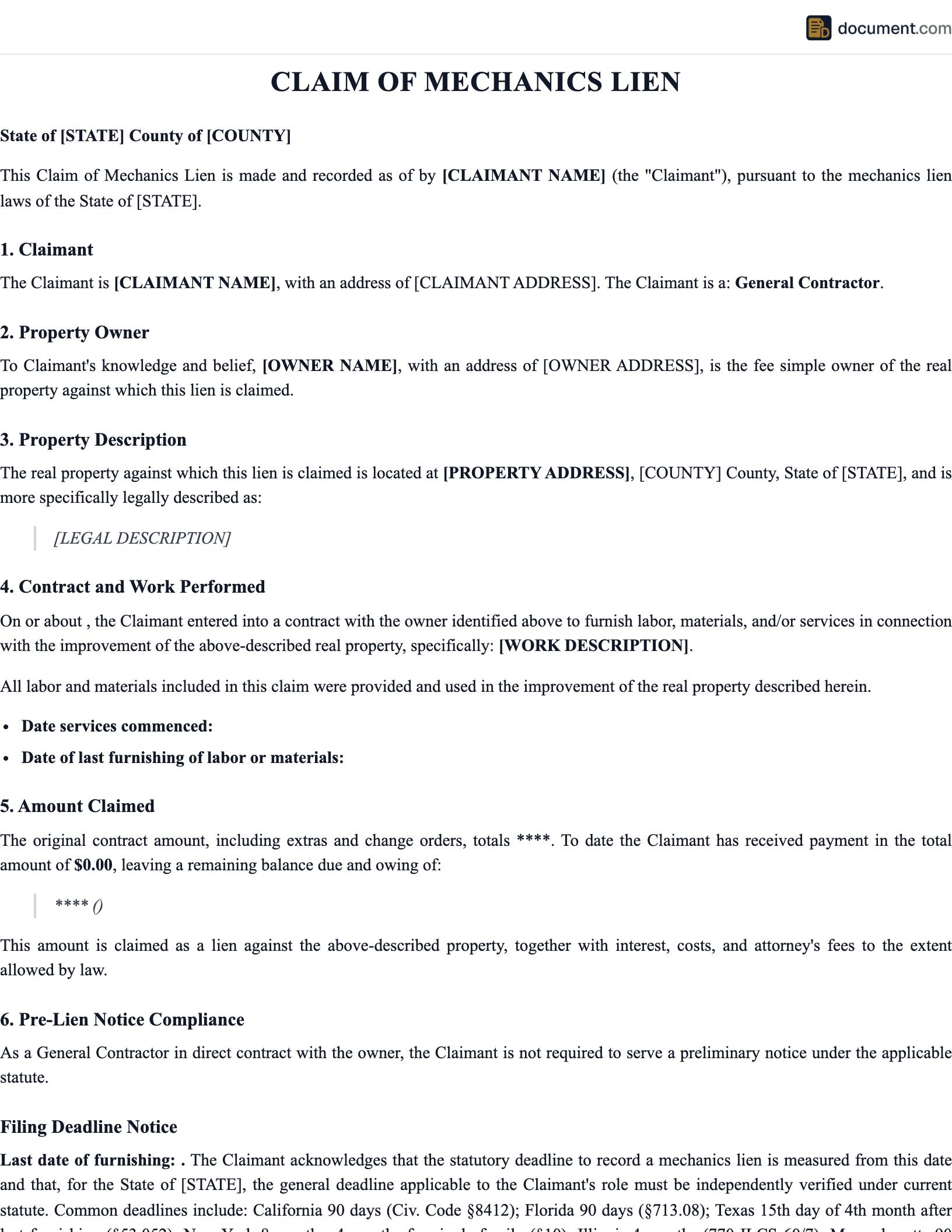
Sample Mechanic's Lien
Below is a condensed preview of our mechanic's lien template. Your completed document will be customized for your state's statutory requirements.
CLAIM OF MECHANIC'S LIEN
NOTICE IS HEREBY GIVEN that the undersigned,[Claimant Name], whose address is [Address], claims a lien upon the real property described below for labor, services, and/or materials furnished for the improvement of said property.
1. PROPERTY OWNER
The name of the owner or reputed owner of the property is[Owner Name].
2. PROPERTY DESCRIPTION
The property subject to this lien is located at[Property Address]and is legally described as: [Legal Description].
3. AMOUNT OF LIEN
The amount of this lien claim, after deducting all just credits and offsets, is $[Amount].
4. WORK PERFORMED
The claimant furnished the following labor, services, and/or materials:[Description of Work]. The first date of furnishing was [Date]and the last date of furnishing was [Date].
VERIFICATION: I declare under penalty of perjury that the foregoing is true and correct to the best of my knowledge and belief.
Frequently Asked Questions
Find answers to common questions about mechanic's liens, filing deadlines, preliminary notices, bond claims, and lien priority.
Official Resources
For additional information on mechanic's lien laws, construction payment rights, and bonding requirements, consult these reputable resources.
Levelset - Lien Law Guide
Comprehensive state-by-state mechanic's lien law guides and deadline calculators
Miller Act (40 U.S.C. 3131-3134)
Federal bonding requirements for public construction projects
AGC - Associated General Contractors
Industry resources for contractors, construction law, and payment best practices
Nolo - Mechanic's Lien Encyclopedia
Free legal information on filing, enforcing, and removing mechanic's liens
ABC - Associated Builders and Contractors
Construction industry resources, education, and advocacy for merit-shop contractors
SFAA - Surety & Fidelity Association
Information on payment bonds, performance bonds, and surety bond claims
Create your Mechanics Lien in under 10 minutes.
Answer a few questions and download a compliant, attorney-drafted document ready for your state.