



What Is a Subcontractor Agreement?
A subcontractor agreement is the contract between a prime contractor (sometimes called the general contractor or upper-tier contractor) and a lower-tier business that will perform a portion of the work the prime has promised to deliver to its own customer. In construction, the prime holds the contract with the property owner and hires electrical, plumbing, mechanical, framing, and finish trades as subs. In federal services, a prime contractor with a Department of Defense award might hire specialized subcontractors for cleared engineering, software, or logistics work. The same structure shows up in IT staffing, freight, and consulting.
The subcontract serves two essential purposes. First, it allocates risk: it spells out who is responsible if the work is late, defective, or causes injury, and it requires the sub to carry insurance and indemnify the prime for claims arising out of the sub's operations. Second, it flows the prime's obligations downward — every duty the prime owes to the owner (schedule, quality, safety, payment timing, change-order procedures, dispute resolution) is mirrored in the subcontract so the prime is not stuck with obligations it cannot enforce against the people actually doing the work.
Subcontractor agreements are legally distinct from employment contracts. The relationship is business-to-business, not employer-to-employee, which means the sub controls how the work is performed, supplies its own labor and tools, carries its own workers' comp, and is responsible for its own taxes. Misclassifying an employee as a subcontractor is one of the most expensive mistakes a contractor can make — back taxes, unpaid overtime, penalties, and class-action exposure can dwarf the cost of any project. The IRS, the Department of Labor, and most state labor agencies all scrutinize the classification, and a clearly drafted subcontract is the first line of defense.
Construction subcontracts are also where mechanic's lien risk gets allocated. Every state grants subcontractors and material suppliers a statutory lien against the project property if they are not paid. The prime contractor and the owner can find themselves paying twice — once to the prime, and again to discharge the lien — if the prime fails to use lien waivers and prompt payment to the lower tiers. A well-drafted subcontract requires the sub to deliver conditional progress lien waivers before each payment and final unconditional waivers at closeout.
Whether you are a general contractor managing thirty trades on a hospital project, a federal prime flowing FAR clauses to a software sub, or a small remodeler hiring a single electrician, our attorney-reviewed subcontract templates give you a starting point that handles scope, schedule, payment, change orders, indemnity, insurance, lien waivers, termination, and dispute resolution in language that has held up in real construction litigation.
Risk Allocation
Indemnity, insurance, and warranty obligations move risk to the sub doing the work
Payment Control
Pay-when-paid timing, retainage, and lien waiver requirements protect cash flow
IRS Classification
Documents independence and supports 1099 treatment in any audit
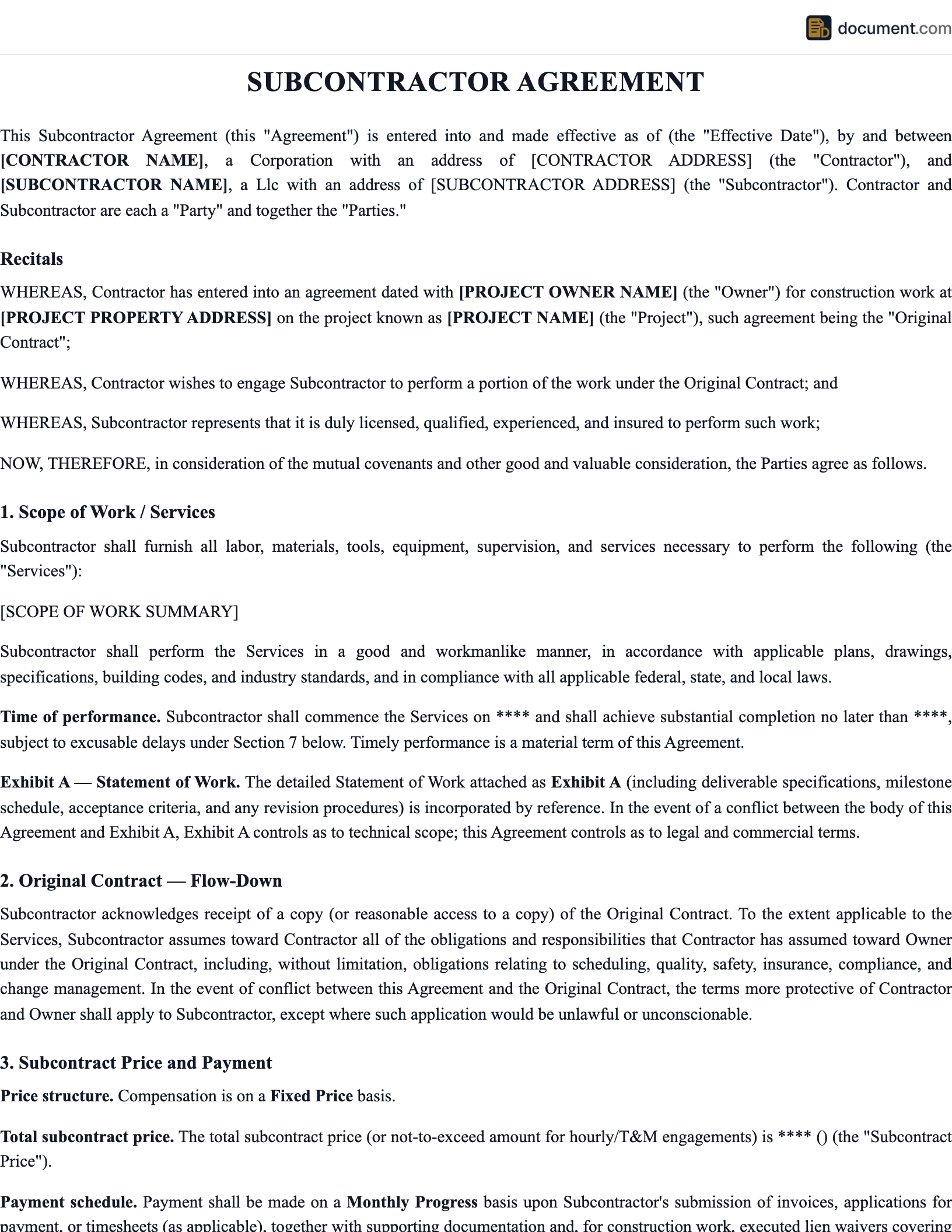
Subcontract Form Preview
A walkthrough of the sections in our standard subcontract template. The completed document is fully customized to the project, the trade, and your prime contract requirements.
Subcontract Agreement
Construction / Trade Services
Section 1: Parties
Section 2: Scope of Work
Section 3: Price & Payment
Section 4: Insurance Required
Types of Subcontractor Agreements
The right template depends on your industry, the federal or commercial nature of the prime contract, and whether you need a master agreement that governs many projects or a single short-form contract.
Construction Subcontract
Trade contractor agreement for general contractors hiring electrical, plumbing, framing, or finish trades
Cleaning
Subcontract for cleaning services defining scope, schedule, and payment for janitorial and facility work
Concrete
Subcontract for pouring, forming, and finishing concrete on foundations, slabs, and driveways
Hipaa
HIPAA-compliant subcontract for vendors handling protected health information on behalf of a covered entity
It
IT subcontract for outsourced technology work including systems support, networking, and infrastructure services
Painting
Subcontract for interior and exterior painting covering prep work, materials, labor, and finish specifications
Plumbing
Plumbing subcontract covering rough-in, fixtures, water heaters, and inspection sign-off on construction jobs
Roofing
Roofing subcontract covering tear-off, underlayment, shingles or membrane, flashing, and warranty terms
Security
Subcontract for security services including on-site guards, patrols, alarm monitoring, and event coverage
Software Development
Subcontract for custom software development including scope, deliverables, IP ownership, and acceptance terms
Solar Panel
Subcontract for solar panel installation covering site assessment, mounting, wiring, and utility interconnection
Truck Driver
Owner-operator trucking subcontract for independent drivers hauling freight on behalf of a carrier
Subcontract vs Other Construction Documents
A subcontract sits between several closely related documents. Knowing the difference prevents you from using the wrong form for the wrong situation.
Subcontract vs Independent Contractor Agreement
Subcontract
- - Used between two contractors on a third-party project
- - Tied to a prime contract with an owner
- - Includes lien waivers, retainage, flowdown
- - Trade-licensed business as the contracting party
Independent Contractor Agreement
- - Used directly between a business and a service provider
- - Stands alone, no upstream prime contract
- - Focuses on deliverables, IP, and 1099 treatment
- - Often a freelancer, consultant, or specialist
Subcontract vs Prime Construction Contract
Subcontract
- - Between prime and trade sub
- - Flows down owner contract terms
- - Pay-when-paid is common
- - Smaller scope, single trade
Prime Contract
- - Between owner and general contractor
- - Defines the master scope, schedule, and price
- - Owner pays prime per AIA G702/G703 cycle
- - Covers entire project
Subcontract vs Purchase Order
Subcontract
- - Labor + materials installed on site
- - Lien rights apply
- - Performance and warranty obligations
- - Long-form agreement
Purchase Order
- - Materials only, delivered to site
- - Governed by UCC Article 2
- - Supplier lien rights vary by state
- - Short-form, often standard terms on the back
How to Create a Subcontractor Agreement: 9 Steps
Drafting a subcontract is a process of working from the prime contract down. These nine steps walk you through the order in which experienced contractors build their templates.
Pre-Qualify the Subcontractor
Verify the sub holds an active state contractor license, has the trade certifications you need, carries the required insurance limits, has bonding capacity if applicable, and has no recent OSHA citations or unpaid wage claims. Pull a D&B or Experian report and call two references on similar projects. The subcontract is only as strong as the company standing behind it.
Define the Scope of Work in Writing
Reference the specific drawings, specification sections, addenda, and revision dates that define the sub's work. List inclusions and exclusions explicitly — this is where most disputes originate. Attach an itemized schedule of values that ties to the lump sum price for progress billing.
Set the Schedule and Liquidated Damages
Tie the sub's milestones to the prime CPM schedule and require coordination through the prime's superintendent. If the prime contract carries owner liquidated damages, flow them down to the sub on a pro-rata basis for delays caused by the sub. Include a 'no damages for delay' clause if your state allows it.
Set Payment Terms and Retainage
Decide whether you want pay-when-paid or pay-if-paid (subject to state enforceability). Set retainage at 5% to 10% and specify the conditions for retainage release. Build in lien waiver delivery as a condition of every payment, using the statutory forms for your state.
Draft Indemnification and Insurance Requirements
Use a 'comparative fault' indemnity to comply with state anti-indemnity statutes. Require CGL, auto, workers' comp, employer's liability, and excess limits appropriate to the project. Mandate additional insured status, primary and non-contributory wording, and waiver of subrogation. Require certificates and ISO endorsements before mobilization.
Address Change Orders
Specify the procedure for written change orders, the time within which the sub must give notice of changes, and the formula for pricing time and material work. The biggest source of subcontract disputes is unauthorized change-order claims at the end of the project.
Add Safety and Quality Provisions
Require compliance with the prime's site safety plan, OSHA, and any project-specific safety requirements. Include the right to back-charge for cleanup, daily reporting requirements, and quality acceptance procedures. For federal projects, add the FAR safety flowdown clauses.
Include Termination and Default Remedies
Specify termination for cause (with notice and cure), termination for convenience (with payment for work performed), and the prime's right to take over and complete the work using a replacement sub on a back-charge basis. Clearly state the surviving obligations after termination — lien waivers, warranties, indemnity, audit.
Execute, File, and Track
Have both parties sign before the sub mobilizes — never let work start on a verbal handshake. Collect insurance certificates, lien waiver forms, W-9s, and licensing documents. Store the executed contract and all related project records for at least 10 years from substantial completion.
Key Components of a Subcontract
These are the elements that should appear in any complete subcontract. Missing components are where disputes find their leverage.
| Component | Description |
|---|---|
| Parties and Project Identification | Legal names, license numbers, project address, prime contract reference |
| Scope of Work | Specific drawings, specs, inclusions, and exclusions defining the sub's deliverables |
| Schedule and Milestones | Start date, milestone dates, completion date, and coordination obligations |
| Contract Price | Lump sum, unit pricing, time-and-materials rates, or guaranteed maximum price |
| Schedule of Values | Itemized breakdown supporting progress billing |
| Payment Terms and Retainage | Pay-when-paid or pay-if-paid, retainage percentage, retainage release |
| Lien Waiver Requirements | Conditional progress and final unconditional waivers in statutory form |
| Change Order Procedures | Written notice, pricing methodology, and time-impact analysis |
| Insurance Requirements | CGL, auto, workers' comp, umbrella, additional insured endorsements |
| Indemnification | Comparative-fault indemnity for third-party claims arising out of sub's work |
| Warranty | One-year general warranty plus longer warranties on specific equipment |
| Safety and Compliance | OSHA, site safety plan, drug testing, and trade-specific certifications |
| Quality Standards | Workmanship requirements, inspection rights, and acceptance criteria |
| Termination | Termination for cause, termination for convenience, and post-termination obligations |
| Dispute Resolution | Mediation, arbitration, or litigation; venue and governing law |
| Flowdown Clauses | FAR clauses, owner contract terms, and prime contract incorporation |
| Independent Contractor Status | Express acknowledgment of independent contractor relationship for tax purposes |
Legal Requirements and Compliance
Subcontracts are subject to a thicker layer of regulation than most business contracts: state licensing, mechanic's lien statutes, prompt payment laws, federal acquisition rules, OSHA multi-employer worksite doctrine, and the IRS classification framework all bear on the agreement.
Federal Acquisition Regulation (FAR)
Federal prime contractors must flow down specific FAR clauses to subcontractors at all tiers. Common mandatory flowdowns include FAR 52.222-26 (equal opportunity), 52.222-35 (veterans), 52.222-36 (workers with disabilities), 52.222-50 (combating trafficking in persons), 52.219-8 (small business), and 52.244-6 (subcontracts for commercial items). Failure to flow down can void the sub's eligibility and expose the prime to enforcement.
State Anti-Indemnity Statutes
More than 40 states have construction anti-indemnity statutes that prohibit a subcontractor from indemnifying a prime contractor or owner for the prime's or owner's own negligence. The exact reach varies — some states bar only sole-negligence indemnities, others bar partial-fault indemnities. California, Texas, New York, and Illinois have particularly strict regimes. Use a comparative-fault indemnity calibrated to your state.
Prompt Payment Laws
Most states have prompt payment laws governing public construction projects (and some apply to private projects). They typically require the prime to pay the sub within 7 to 14 days of receiving payment from the owner, with statutory interest on late payments. The federal Prompt Payment Act imposes similar deadlines on federal projects. Your subcontract should expressly comply with the applicable statute and not attempt to override it.
Worker Misclassification Risk
The IRS, the U.S. Department of Labor, state labor agencies, and unemployment insurance regulators all enforce worker classification independently. Misclassification can result in back payroll taxes, unpaid overtime, workers' comp penalties, and class actions. California's AB 5 and the federal Department of Labor's economic reality test are the strictest current standards. Document independence carefully in every subcontract.
OSHA Multi-Employer Worksite Doctrine
- Controlling employer: A prime contractor that controls the worksite can be cited for hazards created by a sub, even if its own workers are not exposed.
- Creating employer: A sub that creates a hazard can be cited for that hazard regardless of whether its own employees are exposed.
- Exposing employer: Any sub whose employees are exposed to a hazard can be cited.
- Correcting employer: The sub responsible for site safety is liable for failing to correct hazards even when caused by others.
Sample Subcontractor Agreement
Condensed preview of a standard construction subcontract.
SUBCONTRACTOR AGREEMENT
Construction Services
This Subcontract Agreement is made between[Prime Contractor]("Contractor") and[Subcontractor]("Subcontractor") for work on the project located at[Project Address]("Project").
1. SCOPE OF WORK
Subcontractor shall furnish all labor, materials, tools, equipment, and supervision necessary to complete [Trade Description]in accordance with the drawings, specifications, and addenda incorporated by reference.
2. CONTRACT PRICE
Contractor shall pay Subcontractor a lump sum of $[Amount]subject to retainage of [%]per progress billing.
3. PAYMENT
Contractor shall pay Subcontractor within 7 days after Contractor receives payment from Owner for the same work. Each progress payment is conditioned on Subcontractor's delivery of a conditional lien waiver in the form required by state law.
4. INDEMNIFICATION
To the fullest extent permitted by law, Subcontractor shall defend, indemnify, and hold harmless Contractor and Owner from claims arising out of or resulting from the negligent acts or omissions of Subcontractor, its agents, or its lower-tier subcontractors, but only to the extent caused by such negligent acts or omissions.
5. INSURANCE
Subcontractor shall maintain CGL of $1,000,000 per occurrence and $2,000,000 aggregate, auto liability of $1,000,000, workers' compensation as required by law, and shall name Contractor as additional insured on a primary and non-contributory basis.
6. INDEPENDENT CONTRACTOR
Subcontractor is an independent contractor and not an employee or agent of Contractor. Subcontractor controls the manner and means of performing the Work and is solely responsible for payment of all taxes, workers' compensation, and benefits for its workers.
Frequently Asked Questions
Common questions about subcontracts, payment, classification, and risk allocation.
Official Resources
Authoritative sources on subcontract law, federal acquisition rules, and worker classification.
Federal Acquisition Regulation
Official text of the FAR including all subcontract flowdown clauses
IRS - Worker Classification
Federal guidance on independent contractor vs employee determination
DOL - Misclassification
Department of Labor economic reality test for FLSA classification
OSHA Multi-Employer Doctrine
Official OSHA citation policy for multi-employer construction sites
SBA Federal Contracting
Small Business Administration resources for prime and subcontractors
AIA Contract Documents
American Institute of Architects standard subcontract forms (A401, etc.)
ConsensusDocs
Industry-balanced standard construction contracts including subcontracts
Associated General Contractors
Trade association resources on prime/sub relationships and risk management
Create your Subcontractor Agreement in under 10 minutes.
Answer a few questions and download a compliant, attorney-drafted document ready for your state.