



What Is a Painting Subcontractor Agreement?
A painting subcontractor agreement is a construction contract between a general contractor (or property owner) and a professional painting subcontractor who will perform surface preparation, priming, painting, staining, and/or specialty coating applications on a building project. Painting is classified as a finishing trade in the construction sequence, meaning it typically occurs after framing, drywall, millwork, plumbing, and electrical rough-ins are substantially complete. This late-stage positioning makes painting uniquely vulnerable to schedule compression — when earlier trades run behind, the painting schedule gets squeezed, but the completion date rarely moves. A clear agreement that addresses schedule dependencies, access to completed surfaces, and protection of the painter's finished work from trailing trades is essential to preventing the disputes that frequently arise in painting subcontracting.
What makes painting subcontracting distinct from other construction trades is the combination of technical precision and subjective aesthetics. The technical requirements are significant — surface preparation accounts for 80% of coating longevity, product selection must match the substrate and environmental exposure, and application conditions (temperature, humidity, dew point) directly affect adhesion and cure. But painting is also the most visible trade on any project, and quality disputes often come down to subjective judgments about finish smoothness, color consistency, cut-in lines, and sheen uniformity. The agreement must bridge this gap between measurable technical standards (dry film thickness, adhesion testing, mil gauge readings) and visual quality expectations (the "ten-foot rule," natural lighting inspection, final walk-through protocols).
Regulatory compliance adds another layer of complexity to painting subcontracting. The EPA's Renovation, Repair, and Painting (RRP) Rule requires certified firms and trained workers for any painting that disturbs lead-based paint in pre-1978 buildings — violations carry penalties up to $37,500 per day. OSHA regulations govern fall protection for work above 6 feet (scaffolding, ladders, aerial lifts), respiratory protection for spray application and solvent exposure, and hazard communication for paint chemicals. VOC (volatile organic compound) regulations vary by state and air quality district, limiting the types of coatings that can be used in certain areas. A thorough painting subcontractor agreement addresses these regulatory requirements alongside the commercial terms of the relationship.
Surface Preparation
Defines prep standards by surface type — the foundation of coating performance.
Product Specifications
Specifies exact products, sheens, colors, and number of coats for each surface.
Lead Paint Compliance
Addresses EPA RRP Rule certification, lead-safe work practices, and documentation.
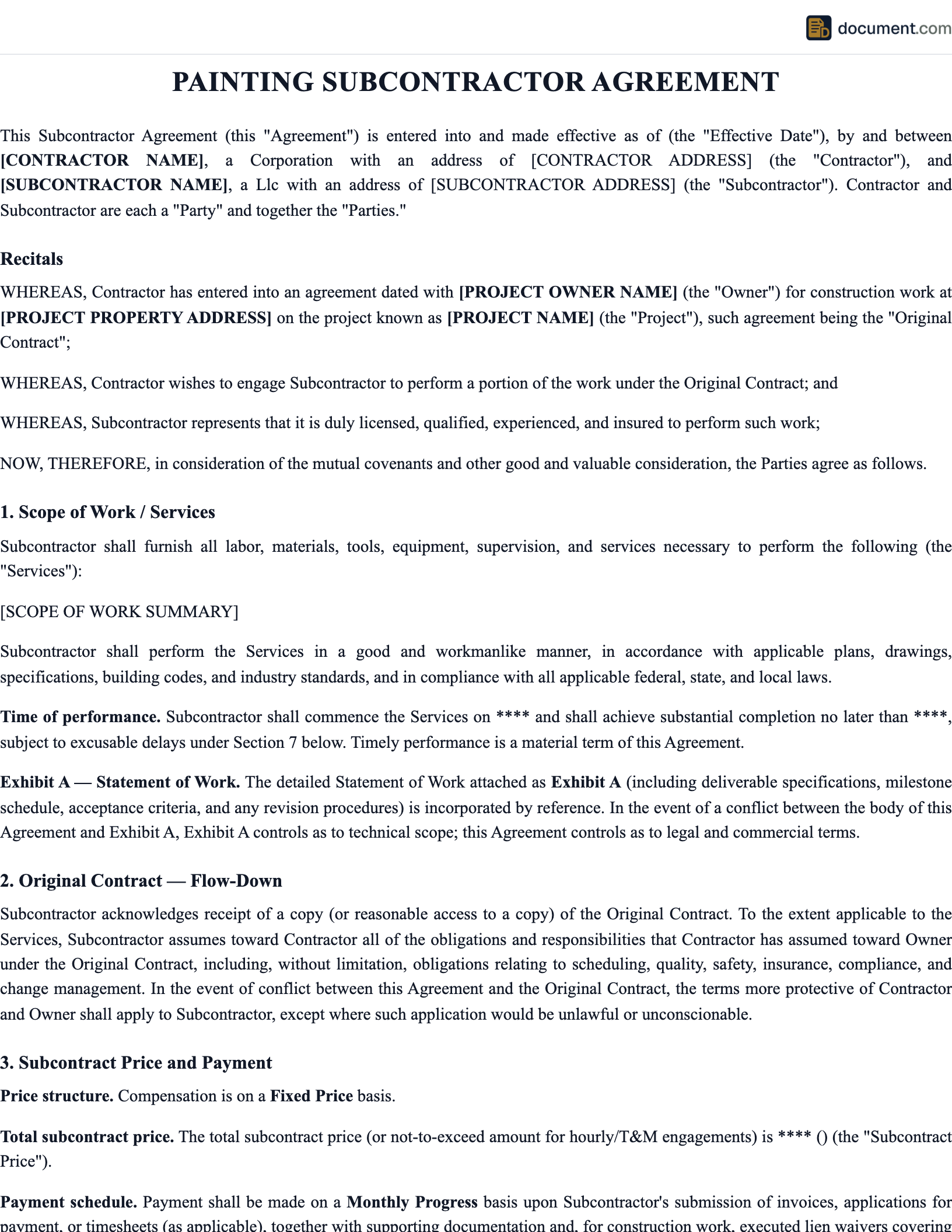
Painting Subcontractor Agreement Form Preview
Painting Subcontractor Agreement
Interior and Exterior Painting Services
1. PARTIES AND PROJECT
This Agreement is entered into between ("General Contractor") and ("Painting Subcontractor"), License # , for painting services at .
2. SCOPE OF PAINTING WORK
Subcontractor shall furnish all labor, materials, and equipment necessary to complete the painting scope described in the Paint Schedule (Exhibit A), including surface preparation, priming, and application of coats of finish paint per the specifications.
3. LEAD PAINT COMPLIANCE
For structures built before 1978, Subcontractor shall comply with EPA RRP Rule (40 CFR Part 745) and maintain current firm certification and certified renovator credentials.
GENERAL CONTRACTOR
SUBCONTRACTOR
Key Components
A comprehensive painting subcontractor agreement covers these essential elements to manage both technical quality and commercial terms:
| Component | Purpose | Key Details |
|---|---|---|
| Paint Schedule | Specifies products for each surface | Manufacturer, product line, sheen, color code, number of coats, primer, application method |
| Surface Preparation | Defines prep standards by substrate | Drywall finish level, sanding, filling, caulking, power washing, rust removal, lead testing |
| Lead Paint Compliance | Ensures EPA RRP Rule adherence | Firm certification, renovator credentials, containment, lead-safe practices, waste disposal |
| Surface Protection | Prevents damage to adjacent finishes | Drop cloths, masking, hardware removal, fixture covering, overspray containment |
| Quality Standards | Bridges technical and visual quality | Inspection protocols, lighting conditions, DFT measurements, touch-up procedures, punch list process |
| Weather Requirements | Sets conditions for exterior work | Temperature range, humidity limits, wind speed, rain forecast, dew point, surface temperature |
| Payment Terms | Structures compensation | Per-SF pricing, lump sum, progress payments, retainage, extras pricing, final payment trigger |
| Warranty | Defines post-completion obligations | Workmanship period, product warranty, exclusions for damage by others, touch-up obligations |
How to Create a Painting Subcontractor Agreement
Prepare the Paint Schedule
Create a comprehensive paint schedule listing every surface to be painted: walls (by room or area), ceilings, trim/baseboards, doors (faces and edges), door frames, window sash and trim, cabinets, exterior siding, fascia, soffits, shutters, railings, and any specialty surfaces. For each surface, specify the exact product (manufacturer and product name), sheen, color code, number of coats (primer plus finish), and application method. This schedule becomes Exhibit A to the agreement.
Define Surface Preparation Standards
Specify prep requirements for each surface type: new drywall finish level and sanding protocol, existing surface cleaning and deglossing, wood filling and sanding grits, metal surface preparation grade (SSPC standard), caulking specifications (product and joint sizes), and lead paint testing protocol for pre-1978 buildings. Clearly state whether the painting subcontractor is responsible for surface preparation or whether preceding trades (drywall finisher, carpenter) must deliver surfaces in a paint-ready condition.
Address Lead Paint and Environmental Compliance
For pre-1978 structures, require EPA RRP Rule compliance: firm certification documentation, certified renovator credentials, lead testing results, containment plans, prohibited practices acknowledgment, cleaning verification procedures, and waste disposal documentation. For all projects, address VOC compliance with applicable state and local air quality regulations, and OSHA requirements for respiratory protection during spray application and solvent use.
Establish Quality and Inspection Procedures
Define the quality inspection process: who inspects (GC superintendent, project manager, owner's representative), inspection timing (after primer, after first coat, final inspection under natural lighting), the deficiency reporting process, touch-up and repair expectations, and the punch list procedure. Specify that final inspection occurs under appropriate lighting conditions — painted surfaces can look very different under construction work lights versus natural light.
Set Protection and Cleanup Standards
Require the subcontractor to protect all adjacent surfaces (floors, countertops, fixtures, hardware, windows, landscaping) from paint, primer, overspray, and solvent damage. Specify drop cloth and masking requirements, hardware removal expectations (vs. masking in place), and the daily and final cleanup scope. Define the subcontractor's liability for damage to unprotected or inadequately protected surfaces and the repair process.
Finalize Payment, Insurance, and Warranty Terms
Structure payment (per-SF, per-room, or lump sum), define progress billing milestones, set retainage terms, and specify the trigger for final payment release (typically completion of the punch list walk-through). Require certificates of insurance with appropriate coverage limits. Define the warranty period and clearly distinguish workmanship defects (painter's responsibility) from product defects (manufacturer's warranty) and damage caused by other trades or the owner.
Frequently Asked Questions
Official Resources
Authoritative resources on painting standards, lead paint compliance, safety, and industry best practices.
EPA RRP Rule - Lead Paint Renovation
Federal requirements for lead-safe work practices, firm certification, and renovator training.
Master Painters Institute (MPI)
Paint specification standards, approved product lists, and surface preparation guidelines used in commercial projects.
OSHA - Painting Safety
Federal safety standards for painting operations including fall protection, respiratory protection, and chemical exposure.
Painting and Decorating Contractors of America
Industry association providing standards, training, and estimating resources for painting contractors.
SSPC - The Society for Protective Coatings
Surface preparation standards (SP series), coating inspection protocols, and industrial painting certifications.
IRS - Independent Contractor vs Employee
IRS worker classification guidance relevant to painting subcontractor relationships.
Create Your Painting Subcontractor Agreement
Define surface prep standards, paint specifications, lead compliance, and payment terms in a professional painting subcontractor agreement.
Create DocumentNo account required. Free to create and preview.