



What Is a Construction Subcontractor Agreement?
A construction subcontractor agreement is the foundational contract governing the relationship between a general contractor and a specialty trade contractor on a building project. In the United States, the vast majority of construction work is performed by subcontractors — on a typical commercial project, 80-90% of the contract value flows through subcontractors who each handle their licensed trade: electrical, plumbing, mechanical/HVAC, structural steel, concrete, framing, roofing, drywall, painting, flooring, fire protection, and dozens of other specialties. The general contractor serves as the project orchestrator — managing the schedule, coordinating between trades, interfacing with the owner and architect, and ensuring that each subcontractor's work meets the project specifications.
The subcontractor agreement sits between two other key contracts in the project hierarchy. Above it is the prime contract between the GC and the project owner, which defines the overall project scope, budget, schedule, and terms. Below it are purchase orders and sub-subcontractor agreements that the subcontractor may issue for materials and further specialized work. The subcontractor agreement must harmonize with the prime contract through flow-down provisions while also addressing the specific trade scope, pricing, and coordination requirements unique to each subcontractor's work. This three-tier contractual structure creates complex legal relationships — a subcontractor may have obligations to the GC under the subcontract, exposure to the owner through flow-down clauses, and liability to their own sub-subcontractors and suppliers.
The financial stakes in construction subcontracting are enormous. The U.S. construction industry generates over $2 trillion annually, and payment disputes are the industry's most persistent problem — the Construction Financial Management Association estimates that contractors write off 2-3% of revenue to bad debt each year. Mechanics' lien rights, payment bond claims, prompt payment act protections, and retainage regulations all exist because the industry has historically struggled with payment flow. A well-drafted subcontractor agreement addresses these payment risks head-on while also managing the operational complexities of coordinating multiple trades on a shared jobsite.
Scope Control
Defines trade scope, exclusions, change orders, and coordination with other trades.
Payment Security
Addresses progress billing, retainage, lien waivers, and payment bond protections.
Risk Allocation
Covers insurance, indemnification, OSHA compliance, and warranty obligations.
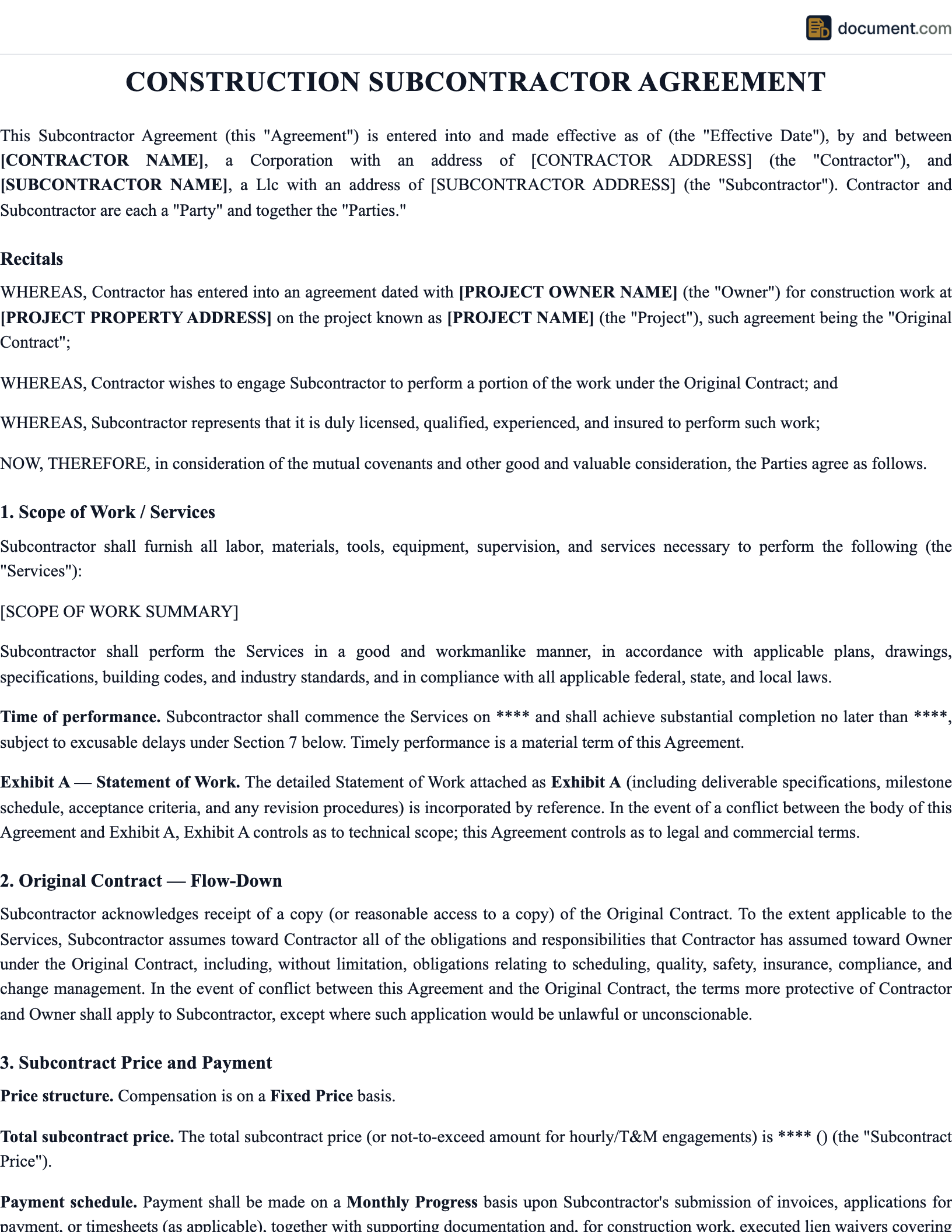
Construction Subcontractor Agreement Form Preview
Construction Subcontractor Agreement
Trade Subcontract for Construction Services
1. PARTIES AND PROJECT
This Agreement is entered into between ("General Contractor") and ("Subcontractor"), License # , for the project known as located at .
2. SCOPE OF WORK
Subcontractor shall furnish all labor, materials, equipment, and supervision necessary to complete the work described in Exhibit A, in strict accordance with the Contract Documents.
3. CONTRACT SUM
General Contractor shall pay Subcontractor the sum of $ for the complete scope of work, subject to adjustments by approved Change Orders.
GENERAL CONTRACTOR
SUBCONTRACTOR
Key Components
A well-structured construction subcontractor agreement addresses these critical areas governing the GC-subcontractor relationship:
| Component | Purpose | Key Details |
|---|---|---|
| Scope of Work | Defines the trade scope in detail | Inclusions, exclusions, reference drawings, spec sections, coordination scope, general conditions items |
| Contract Price | Establishes compensation | Lump sum, unit prices, T&M rates, allowances, alternates, schedule of values |
| Payment Terms | Governs payment flow | Progress billing, retainage (5-10%), pay-when-paid, lien waivers, back-charges |
| Schedule | Coordinates timing | Start/finish dates, milestone deadlines, delay notifications, liquidated damages, float ownership |
| Change Orders | Manages scope modifications | Written process, markup percentages, pricing deadlines, constructive changes, time extensions |
| Insurance | Allocates risk through coverage | CGL, completed ops, workers' comp, auto, umbrella, additional insured, waiver of subrogation |
| Indemnification | Allocates legal liability | Mutual vs one-way, limited to subcontractor negligence, anti-indemnity statute compliance |
| Dispute Resolution | Provides conflict resolution path | Negotiation, mediation, arbitration or litigation, venue, continuation of work during disputes |
How to Create a Construction Subcontractor Agreement
Define the Trade Scope
Review the project plans, specifications, and bid documents to prepare a comprehensive scope of work that clearly delineates what is included and excluded from the subcontractor's scope. Reference specific drawing sheets, specification sections, and addenda. Address general conditions items (cleanup, temporary protection, hoisting, dumpster use) and coordination responsibilities with adjacent trades. A well-defined scope prevents the most common subcontractor disputes — scope gaps and overlaps between trades.
Establish Contract Price and Payment Terms
Structure the contract price (lump sum, unit prices, or T&M with a GMP), prepare a schedule of values for progress billing, set retainage terms (typically 5-10%, reduced to 5% after 50% completion), define the pay application process and payment timeline, and specify lien waiver exchange requirements. Address pay-when-paid provisions and ensure compliance with the state's prompt payment act — most states require payment within 7-30 days of receipt of a proper pay application.
Incorporate Schedule and Coordination Requirements
Define the subcontractor's schedule milestones tied to the CPM project schedule, establish advance notice requirements for mobilization, specify coordination meeting attendance obligations, address the process for schedule changes and re-sequencing, and include delay notification requirements (most agreements require written notice within 48-72 hours of any delay event). Define whether schedule float belongs to the project or the subcontractor.
Set Insurance and Indemnification Requirements
Specify insurance types and minimum limits, require certificates of insurance with additional insured endorsements before work begins, address waiver of subrogation requirements, and draft indemnification provisions that comply with the state's anti-indemnity statute (many states prohibit broad-form indemnification that requires a subcontractor to indemnify the GC for the GC's own negligence). Review the prime contract's insurance requirements to ensure the subcontract flows them down properly.
Draft Change Order and Claims Procedures
Establish a written change order process with clear authorization levels, define markup percentages for changes (direct cost plus overhead and profit), set deadlines for pricing change order work, address constructive change claims, and include a claims preservation clause requiring timely written notice of any claim (typically within 7-21 days of the event giving rise to the claim). Specify that no additional work is authorized without a signed change order.
Finalize Safety, Warranty, and Dispute Resolution
Incorporate the GC's site-specific safety plan by reference, require the subcontractor to designate a competent person, address drug testing and safety training requirements, define the warranty period and its exclusions, establish the tiered dispute resolution process (negotiation, mediation, then arbitration or litigation), and specify the governing law and venue. Include a termination clause covering both convenience and cause, with clear procedures for each.
Frequently Asked Questions
Official Resources
Authoritative resources on construction subcontracting law, safety, and industry standards.
Associated General Contractors of America
Industry resources on subcontracting, standard contract forms (ConsensusDocs), and construction law.
AIA A401 - Standard Subcontractor Agreement
The most widely used standard form subcontractor agreement in the U.S. construction industry.
OSHA Construction Industry Standards
Federal safety regulations (29 CFR 1926) governing all construction work, including multi-employer citations.
IRS - Independent Contractor vs Employee
IRS worker classification guidance relevant to construction subcontractor relationships.
ConsensusDocs Standard Construction Contracts
Coalition-drafted standard construction contracts including the ConsensusDocs 750 subcontractor agreement.
DOL - Davis-Bacon and Related Acts
Prevailing wage requirements for federally funded construction projects affecting subcontractor labor costs.
Create Your Construction Subcontractor Agreement
Define scope, payment terms, insurance requirements, and lien protections in a professional construction subcontractor agreement.
Create DocumentNo account required. Free to create and preview.