



What Is a Concrete Subcontractor Agreement?
A concrete subcontractor agreement is a construction contract between a general contractor (or project owner acting as their own GC) and a concrete subcontractor who will perform specific concrete operations on a construction project. Concrete work is one of the most technically demanding and schedule-critical trades in construction — once a ready-mix truck arrives on site, the clock starts ticking. The concrete must be placed, consolidated, screeded, and finished within a narrow window that varies by mix design, temperature, humidity, and wind conditions. This time pressure, combined with the permanence of concrete (you cannot easily undo a bad pour), makes a detailed written agreement essential for both parties.
The agreement defines the full scope of concrete operations — which may include excavation and grade preparation, formwork construction, reinforcement (rebar and wire mesh) placement, embedded item installation (anchor bolts, sleeves, waterstops), concrete ordering and placement, vibration and consolidation, finishing (broom, trowel, exposed aggregate, stamped, or polished), curing compound application or wet curing, joint cutting, and form stripping. On larger commercial projects, the concrete subcontractor may also be responsible for concrete pumping, post-tensioning, or tilt-up panel fabrication. The agreement specifies which of these activities fall within the subcontractor's scope and which are handled by others.
From a legal and financial standpoint, concrete subcontracting involves significant exposure for both parties. The subcontractor invests heavily in labor, equipment, and materials — a single commercial pour can involve $50,000 or more in ready-mix concrete alone. If the general contractor does not pay, the subcontractor has mechanics' lien rights but must follow state-specific preliminary notice and filing deadlines precisely or lose those rights. Conversely, the general contractor bears risk if the subcontractor's work fails testing, does not meet structural specifications, or causes schedule delays that trigger liquidated damages from the project owner. A thorough agreement allocates these risks clearly and provides dispute resolution mechanisms before problems arise.
Mix Design Control
Specifies PSI, slump, air content, and admixture requirements for each application.
Lien Protection
Addresses preliminary notices, lien waivers, and payment security for materials.
Testing & QC
Covers cylinder testing, slump checks, and inspection protocols per ACI standards.
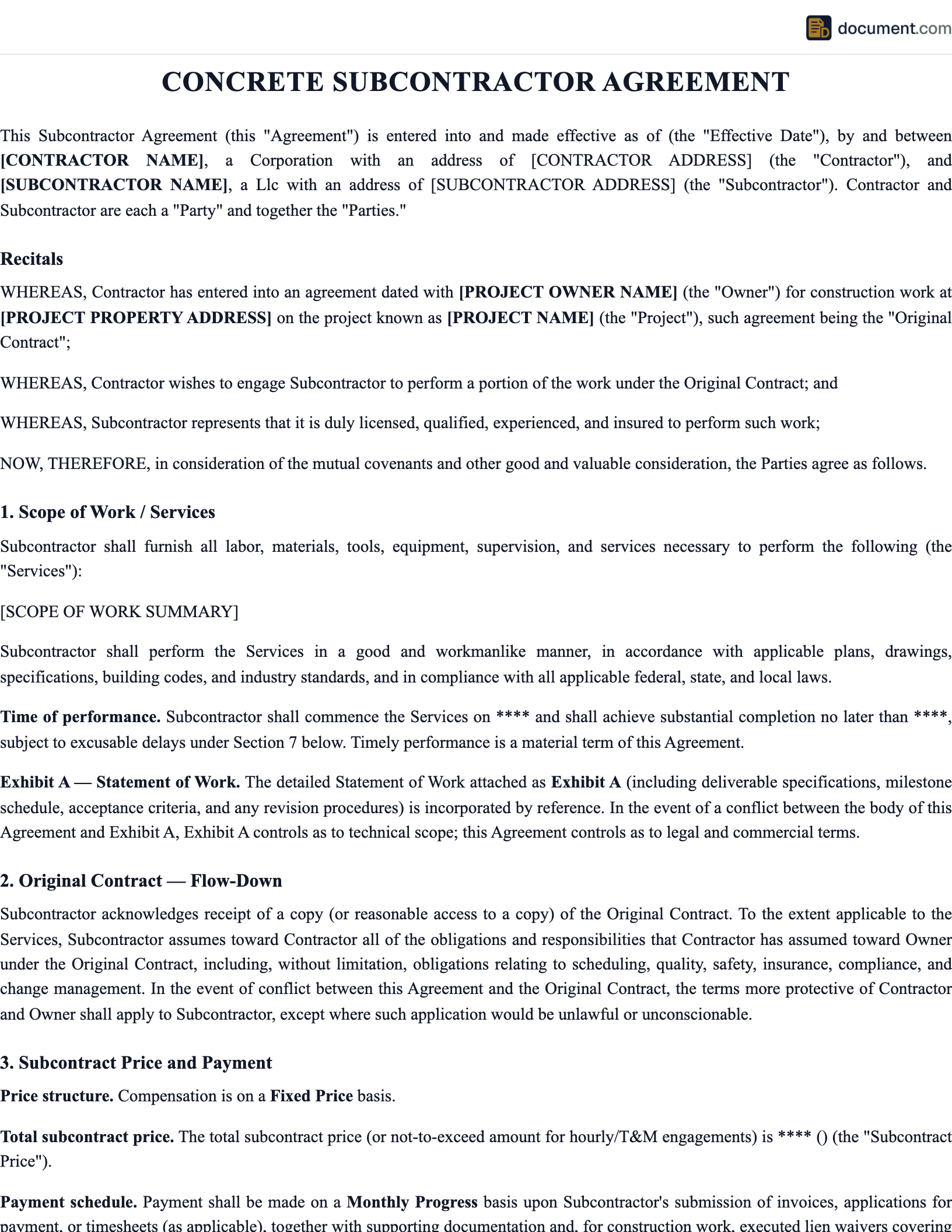
Concrete Subcontractor Agreement Form Preview
Concrete Subcontractor Agreement
Structural and Flatwork Concrete Services
1. PARTIES AND PROJECT
This Agreement is entered into between ("General Contractor") and ("Concrete Subcontractor") for concrete work at ("Project Site").
2. SCOPE OF CONCRETE WORK
Subcontractor shall furnish all labor, equipment, and materials necessary to complete the concrete work described in Exhibit A, including forming, reinforcement placement, concrete placement, finishing, and curing per the project drawings dated .
3. CONCRETE SPECIFICATIONS
All concrete shall meet a minimum compressive strength of PSI at 28 days, with a maximum slump of inches and air entrainment of %.
GENERAL CONTRACTOR
SUBCONTRACTOR
Key Components
A comprehensive concrete subcontractor agreement covers these essential elements to manage the technical, financial, and legal complexities of concrete construction:
| Component | Purpose | Key Details |
|---|---|---|
| Scope of Work | Defines all concrete operations included | Forming, rebar, placement, finishing, curing, joint cutting, form stripping, embedded items |
| Mix Design | Sets technical concrete specifications | PSI requirements, slump, air entrainment, w/c ratio, admixtures, aggregate type, batch plant |
| Pour Schedule | Manages timing-critical operations | Pour sequence, coordination with other trades, weather contingencies, pump truck scheduling |
| Testing & Inspection | Ensures structural compliance | Slump tests, air tests, cylinder breaks at 7/28 days, rebar inspections, special inspections |
| Payment Terms | Structures compensation | Unit prices, progress payments, retainage, lien waivers, back-charge procedures |
| Insurance | Allocates risk and liability | GL, completed operations, workers' comp, auto, umbrella, additional insured requirements |
| Warranty | Defines post-completion obligations | Workmanship warranty period, exclusions for design defects, normal cracking, settlement |
| Change Orders | Manages scope modifications | Written authorization, unit price schedule, standby time costs, time extensions |
How to Create a Concrete Subcontractor Agreement
Define the Concrete Scope
Review the structural and architectural drawings to identify every concrete element — footings, foundation walls, slabs on grade, elevated decks, columns, beams, stairs, retaining walls, flatwork, curbs. For each element, specify whether the subcontractor's scope includes excavation, forming, rebar, placement, finishing, curing, and form stripping, or whether any of these activities are excluded and handled by others.
Specify Mix Designs and Materials
Document the required mix design for each concrete application: minimum compressive strength (PSI), slump range, air entrainment percentage, maximum water-cement ratio, aggregate size, and any required admixtures. Identify the approved ready-mix supplier(s) and specify who orders and pays for the concrete. Include provisions for mix design substitutions and the approval process.
Establish the Pour Schedule and Weather Protocol
Create a preliminary pour sequence that coordinates with other trades (plumbing rough-in before slab pour, structural steel before elevated decks). Define weather parameters for pouring — minimum/maximum temperatures, wind speed limits, rain probability thresholds. Specify who makes the go/no-go decision on weather days, the deadline for canceling ready-mix orders, and who bears the cost of canceled loads.
Set Testing and Inspection Requirements
Specify the testing protocol: number of test cylinders per pour volume, slump and air testing frequency, who hires and pays the testing agency, the process for hold-point inspections (rebar inspection before pour), and the procedure when test results fail — including who pays for core drilling, additional testing, or removal and replacement of deficient concrete.
Structure Payment and Lien Protections
Define the payment basis (lump sum, unit prices per cubic yard/square foot/linear foot, or time and materials), progress billing schedule, retainage percentage and release conditions, lien waiver exchange requirements, and the process for back-charges. Address material payment security — whether joint checks will be issued for ready-mix purchases and whether a payment bond is required.
Address Insurance, Warranty, and Dispute Resolution
Require certificates of insurance with appropriate limits and additional insured endorsements before the subcontractor mobilizes. Define the workmanship warranty period and its exclusions. Establish the dispute resolution process — typically starting with project-level negotiation, escalating to mediation, and specifying whether unresolved disputes go to arbitration or litigation and in which jurisdiction.
Frequently Asked Questions
Official Resources
Authoritative resources on concrete construction standards, safety, and subcontractor compliance.
American Concrete Institute (ACI)
Industry standards for concrete design, placement, testing, and inspection including ACI 318 and ACI 301.
National Ready Mixed Concrete Association
Resources on concrete specifications, mix design, quality control, and sustainable concrete practices.
OSHA - Concrete and Masonry Construction
Federal safety standards for concrete construction including formwork, silica exposure, and reinforcement.
ASTM International - Concrete Standards
Testing standards for concrete including compressive strength (C39), slump (C143), and air content (C231).
IRS - Independent Contractor vs Employee
IRS guidance on worker classification factors relevant to construction subcontractor relationships.
Associated General Contractors of America
Industry resources on subcontractor agreements, payment practices, and construction law.
Create Your Concrete Subcontractor Agreement
Define mix specifications, pour schedules, testing protocols, and payment terms in a professional concrete subcontractor agreement.
Create DocumentNo account required. Free to create and preview.