



What Is an IT Subcontractor Agreement?
An IT subcontractor agreement is a contract between a primary technology services company and an independent technology professional or firm that will perform specific IT work as part of a larger project or ongoing service delivery. The arrangement is common throughout the technology industry — managed service providers (MSPs) subcontract specialized cybersecurity assessments to niche firms, software development agencies subcontract backend development or QA testing to specialized teams, IT consulting firms bring in subcontractors with specific platform expertise (Salesforce, SAP, AWS, Azure), and enterprise technology companies subcontract infrastructure deployment and support in regions where they lack local presence. The agreement bridges the gap between the prime contractor's obligations to their end client and the subcontractor's independent performance of a defined technology scope.
What distinguishes IT subcontracting from general subcontracting is the centrality of intellectual property, data security, and confidentiality. When an IT subcontractor writes code, designs a database schema, architects a cloud infrastructure, or configures security systems, they are creating or accessing assets whose value may far exceed the contract price. A single developer working on a SaaS platform may write code worth millions to the business. A cybersecurity subcontractor performing penetration testing will discover vulnerabilities that could be catastrophically exploited if disclosed. A database administrator migrating a healthcare system will handle protected health information subject to HIPAA penalties of up to $1.5 million per violation category. These realities demand contract provisions that go well beyond the scope and payment terms found in a standard subcontractor agreement.
The IT subcontracting market has grown substantially with the rise of remote work, cloud-first architectures, and the global shortage of skilled technology workers. Companies increasingly rely on subcontracted specialists rather than building all capabilities in-house. This reliance creates complex supply chains where sensitive data flows through multiple parties, intellectual property ownership must be tracked through layers of contracts, and a security failure at any point in the chain can expose the end client. The subcontractor agreement is the contractual mechanism for managing these risks — it must address not only the bilateral relationship between the prime contractor and subcontractor but also the flow-down obligations from the end client's contract, regulatory requirements, and industry security standards.
IP Ownership
Assigns all code, designs, and deliverables to the hiring party with clear pre-existing IP carve-outs.
Data Security
Mandates encryption, access controls, breach notification, and regulatory compliance.
SLA Guarantees
Defines uptime, response times, service credits, and performance reporting.
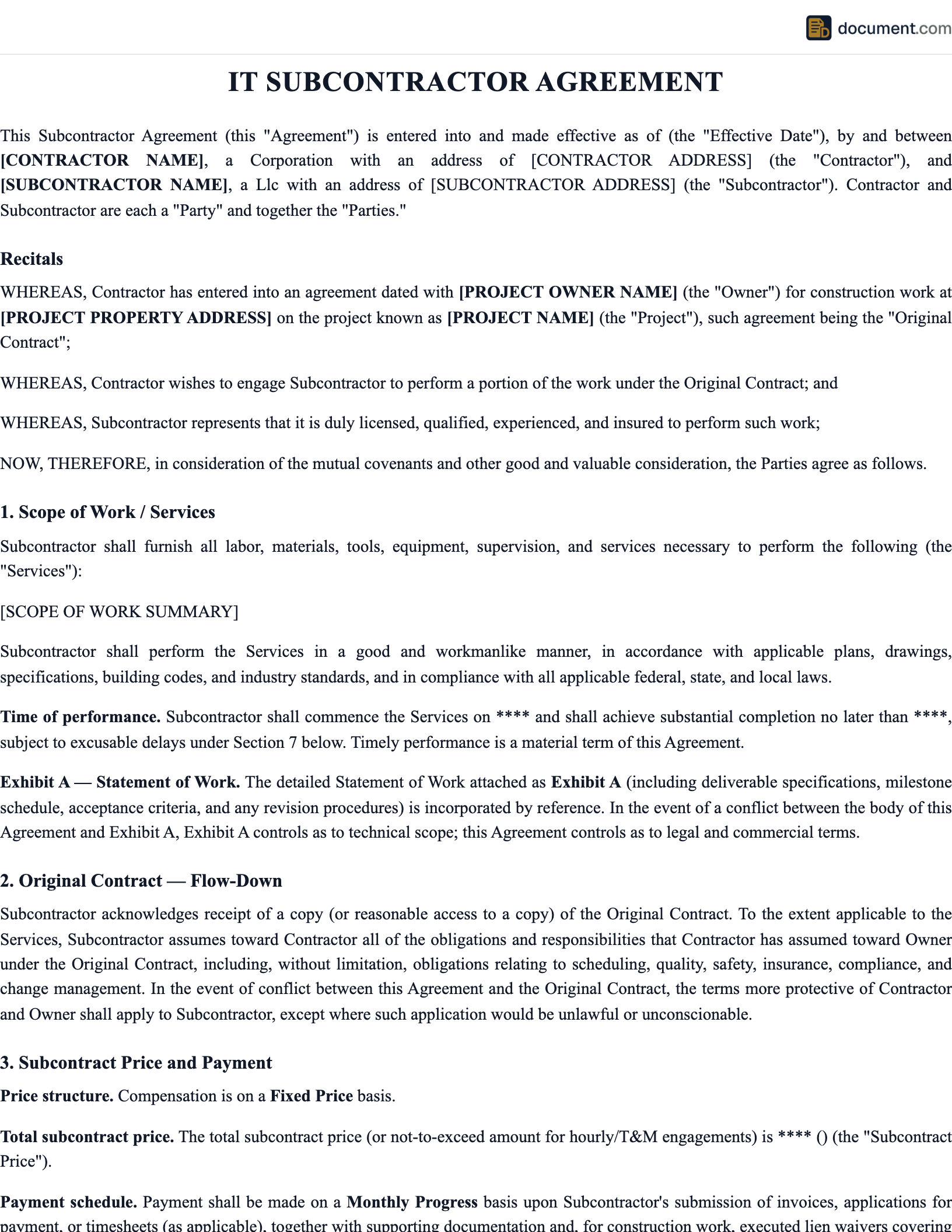
IT Subcontractor Agreement Form Preview
IT Subcontractor Agreement
Technology Services Subcontract
1. PARTIES
This Agreement is entered into between ("Prime Contractor") and ("IT Subcontractor") for technology services related to the project.
2. SCOPE OF IT SERVICES
Subcontractor shall perform the technology services described in Exhibit A (Statement of Work), including , using the technology stack and standards specified in Exhibit B (Technical Requirements).
3. INTELLECTUAL PROPERTY
All Work Product, including source code, documentation, designs, and inventions, shall be the sole and exclusive property of Prime Contractor upon creation. Subcontractor hereby assigns all right, title, and interest in the Work Product.
PRIME CONTRACTOR
IT SUBCONTRACTOR
Key Components
A comprehensive IT subcontractor agreement addresses these critical areas specific to technology engagements:
| Component | Purpose | Key Details |
|---|---|---|
| Statement of Work | Defines the technology scope | Deliverables, milestones, technology stack, environments, acceptance criteria, exclusions |
| IP Assignment | Transfers ownership of work product | Code ownership, pre-existing IP license, open-source disclosure, moral rights waiver |
| Data Security | Protects sensitive information | Encryption, access controls, breach notification, GDPR/CCPA/HIPAA compliance, audit rights |
| Confidentiality | Restricts information disclosure | NDA terms, trade secret protection, return/destruction obligations, survival period |
| Service Levels | Sets performance standards | Uptime guarantees, response/resolution times, service credits, maintenance windows |
| Acceptance Testing | Validates deliverable quality | Test criteria, testing period, defect severity levels, fix cycles, deemed acceptance |
| Payment Terms | Structures compensation | T&M rates, fixed milestones, retainer, invoice format, holdback for acceptance |
| Transition & Exit | Ensures continuity at termination | Knowledge transfer, code handover, data return/deletion, transition assistance period |
How to Create an IT Subcontractor Agreement
Draft the Statement of Work
Define the technology scope in precise technical terms: specific deliverables (API endpoints, database schemas, UI components, network configurations), technology stack and version requirements (React 18+, Node.js 20+, PostgreSQL 15), development environment and deployment targets (AWS us-east-1, Kubernetes cluster), milestones with delivery dates, and explicit exclusions. The SOW should be detailed enough that a qualified replacement team could complete the work from the SOW alone.
Establish IP and Confidentiality Terms
Draft an IP assignment clause that transfers all work product ownership to the hiring party, with a schedule listing any pre-existing IP the subcontractor will bring into the project (licensed, not assigned). Require disclosure of all open-source components and their licenses. Include comprehensive confidentiality obligations covering source code, architecture, data, business logic, and client information, with survival provisions extending 3-5 years post-termination.
Define Data Security and Compliance Requirements
Specify the security standards the subcontractor must maintain: encryption requirements (AES-256 at rest, TLS 1.2+ in transit), access control protocols (MFA, least privilege, VPN for remote access), secure development practices (OWASP Top 10, code review, dependency scanning), breach notification timelines (24-72 hours), and compliance with applicable regulations (GDPR, CCPA, HIPAA, PCI DSS, SOC 2). Include the right to conduct security audits and penetration tests of the subcontractor's systems.
Set SLAs and Acceptance Testing Procedures
For ongoing services, define uptime targets, response time SLAs by severity level, service credit calculations, and reporting requirements. For project deliverables, establish acceptance criteria tied to functional requirements, a testing period (15-30 business days), defect categorization (critical/major/minor), the fix-and-retest cycle (maximum attempts before termination right), and deemed acceptance provisions.
Structure Payment and Change Management
Select the appropriate payment model (T&M, fixed-price milestones, or retainer), define rate cards for different skill levels, establish the change request process for scope modifications (written request, impact assessment, pricing, approval before work begins), and specify invoice documentation requirements (timesheets, progress reports, milestone evidence). Include payment holdback provisions tied to acceptance testing outcomes.
Address Termination, Transition, and Dispute Resolution
Define termination rights (for cause with cure period, for convenience with notice), transition obligations (30-90 day knowledge transfer, code repository handover, documentation delivery, credential transfer), data return and destruction certification, the dispute resolution process (negotiation, mediation, arbitration), governing law, and any post-termination restrictions (non-solicitation of clients, confidentiality survival).
Frequently Asked Questions
Official Resources
Authoritative resources on IT contracting, data security, intellectual property, and technology compliance.
NIST Cybersecurity Framework
Federal framework for managing cybersecurity risk, widely referenced in IT subcontractor security requirements.
OWASP Top 10 Security Risks
Industry-standard list of the most critical web application security risks for secure development practices.
U.S. Copyright Office - Software Registration
Copyright registration procedures for software, relevant to IP ownership provisions in IT agreements.
IRS - Independent Contractor vs Employee
IRS worker classification guidance critical for IT subcontractor relationships.
HHS HIPAA for Professionals
HIPAA compliance requirements for IT subcontractors handling protected health information.
California Attorney General - CCPA
California Consumer Privacy Act requirements affecting IT subcontractors processing California consumer data.
Create Your IT Subcontractor Agreement
Define IP ownership, data security requirements, SLAs, and payment terms in a professional IT subcontractor agreement.
Create DocumentNo account required. Free to create and preview.