
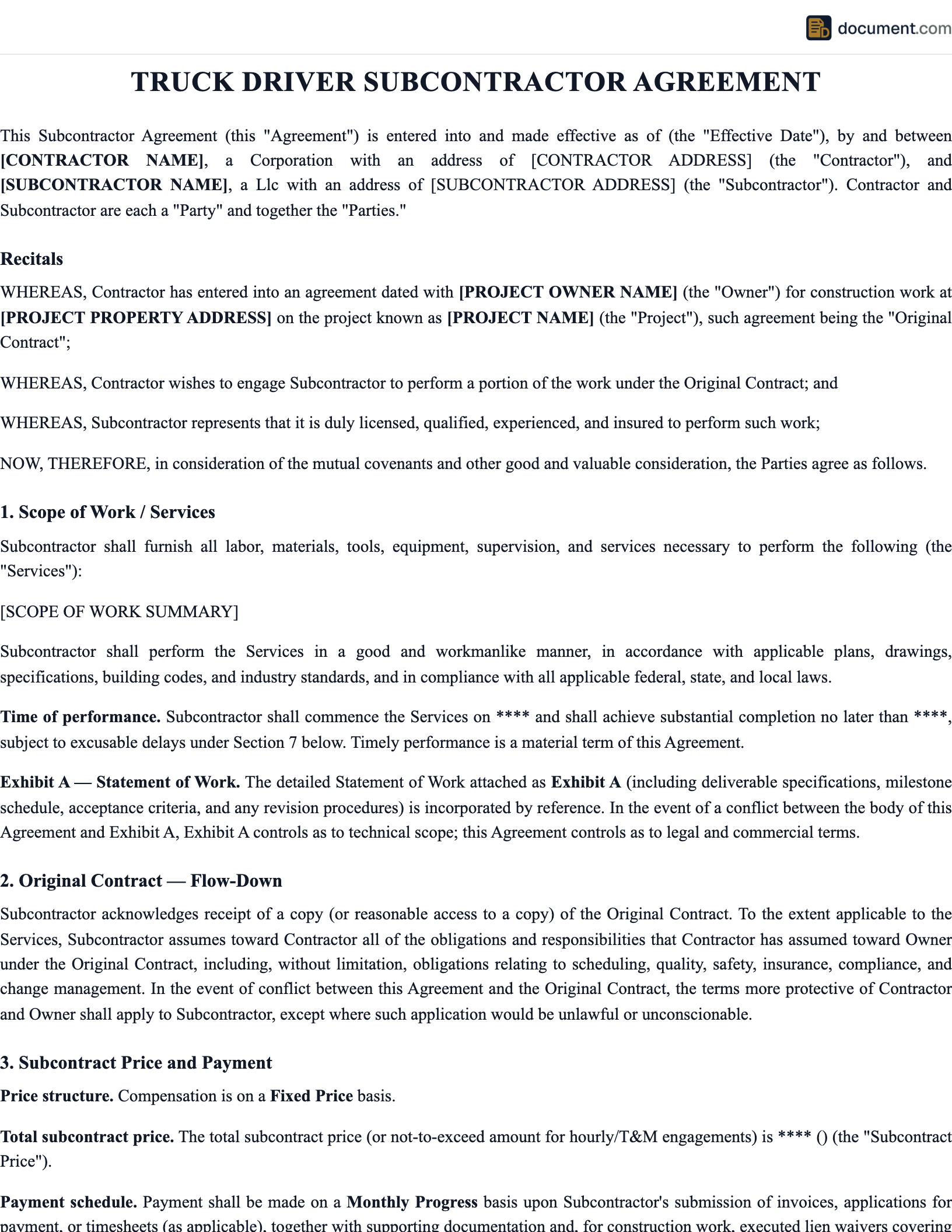



What Is a Truck Driver Subcontractor Agreement?
A truck driver subcontractor agreement is the legal foundation for the relationship between a motor carrier and an owner-operator who hauls freight as an independent business rather than a company employee. The trucking industry relies heavily on this model — the Owner-Operator Independent Drivers Association (OOIDA) estimates that roughly 350,000 owner-operators work in the United States, representing approximately 10% of all truck drivers. These drivers own or lease their own Class 8 tractors, bear their own operating expenses (fuel, maintenance, insurance, permits), and contract with carriers to move freight under the carrier's motor carrier authority. The subcontractor agreement governs this relationship under a complex framework of federal regulations — primarily the FMCSA truth-in-leasing rules at 49 CFR Part 376 — that were enacted specifically to protect owner-operators from exploitative carrier practices.
The distinction between a truck driver subcontractor and an employee driver is one of the most heavily litigated classification questions in American labor law. The IRS, the Department of Labor, state workforce agencies, and courts all apply different tests — the IRS uses a multi-factor right-to-control test, the DOL applies the economic reality test, and several states (most notably California under AB5) use the restrictive ABC test that presumes worker status unless the hiring entity proves all three prongs. Misclassification exposes carriers to back taxes, overtime claims, unemployment insurance assessments, workers' compensation penalties, and class-action lawsuits that have resulted in settlements exceeding $100 million in the trucking industry. A properly drafted subcontractor agreement does not guarantee independent contractor status — the actual working relationship must reflect genuine independence — but it is a necessary first step in establishing and documenting that the driver operates as a separate business entity.
Beyond classification, the agreement must navigate a regulatory landscape unique to commercial trucking. The FMCSA regulates motor carriers and their drivers through the Federal Motor Carrier Safety Regulations (49 CFR Parts 350-399), covering hours of service, drug and alcohol testing, commercial driver's license standards, vehicle maintenance, hazardous materials transportation, and the Compliance Safety Accountability (CSA) scoring system that tracks carrier and driver safety performance. The DOT establishes vehicle weight limits, inspection standards, and commercial licensing requirements. State-level regulations add fuel tax reporting (IFTA), registration apportionment (IRP), oversize/overweight permitting, and varying rules on independent contractor classification. A truck driver subcontractor agreement must address all of these regulatory layers while also covering the core commercial terms: compensation, insurance, equipment, fuel costs, detention time, and the practical realities of life on the road.
FMCSA Compliance
Satisfies truth-in-leasing regulations, ELD mandates, and DOT safety requirements.
Transparent Compensation
Defines per-mile rates, fuel surcharges, detention pay, and itemized settlement statements.
Classification Protection
Establishes independent contractor status with proper control and economic independence factors.
Truck Driver Subcontractor Agreement Form Preview
Truck Driver Subcontractor Agreement
Independent Owner-Operator Equipment Lease and Service Agreement
1. PARTIES AND AUTHORITY
This Agreement is entered into between ("Carrier"), USDOT # , MC # , and ("Owner-Operator"), CDL # , State of Issue: .
2. EQUIPMENT DESCRIPTION
Owner-Operator shall provide the following equipment: Year/Make/Model , VIN , License Plate # . Equipment shall at all times meet DOT safety standards under 49 CFR Part 396.
3. COMPENSATION
Carrier shall pay Owner-Operator at the rate of $ per loaded mile / per load / percentage of line-haul revenue, plus applicable fuel surcharge per the attached Compensation Schedule.
CARRIER
OWNER-OPERATOR
Key Components
A comprehensive truck driver subcontractor agreement addresses the following critical areas governing the carrier-owner-operator relationship:
| Component | Purpose | Key Details |
|---|---|---|
| Party Identification | Establishes carrier and driver entities | USDOT number, MC authority, CDL number and class, endorsements, EIN/SSN, business entity type |
| Equipment Lease | Complies with 49 CFR Part 376 | Vehicle description, VIN, exclusive possession by carrier, lease term (minimum 30 days), equipment return provisions |
| Compensation | Defines payment structure | Per-mile, per-load, or percentage rates; fuel surcharge pass-through; detention pay; deadhead compensation; settlement frequency |
| Deductions | Itemizes permitted withholdings | Insurance premiums, escrow contributions, fuel advances, ELD fees, cargo claims, administrative charges — must be itemized per FMCSA rules |
| Insurance | Allocates coverage responsibility | Primary liability, cargo, bobtail/non-trucking, occupational accident, physical damage, trailer interchange |
| Safety Compliance | Ensures DOT regulatory adherence | HOS compliance, ELD use, drug/alcohol testing, vehicle inspections, CDL maintenance, Clearinghouse registration |
| Independent Status | Documents contractor classification | Right to refuse loads, control of schedule and routes, ability to work for other carriers, own business expenses, no employee benefits |
| Termination | Defines exit procedures | Notice period, cause triggers, final settlement timeline, escrow return, equipment release, non-compete limitations |
How to Create a Truck Driver Subcontractor Agreement
Identify the Parties and Regulatory Credentials
Document the carrier's full legal name, USDOT number, MC (motor carrier) authority number, and business address. For the owner-operator, record their legal name or business entity, CDL number with class and endorsements, EIN or Social Security Number, and the state of their principal place of business. Verify the carrier's authority is active on the FMCSA SAFER system and confirm the driver's CDL status and Drug and Alcohol Clearinghouse registration. This foundational section establishes the legal entities and their regulatory standing — a critical first step because operating without proper authority or with a disqualified driver exposes both parties to substantial fines and potential criminal liability.
Describe the Equipment and Lease Terms
Per 49 CFR Part 376 truth-in-leasing requirements, the agreement must describe the owner-operator's equipment by year, make, model, VIN, and license plate number. Specify that the carrier has exclusive possession, control, and use of the equipment while it is under lease — this is a federal requirement because the carrier's operating authority and insurance only cover equipment under its control. Define the lease term (minimum 30 days per federal regulation), establish procedures for adding or substituting equipment, address the driver's obligation to maintain the vehicle to DOT standards (49 CFR Part 396), and specify the process for equipment return upon termination including the condition the vehicle must be in and the timeframe for return.
Structure Compensation and Settlement Procedures
Define the compensation model — per-mile rate (loaded and/or empty), per-load flat rate, or percentage of line-haul revenue (industry standard ranges from 65-85% for owner-operators providing their own trailer, and 70-80% for those pulling carrier trailers). Specify the fuel surcharge calculation methodology and confirm that 100% of the shipper-paid fuel surcharge passes through to the driver. Address detention time pay (rate per hour and free time allowance), layover pay, stop-off charges, and deadhead compensation. Per FMCSA regulations, the carrier must provide an itemized settlement statement with every payment showing gross compensation, each individual deduction, and net pay — payments must occur at least every 15 days.
Allocate Insurance Responsibilities and Costs
Specify which party provides and pays for each type of coverage: the carrier typically provides primary auto liability insurance (FMCSA minimums are $750,000 for general freight, higher for hazmat) and cargo insurance while the truck is under dispatch. The owner-operator is typically responsible for bobtail/non-trucking liability coverage (for operation outside dispatch), physical damage coverage on their own equipment, and occupational accident insurance (since independent contractors are not covered by workers' compensation). If the carrier offers insurance programs that the driver can opt into, itemize the premium deductions. Address the claims process, deductibles, and any cargo claim liability the driver may bear. Ensure compliance with 49 CFR Part 387 minimum insurance requirements.
Establish Safety and DOT Compliance Obligations
Define the driver's obligation to comply with all FMCSA safety regulations including: hours of service rules (11-hour driving limit within a 14-hour on-duty window, 30-minute break, 60/70-hour weekly limits); ELD mandate compliance; pre-trip and post-trip vehicle inspection requirements (49 CFR 396.13); participation in the carrier's DOT drug and alcohol testing program (pre-employment, random, post-accident, reasonable suspicion, and return-to-duty testing); registration in the FMCSA Drug and Alcohol Clearinghouse; and immediate notification to the carrier of any moving violation, accident, CDL status change, or out-of-service order. Address how the driver's safety performance affects the carrier's CSA scores and what safety-related events constitute grounds for immediate contract termination.
Document Independent Contractor Status and Termination
Include clear provisions that support independent contractor classification: the driver controls their own schedule and can refuse loads without penalty; the driver may operate for other carriers when not under dispatch; the driver bears their own business expenses; the carrier does not provide employee benefits; and the carrier controls the result of the work (delivery) but not the means and manner. Define termination procedures including the required notice period, grounds for immediate termination (failed drug test, CDL revocation, safety violations, cargo theft), the timeline for final settlement (within 15 days per industry standard), return of carrier-owned equipment, and release of any escrow funds (49 CFR 376.12(k) requires return within 45 days). Specify the governing law, dispute resolution method, and venue for any legal proceedings.
Frequently Asked Questions
Official Resources
Authoritative resources on truck driver subcontracting, owner-operator regulations, and federal motor carrier compliance.
Federal Motor Carrier Safety Administration
Primary federal regulator for motor carriers and commercial drivers — truth-in-leasing, HOS, drug testing, and CSA scores.
U.S. Department of Transportation
Federal oversight of commercial vehicle safety standards, weight limits, CDL requirements, and interstate commerce regulations.
IRS - Independent Contractor vs Employee
IRS worker classification guidance and the multi-factor test applied to owner-operator trucking relationships.
Owner-Operator Independent Drivers Association
Industry advocacy for owner-operators — resources on lease agreements, fuel surcharges, regulatory compliance, and driver rights.
49 CFR Part 376 - Lease and Interchange of Vehicles
Full text of FMCSA truth-in-leasing regulations governing owner-operator equipment leases to motor carriers.
FMCSA Drug and Alcohol Clearinghouse
Federal database tracking commercial driver drug and alcohol violations — required for all CDL holders and their employers.
Create Your Truck Driver Subcontractor Agreement
Define compensation, FMCSA compliance, insurance responsibilities, and owner-operator terms in a professional truck driver subcontractor agreement.
Create DocumentNo account required. Free to create and preview.