



What Is a Software Development Subcontractor Agreement?
A software development subcontractor agreement is a legally binding contract that governs the relationship between a hiring company (whether a software firm, digital agency, or end client) and an independent software developer or development team engaged to build, extend, or maintain software applications. This agreement is fundamentally different from construction or physical-trade subcontracting because the primary deliverable — source code — is intellectual property that must be explicitly assigned through contract provisions. Without proper IP assignment language, U.S. copyright law defaults to leaving ownership with the creator, meaning the company that paid for the code may not legally own it.
The agreement must navigate several challenges unique to software development. Scope definition is inherently difficult because software requirements evolve as stakeholders interact with working prototypes — the waterfall ideal of fixed scope rarely survives contact with reality. Quality is hard to measure objectively — code can work correctly yet be poorly structured, insecure, or unmaintainable. Deliverables incorporate third-party open-source components with their own license obligations that can impose viral requirements on the surrounding code. And the developer's ongoing knowledge of the system creates dependency risk if they become unavailable. A well-crafted agreement addresses all of these concerns through IP assignment clauses, acceptance criteria, open-source policies, documentation requirements, and transition assistance obligations.
From a regulatory perspective, software development subcontracting increasingly involves data privacy considerations. If the developer will access, process, or store personal data during development or testing, the agreement must include data processing provisions compliant with applicable regulations — GDPR for EU data subjects, CCPA/CPRA for California residents, HIPAA for protected health information, or PCI DSS for payment card data. The agreement should also address export control compliance (relevant for encryption technology under EAR/ITAR) and government contracting flow-down requirements if the prime contract is with a federal agency.
IP Ownership
Ensures full code ownership transfers to the client through proper assignment clauses.
Milestone Delivery
Structures payment around accepted deliverables with clear criteria.
Confidentiality
Protects source code, credentials, business logic, and customer data.
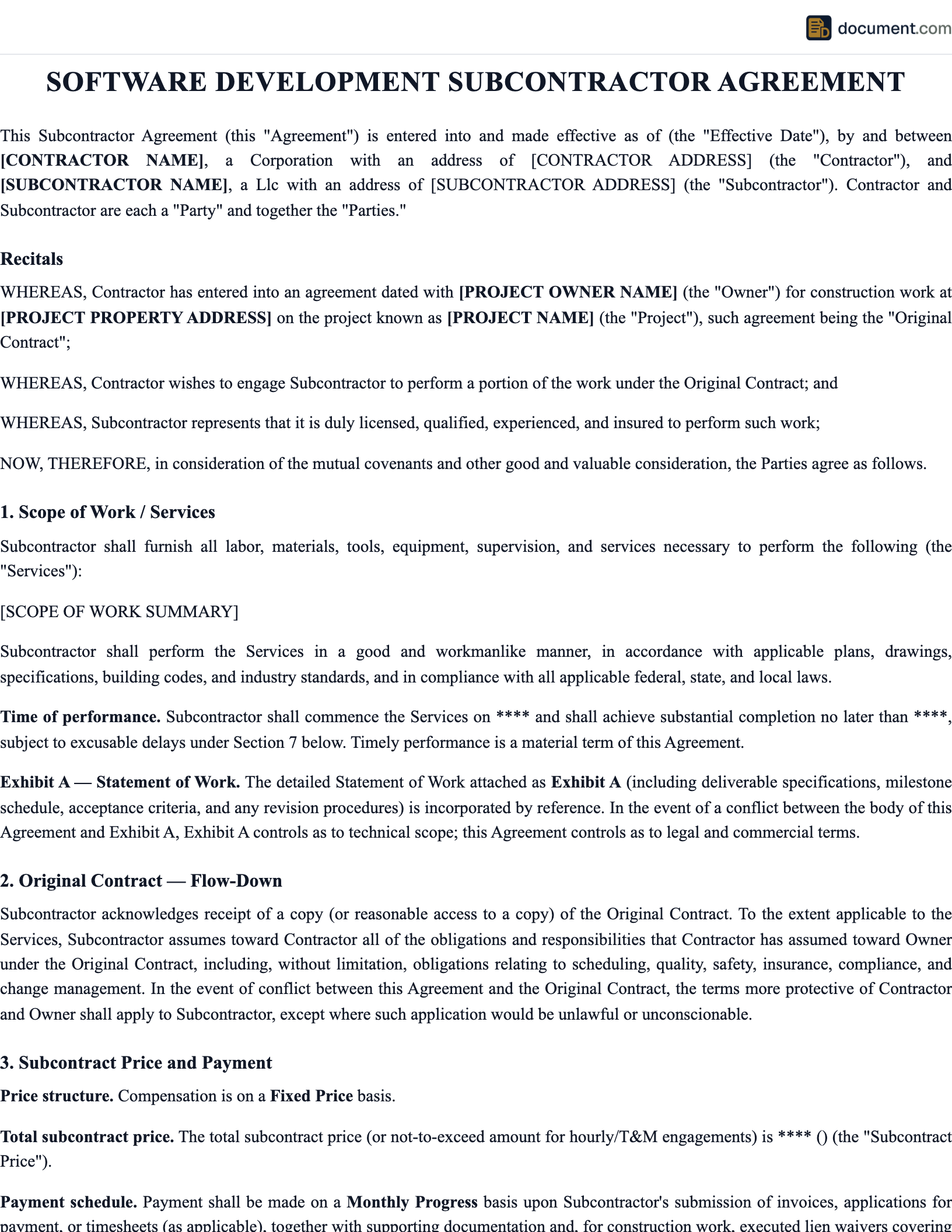
Software Development Subcontractor Agreement Form Preview
Software Development Subcontractor Agreement
Intellectual Property Assignment & Services Contract
1. PARTIES
This Agreement is entered into between ("Company") and ("Developer") for software development services related to ("Project").
2. INTELLECTUAL PROPERTY ASSIGNMENT
All Work Product created by Developer under this Agreement shall be considered work-for-hire to the maximum extent permitted by law. Developer hereby irrevocably assigns to Company all rights, title, and interest in the Work Product.
3. DELIVERABLES AND ACCEPTANCE
Developer shall deliver milestones per Schedule A. Company shall have business days to test and accept each deliverable.
COMPANY
DEVELOPER
Key Components
A comprehensive software development subcontractor agreement addresses the IP-centric nature of code delivery, the challenge of defining and measuring software quality, and the evolving scope inherent in software projects:
| Component | Purpose | Key Details |
|---|---|---|
| IP Assignment | Transfers code ownership to client | Work-for-hire declaration, copyright assignment, patent assignment, moral rights waiver, cooperation clause |
| Scope & Specifications | Defines what will be built | Feature requirements, tech stack, platform targets, API specs, UI/UX wireframes |
| Acceptance Criteria | Measures deliverable quality | Functional testing, performance benchmarks, security scanning, accessibility compliance |
| Payment Structure | Aligns payment with delivery | Fixed-price milestones, T&M rates, retainage, payment-IP linkage, change-order rates |
| Confidentiality | Protects proprietary information | Source code, credentials, business logic, customer data, data processing addendum |
| Open-Source Policy | Manages license compliance risk | SBOM disclosure, copyleft restrictions, approved licenses, scanning requirements |
| Warranty & Support | Defines post-delivery obligations | Bug-fix period, severity-based SLAs, exclusions, transition assistance, documentation |
How to Create a Software Development Subcontractor Agreement
Define the Technical Scope
Document the application features, platform targets (web, iOS, Android, desktop), technology stack requirements (languages, frameworks, databases), API integrations with third-party services, UI/UX design specifications or wireframes, performance requirements (load times, concurrent users, uptime targets), and infrastructure/deployment environment. Reference detailed specifications documents by name and attach them as exhibits.
Draft IP Assignment and Confidentiality Provisions
Include a belt-and-suspenders IP provision: declare all work product as work-for-hire, AND include a separate irrevocable assignment of all intellectual property rights. Require disclosure of pre-existing IP the developer plans to incorporate. Define confidential information broadly to include source code, architecture, credentials, and business data. Include a data processing addendum if the developer will handle personal data.
Structure Milestones and Acceptance Testing
Break the project into discrete milestones with specific deliverables, define acceptance criteria for each milestone (functional requirements, performance benchmarks, security scan results), establish the acceptance testing period (10-15 business days), define the process for reporting and resolving defects during testing, and specify the consequence of failing to complete testing within the period (deemed acceptance).
Establish Payment and Change-Order Terms
Tie payments to milestone acceptance (not just delivery), specify retainage percentage (5-10% until final acceptance), define payment terms (net-15 or net-30), establish change-order procedures for scope changes (written request, cost estimate, schedule impact, written approval required), and link IP transfer to receipt of full payment to protect the client's investment.
Set Repository, Open-Source, and Warranty Policies
Specify version control requirements (client-owned repository, branching strategy, code review process), require SBOM disclosure and open-source license scanning, prohibit copyleft licenses without approval, define the warranty period (30-90 days) with severity-based response times, require code documentation and deployment procedures, and establish transition assistance obligations for knowledge transfer upon termination.
Frequently Asked Questions
Official Resources
Authoritative resources on software IP, open-source licensing, data privacy, and independent contractor classification.
U.S. Copyright Office - Software Registration
Federal guidance on registering copyright in computer programs and source code.
Open Source Initiative - License List
Authoritative list of OSI-approved open-source licenses with full license texts and summaries.
IRS - Independent Contractor Classification
IRS guidance on determining whether a worker is an independent contractor or employee.
FTC - Unfair Business Practices
Federal Trade Commission enforcement authority relevant to software development contracts and consumer protection.
NIST - Cybersecurity Framework
National Institute of Standards and Technology framework for secure software development practices.
SBA - Contractor vs Employee
Small Business Administration guidance on properly classifying software developers as subcontractors.
Create Your Software Development Subcontractor Agreement
Define IP ownership, milestone deliverables, acceptance criteria, and confidentiality terms in a professional software development subcontract.
Create DocumentNo account required. Free to create and preview.