



What Is a Security Subcontractor Agreement?
A security subcontractor agreement is a legally binding contract that governs the relationship between a prime security contractor, property manager, or facility owner and a licensed private security company engaged to provide protective services. Unlike a simple vendor agreement for commodity services, a security subcontract involves delegating responsibility for the safety of people, property, and information — a delegation that carries significant legal exposure. The agreement must address the heavily regulated nature of the private security industry, where state licensing boards impose requirements on company registration, individual guard licensing, training minimums, firearms qualifications, and operational procedures that vary dramatically from state to state.
The scope of security subcontracting spans a wide spectrum of services, each with distinct legal and operational requirements. Unarmed guard services involve static post protection, roving patrols, access control enforcement, and visitor management. Armed guard services add use-of-force protocols, firearms qualification and storage requirements, and significantly higher insurance thresholds. Alarm monitoring and response services involve electronic surveillance infrastructure, response time commitments, and false alarm management. Access control and CCTV system installation and maintenance involve technical work that may require additional contractor licensing (low-voltage electrical in many states). Event security involves crowd management, alcohol service oversight, and temporary deployment planning. Each service category requires different licensing, insurance, and operational provisions in the agreement.
The liability landscape in security subcontracting is uniquely complex because security providers can face claims from two opposing directions: liability for failing to prevent harm (negligent security) and liability for causing harm while attempting to prevent it (excessive force, false imprisonment, assault). The agreement must carefully balance these competing risks through clear use-of-force policies, detailed scope definitions that establish the security standard without creating unrealistic expectations, robust insurance requirements with specialized coverage endorsements, and indemnification provisions that allocate responsibility based on each party's negligence rather than attempting blanket risk transfer.
Licensed & Bonded
Verifies state security agency licensing, guard registrations, and fidelity bonding.
Use-of-Force Protocol
Defines force continuum, de-escalation requirements, and incident reporting.
Surveillance & Access
Covers CCTV monitoring, access control systems, and data handling protocols.
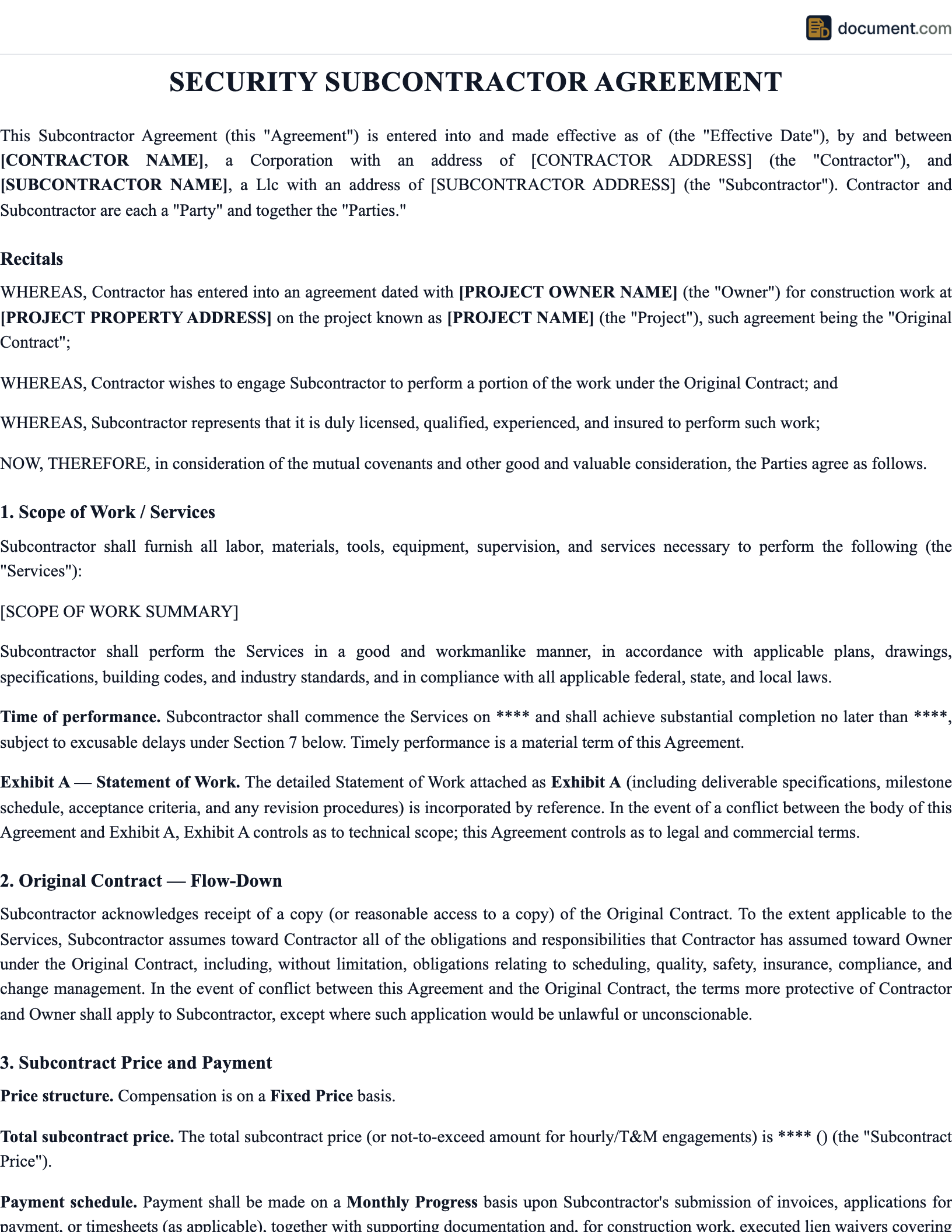
Security Subcontractor Agreement Form Preview
Security Services Subcontractor Agreement
Licensed Private Security Contract
1. PARTIES
This Agreement is entered into between ("Prime Contractor") and ("Security Subcontractor"), Agency License No. , for security services at .
2. SCOPE OF SERVICES
Subcontractor shall provide (armed/unarmed guard, patrol, monitoring) services during the hours of with a minimum of personnel per shift.
3. USE OF FORCE
All security personnel shall adhere to the Subcontractor's written use-of-force policy, which shall comply with applicable state law and prioritize verbal de-escalation before any physical intervention.
PRIME CONTRACTOR
SECURITY SUBCONTRACTOR
Key Components
A comprehensive security subcontractor agreement addresses the regulated nature of private security, the risk of both negligent security and excessive force claims, and the confidentiality obligations inherent in protective services:
| Component | Purpose | Key Details |
|---|---|---|
| Licensing & Registration | Ensures legal authority to provide security | Agency license, individual guard cards, armed endorsements, firearms permits |
| Scope of Services | Defines security coverage parameters | Post locations, patrol routes, shift hours, staffing levels, armed/unarmed designation |
| Use-of-Force Policy | Establishes intervention authority and limits | Force continuum, de-escalation requirements, firearms protocols, incident reporting |
| Personnel Requirements | Ensures qualified guard deployment | Background checks, training hours, certifications, uniform standards, drug testing |
| Insurance & Bonding | Covers specialized security risks | GL with assault/battery, professional liability, fidelity bonds, firearms coverage |
| Confidentiality | Protects sensitive security information | Access codes, patrol schedules, vulnerability data, footage handling, data destruction |
| Response Standards | Defines performance expectations | Priority tiers, response times, escalation procedures, reporting requirements |
How to Create a Security Subcontractor Agreement
Verify Licensing and Compliance
Confirm the security subcontractor holds a valid private security agency license in your state, verify individual guard registrations for all personnel who will be deployed, confirm armed guard endorsements and firearms qualifications where applicable, and check disciplinary history through the state regulatory agency's database. Document all license numbers, expiration dates, and training certifications in the agreement.
Define the Security Scope and Standards
Detail the specific services: post locations and coverage hours, patrol routes and frequency, armed versus unarmed designation, staffing levels per shift, access control procedures, visitor management protocols, emergency response responsibilities, and any specialized services (K-9 patrol, executive protection, event security). Define response time standards by incident priority level.
Establish Use-of-Force and Conduct Policies
Require the subcontractor to provide their written use-of-force policy for review, confirm it complies with state law, define prohibited conduct (racial profiling, unauthorized searches, excessive force), establish the force continuum from verbal commands through physical intervention, and create incident reporting requirements with specific timelines for different incident categories.
Document Personnel and Background Check Requirements
Specify the minimum qualifications for deployed personnel: background check scope (federal, state, county criminal; sex offender registry; employment verification; drug screening), minimum training hours exceeding state requirements, required certifications (CPR/First Aid, AED, defensive tactics), uniform and equipment standards, and the client's right to approve or reject specific personnel.
Structure Insurance, Payment, and Confidentiality Terms
Require comprehensive insurance with assault-and-battery coverage, professional liability, and fidelity bonding. Define billing rates (hourly per guard, by shift type), overtime calculations, holiday premiums, and payment terms. Include robust confidentiality provisions covering security protocols, access credentials, patrol schedules, incident reports, and surveillance footage, with obligations surviving termination.
Frequently Asked Questions
Official Resources
Authoritative resources on private security regulation, licensing, and industry standards.
ASIS International
Global organization for security professionals providing standards, certifications (CPP, PSP, PCI), and best practices.
DOL - Fair Labor Standards Act
Federal labor standards applicable to security guard scheduling, overtime, and minimum wage requirements.
OSHA - Workplace Violence Prevention
Federal OSHA guidance on workplace violence prevention programs relevant to security operations.
EEOC - Background Check Guidance
Federal guidance on the lawful use of background checks in hiring security personnel.
SBA - Contractor vs Employee Classification
Small Business Administration guidance on properly classifying security workers as subcontractors.
International Foundation for Protection Officers
Professional development organization offering the Certified Protection Officer (CPO) designation and training resources.
Create Your Security Subcontractor Agreement
Define guard deployment, use-of-force policies, licensing verification, and liability terms in a professional security subcontract.
Create DocumentNo account required. Free to create and preview.