



What Is a Roofing Subcontractor Agreement?
A roofing subcontractor agreement is the written contract between a general contractor or property owner and a state-licensed roofing contractor engaged to install, replace, or repair a roof system. The roof is the primary weather barrier for the entire structure; a single missed flashing detail, improperly sealed penetration, or inadequate drainage slope can produce water intrusion damaging insulation, framing, drywall, electrical systems, and personal property. Resulting loss claims routinely exceed the contract value many times over, making careful risk allocation essential. The agreement also documents compliance with state contractor-licensing law (CSLB C-39 in California under BPC § 7048; DBPR roofing certification in Florida under Fla. Stat. § 489.105) and federal OSHA fall-protection standards under 29 CFR Part 1926 Subpart M.
Two distinct warranty layers must be documented. The roofer's workmanship warranty covers installation defects (improper nail patterns, inadequate flashing, poor ventilation, deck preparation failures); industry standard is 2 to 5 years residential and 5 to 10 years commercial. The manufacturer's material warranty covers product defects (delamination, premature granule loss, seal-strip failure); 25 to 50 years residential pro-rated, 15 to 30 years for commercial membrane. Enhanced manufacturer warranties (GAF Golden Pledge, CertainTeed SureStart Plus, Carlisle SynTec NDL) are available only when a manufacturer-certified contractor performs the installation and the warranty is registered within the activation deadline. The agreement should document certification status and the specific warranty target.
Safety is the defining operational concern. Roofing has the highest fatality rate of any construction trade according to BLS data, and OSHA enforces strict fall-protection requirements under 29 CFR 1926.501. A GC who hires a roofer without verifying license, insurance, EMR, and fall-protection compliance can be cited as a controlling employer under OSHA's multi-employer worksite policy (CPL 02-00-124). The agreement's insurance, indemnification, and additional- insured provisions allocate this exposure: $1 million per occurrence and $2 million aggregate CGL with completed-operations extension is the floor; primary- and-noncontributory wording (ISO CG 20 01) and waiver of subrogation are essential.
State contractor licensing: CSLB C-39, Florida DBPR, and Texas TDLR
California requires CSLB Class C-39 Roofing Contractor licensing for any roofing project over $500 (BPC § 7048). Unlicensed contractors lose the right to compensation under BPC § 7031 and may face misdemeanor prosecution under § 7028. Florida requires certified or registered roofing contractor licensing under Fla. Stat. § 489.105 and Rule 61G4-15.001 F.A.C. Texas does not require a state license for residential roofing but mandates TDLR registration for residential roofing contractors performing insurance restoration work under Texas Occ. Code Ch. 1304. Arizona requires ROC CR-42 or KA-42 licensing. Most states impose continuing-education requirements and bonding for consumer protection. The agreement should disclose the license number and require continuous validity.
Payment-bond rights under the Miller Act and state little-Miller Acts
On federal jobs over $150,000, the Miller Act (40 U.S.C. § 3131) requires the prime contractor to furnish a payment bond in the full contract amount for the protection of subcontractors and suppliers. Unpaid first- and second-tier subcontractors may sue on the bond in U.S. District Court within one year of last furnishing labor or material under § 3133(b)(4), with the 90-day notice requirement applying to second- tier claimants. State little-Miller Act statutes provide parallel protection on state-funded projects: California Pub. Cont. Code § 7103 et seq.; Texas Government Code Ch. 2253; Florida Stat. § 255.05 ($200,000 threshold). The agreement should preserve the roofer's bond-claim rights, require delivery of a copy of the payment bond before mobilization, and bar any contractual waiver of bond rights (Cal. Civ. Code § 8122 voids prospective waivers).
Fall Protection
Addresses OSHA Subpart M compliance, harness requirements, and safety plans.
Warranty Coverage
Documents workmanship and manufacturer warranty terms and certifications.
Weather Protocols
Defines weather-day policies, temporary dry-in, and schedule flexibility.
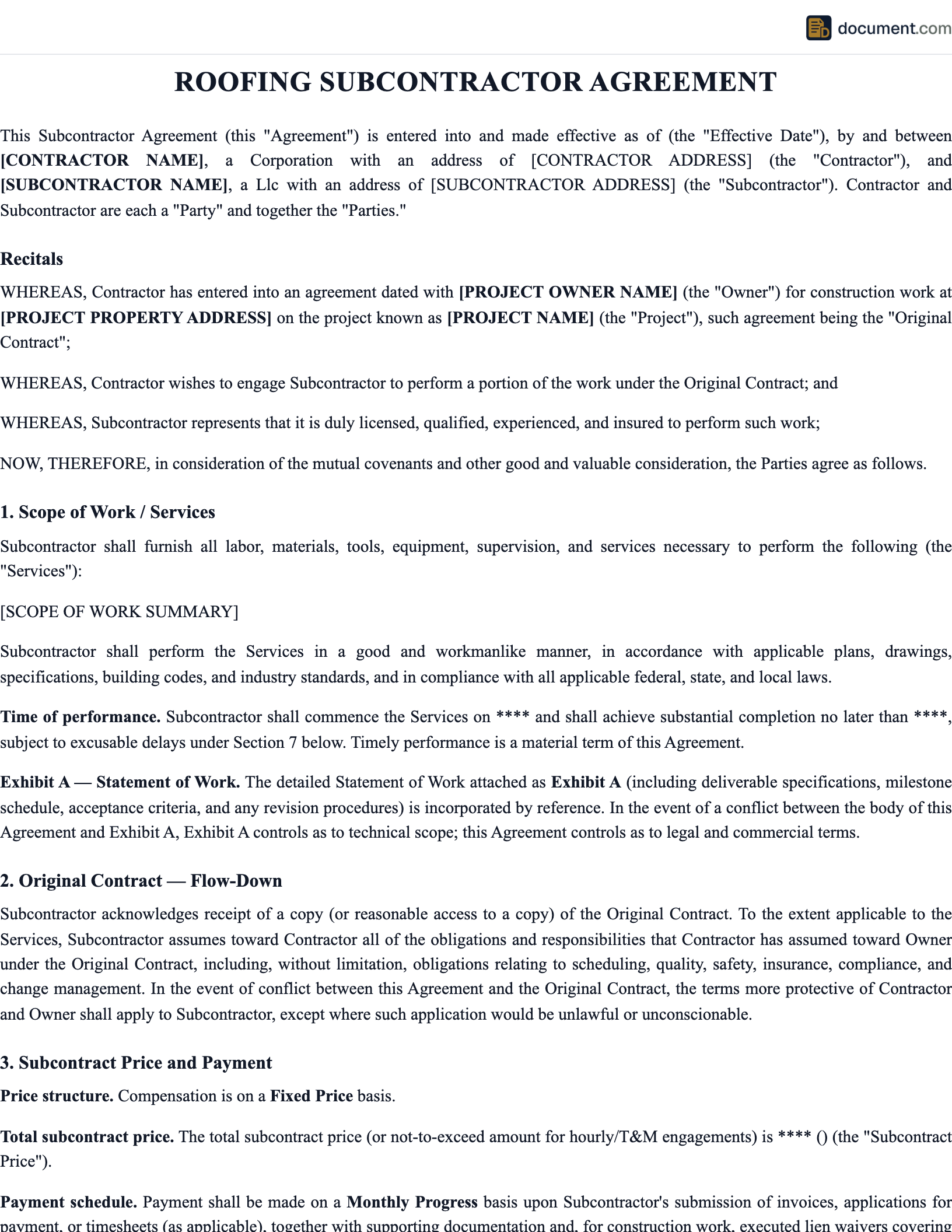
Roofing Subcontractor Agreement Form Preview
Roofing Subcontractor Agreement
Licensed Roofing Services Contract
1. PARTIES AND PROJECT
This Agreement is entered into between ("General Contractor") and ("Roofing Subcontractor"), License No. , for roofing work at .
2. SCOPE OF WORK
Subcontractor shall perform complete roof (tear-off/overlay/new construction) using roofing system, including underlayment, flashing, ventilation, and cleanup per manufacturer specifications.
3. WARRANTY
Subcontractor provides a -year workmanship warranty and shall obtain manufacturer warranty registration within 30 days of project completion.
GENERAL CONTRACTOR
ROOFING SUBCONTRACTOR
Key Components
A comprehensive roofing subcontractor agreement addresses safety, weather exposure, material specifications, and the layered warranty structure unique to roofing:
| Component | Purpose | Key Details |
|---|---|---|
| Roofing System Specification | Defines exact materials and installation methods | Manufacturer, product line, color, underlayment, ice barrier, starter/ridge, fasteners |
| Tear-Off & Disposal | Assigns removal and cleanup responsibility | Layers to remove, dumpster, dump fees, hazmat protocols, property protection |
| Safety Plan | Ensures OSHA compliance and worker safety | Fall protection type, harness inspection, safety meetings, guardrails, scaffolding |
| Warranty Structure | Documents dual warranty obligations | Workmanship period, manufacturer program, installer certification, registration process |
| Weather Provisions | Manages weather-dependent scheduling | Weather-day definitions, temp minimums, dry-in requirements, schedule extensions |
| Insurance & Bonding | Allocates risk for high-hazard work | GL, workers' comp, completed operations, additional insured, EMR requirements |
| Payment Milestones | Ties payment to verified progress | Material delivery, tear-off/dry-in, completion, retainage, lien waivers |
How to Create a Roofing Subcontractor Agreement
Verify Licensing and Certifications
Confirm the roofer holds a valid contractor's license for roofing work in your state (many states require specific roofing classifications), verify manufacturer certifications (GAF Master Elite, CertainTeed SELECT ShingleMaster, Owens Corning Platinum Preferred), and request proof of OSHA 10/30-hour training for the crew lead. Check the license through your state contractor licensing board's online portal.
Specify the Roofing System
Document the exact roofing system to be installed: manufacturer and product line, shingle/membrane type and color, underlayment specification (synthetic felt or peel-and-stick ice and water shield with coverage areas), starter strip and ridge cap products, flashing materials and methods at walls, chimneys, valleys, and penetrations, ventilation components (ridge vent, soffit vents, power vents), and pipe boot specifications.
Define Tear-Off and Preparation Scope
Specify the number of layers to be removed, whether removal goes to the deck, who provides dumpsters and pays disposal fees, procedures for discovering hazardous materials (asbestos shingles or insulation), protection requirements for landscaping, windows, and HVAC units, and the process for documenting and pricing damaged decking discovered during tear-off.
Establish Safety Requirements
Require a written fall protection plan per OSHA 29 CFR 1926 Subpart M, specify fall protection methods for the roof slope (guardrails, PFAS, safety nets), document daily toolbox talk requirements, require current harness and lanyard inspection records, and define the GC's right to stop work for safety violations. Address scaffolding responsibility and property access for equipment staging.
Structure Payment and Warranty Terms
Establish milestone-based payments (material delivery, dry-in, completion), retainage percentage and release conditions, workmanship warranty period and scope, manufacturer warranty registration requirements and deadlines, and weather-day provisions including temporary weatherproofing costs and schedule extension procedures.
Frequently Asked Questions
Official Resources
Authoritative resources on roofing codes, safety standards, and manufacturer certification programs.
OSHA - Fall Protection in Construction
Federal OSHA standards for fall protection on roofing and construction projects.
National Roofing Contractors Association (NRCA)
Industry trade association providing roofing standards, training, and best practice guidelines.
ICC - International Building Code
Building code provisions governing roof design, wind uplift, and fire ratings.
EPA - Asbestos Information
EPA regulations for handling asbestos-containing roofing materials during tear-off.
GAF - Contractor Certification Programs
Leading manufacturer's certified contractor programs and enhanced warranty options.
SBA - Contractor vs Employee Classification
Small Business Administration guidance on proper classification of subcontractors.
Create Your Roofing Subcontractor Agreement
Define material specs, safety requirements, warranty terms, and payment milestones in a professional roofing subcontract.
Create DocumentNo account required. Free to create and preview.