



What Is a Lien Waiver?
A lien waiver is a signed legal document in which a contractor, subcontractor, material supplier, equipment lessor, or design professional releases their statutory right to file a mechanic's lien against a project's real property in exchange for — or in acknowledgment of — a payment. Lien waivers are the connective tissue of the construction payment chain. Every progress payment and every final payment on almost every commercial project in the United States is accompanied by a lien waiver, and the flow of waivers through the chain is how general contractors, lenders, title companies, and owners protect themselves from the risk of a mechanic's lien being filed against property for work that has already been paid for.
A mechanic's lien is one of the most powerful collection remedies in American law: a statutory security interest that attaches directly to real property for the value of labor or materials furnished to improve that property. Because the lien attaches to the property itself — not just to the debtor — it can force a sale of the property and typically jumps ahead of unsecured creditors in priority. Owners, lenders, and title insurers will not disburse construction loan funds or issue title policies until they have received signed waivers from every party in the chain who could potentially file a lien.
There are four standard waiver types, defined by two independent dimensions:conditional vs unconditional (is the waiver contingent on the payment actually clearing?) and progress vs final(does it release rights only for this month's payment, or for the entire remaining project?). The correct type to use in any given situation depends on where you are in the payment cycle, whether the payment has actually cleared, and in some states, what form the statute mandates.
Twelve states have enacted mandatory statutory waiver forms that override any privately drafted language: Arizona, California, Florida, Georgia, Massachusetts, Michigan, Mississippi, Missouri, Nevada, Texas, Utah, and Wyoming. In these states, a waiver that does not match the statutory form is either void or non-binding as to matters outside the statutory scope. In all other states, lien waivers are governed by general contract principles. Our templates adapt automatically to the form required in your state.
Exchange for Payment
Trades lien rights for a progress or final payment on a construction project.
Protects the Owner
Owners and lenders require waivers to fund draws and issue clean title.
Statute-Specific
12 states mandate word-for-word statutory forms that override private language.
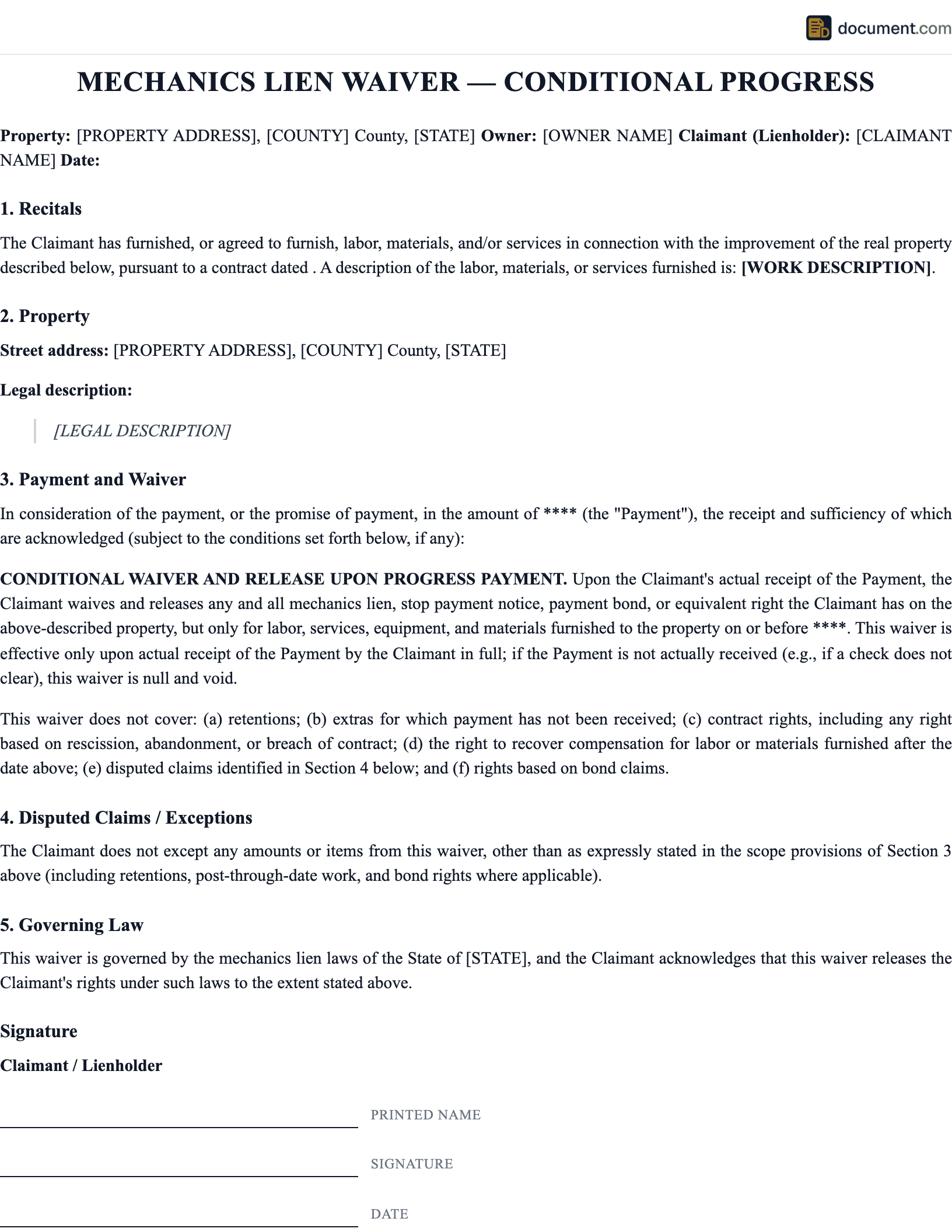
Lien Waiver Form Preview
Conditional Waiver and Release
On Progress Payment
Authorized Signature
Date
The Four Types of Lien Waiver
Every lien waiver falls into one of four standard types, defined by the intersection of two dimensions: whether the waiver is effective conditionally or unconditionally, and whether it covers a progress payment or a final payment.
Conditional Waiver on Progress Payment
Releases lien rights for a specific progress payment only when that payment actually clears the bank. The safest form for subcontractors and suppliers.
Unconditional Waiver on Progress Payment
Unconditionally releases lien rights for a progress payment. Should only be signed after the payment is in hand and verified.
Conditional Waiver on Final Payment
Releases all remaining lien rights for the entire project, effective only when the final payment clears.
Unconditional Waiver on Final Payment
Complete, unconditional release of all lien and bond rights for the project. Signed only after final payment has cleared.
Partial Lien Waiver
Waives lien rights up to a specific dollar amount, leaving rights intact for any additional unpaid balance.
Full and Final Lien Waiver
Closes out the project entirely — waives all present and future lien rights for the described work.
Conditional vs Unconditional: The Single Most Important Decision
The conditional vs unconditional distinction is the most important — and most misunderstood — concept in construction payment. A conditional waiver releases lien rights only if the underlying payment actually clears; if the check bounces or the wire is reversed, the waiver is automatically ineffective and lien rights survive. An unconditional waiver releases lien rights the instant it is signed, regardless of what later happens to the payment. Unconditional waivers are, legally, a complete surrender of a secured collection remedy.
Conditional Waiver
- - Effective only upon actual receipt and clearance of the identified payment
- - Safe to sign and deliver in exchange for a check or wire
- - Standard practice for progress payments in most commercial projects
- - Automatically preserves lien rights if payment fails to clear
Unconditional Waiver
- - Effective the moment it is signed; no payment-contingency language
- - NEVER sign until payment has actually cleared your bank account
- - Typically issued after the check has cleared (3-10 business days)
- - Once signed, lien rights for the covered amount are gone forever
Critical rule: The industry best practice is: conditional on delivery, unconditional on clearance. Deliver a conditional waiver to exchange for the check. Deliver an unconditional waiver only after the check has cleared. Following this rule religiously prevents the worst outcome in construction payment — signing away secured collection rights in exchange for a bounced check.
Progress vs Final Waivers
A progress waiver releases lien rights only for the specific payment identified in the waiver, typically one monthly pay application. All other amounts — prior unpaid balances, change orders not yet approved, retainage, and any work not yet billed — remain subject to lien. A final waiver releases all lien rights for the entire project through the date of the waiver, covering everything including retainage and unbilled change orders.
Final waivers are reserved for true project completion and the release of retainage. They should never be signed in connection with a progress payment, even if the paying party insists. Confusing a progress waiver for a final waiver is one of the most expensive mistakes a subcontractor can make, because the final waiver eliminates all future lien rights on the project — including rights for amounts still legitimately owed.
States That Mandate Statutory Forms
In twelve states, the lien waiver statute prescribes specific forms that must be used word-for-word. Deviation from the statutory text can render the waiver void or limit its effect to the statutory scope. These states are:
| State | Statute |
|---|---|
| Arizona | A.R.S. § 33-1008 |
| California | Civil Code §§ 8132-8138 |
| Florida | Fla. Stat. § 713.20 |
| Georgia | O.C.G.A. § 44-14-366 |
| Massachusetts | M.G.L. c. 254, § 32 |
| Michigan | MCL § 570.1115 |
| Mississippi | Miss. Code § 85-7-419 |
| Missouri | Mo. Rev. Stat. § 429.005 |
| Nevada | NRS § 108.2457 |
| Texas | Tex. Prop. Code § 53.284 |
| Utah | Utah Code § 38-1a-802 |
| Wyoming | Wyo. Stat. § 29-1-312 |
How to Use Lien Waivers Correctly
Identify the Exact Payment You Are Waiving
Before drafting any waiver, pin down the exact payment it covers: the dollar amount, the pay application number, the check or wire reference, and the through date. A waiver with vague or inaccurate payment details is the leading cause of downstream disputes.
Choose the Right Type
Progress or final? Conditional or unconditional? If you are delivering a waiver in exchange for a check that has not yet cleared, use conditional-on-progress. If the payment has cleared and you want to document it, use unconditional-on-progress. Final waivers are reserved for true project completion and retainage release.
Use the Statutory Form If Required
If the project is in one of the twelve statutory-form states, use the exact statutory language word-for-word. Any deviation is a legal risk. Our state-aware templates handle this automatically.
List Exceptions and Reservations
Most waivers include a space to list disputed amounts, retainage held, and pending change orders. Always fill this in — these exceptions preserve lien rights for amounts that are not actually being paid today.
Sign Only With Proper Authority
A lien waiver is a corporate legal act. It should be signed by a company officer, owner, or authorized signatory — not a field superintendent. Waiver authority should be documented internally and communicated to GCs and owners in writing.
Deliver and File Promptly
Deliver the signed waiver to the paying party the moment it is executed, and keep a copy in your project file along with proof of the related payment. Missing waivers from lower-tier subs and suppliers are the most common reason a GC's final draw gets held up.
Reconcile Waivers Against Payments Monthly
Each month, reconcile every waiver issued against the corresponding payment actually received and cleared. Any mismatch — especially an unconditional waiver issued for a payment that later bounced — needs to be caught immediately.
Keep Records for at Least the Lien Period Plus Two Years
Lien periods range from 60 days to over a year depending on the state. Keep waiver records for at least the lien period plus two years to defend against any later claim that a waiver was forged, unauthorized, or overbroad.
Common Lien Waiver Mistakes
Signing an unconditional waiver before the check clears
The cardinal sin of construction payment. Once signed, the waiver is effective — even if the check bounces a week later.
Wrong through date
Using the signing date instead of the pay-period cutoff date unintentionally waives rights for work performed between those dates.
Using a non-statutory form in a statutory state
In CA, TX, FL, and 9 other states, non-statutory waivers may be void or severely limited.
Signing a final waiver instead of a progress waiver
Eliminates all remaining lien rights for the project — including retainage and unbilled change orders.
Failing to list disputed amounts and retainage in exceptions
Silent exceptions may be unintentionally released depending on the state's construction of the waiver language.
Field personnel signing waivers without authority
May be enforceable under apparent-authority principles, putting the company on the hook.
Key Components of a Lien Waiver
| Component | Description |
|---|---|
| Waiver Type Label | Clear identification as conditional/unconditional and progress/final |
| Project Information | Project name, site address, owner name, and general contractor |
| Claimant Information | Legal entity name, role, and tier (GC, subcontractor, supplier, etc.) |
| Payment Amount | Exact dollar amount being waived and corresponding pay application number |
| Check / Wire Reference | Check number, wire reference, or ACH trace to tie the waiver to the actual payment |
| Through Date | Cutoff date through which the waiver applies; critical for defining scope |
| Release Language | Statutory or contractual language effecting the release of lien and bond rights |
| Conditional Language | For conditional waivers, the payment-contingency clause that defers effectiveness until clearance |
| Exceptions and Reservations | Disputed amounts, retainage, pending change orders, and other preserved claims |
| Signature Block | Authorized signatory name, title, and date of execution |
| Notarization (if required) | Notary block for states that require notarization (e.g., Texas) |
Sample Conditional Waiver on Progress Payment
CONDITIONAL WAIVER AND RELEASE ON PROGRESS PAYMENT
Upon receipt by the undersigned of a check in the sum of $184,350.00payable to Apex Mechanical Contractors Inc., and when the check has been properly endorsed and has been paid by the bank on which it is drawn, this document becomes effective to release any mechanic's lien right, any right arising from a payment bond that complies with a state or federal statute, any common law payment bond right, any claim for payment, and any rights under any similar ordinance, rule, or statute related to claim or payment rights for persons in the undersigned's position that the undersigned has on the job of Riverfront Holdings LLC located at 4500 Water Street, Any City, State, to the following extent:
This release covers a progress payment for labor, services, equipment, or material furnished to the jobsite through March 31, 2026, only and does not cover any retention retained before or after the release date; extras furnished before the release date for which payment has not been received; extras or items furnished after the release date; and contract rights, including (1) a right based on rescission, abandonment, or breach of contract, and (2) the right to recover compensation for work not compensated by the payment.
Before signing this document, the undersigned confirms receipt of the progress payment.
Frequently Asked Questions
Official Resources
Create Your Lien Waiver in Minutes
State-compliant conditional and unconditional forms for progress and final payments.
Start Your Waiver