
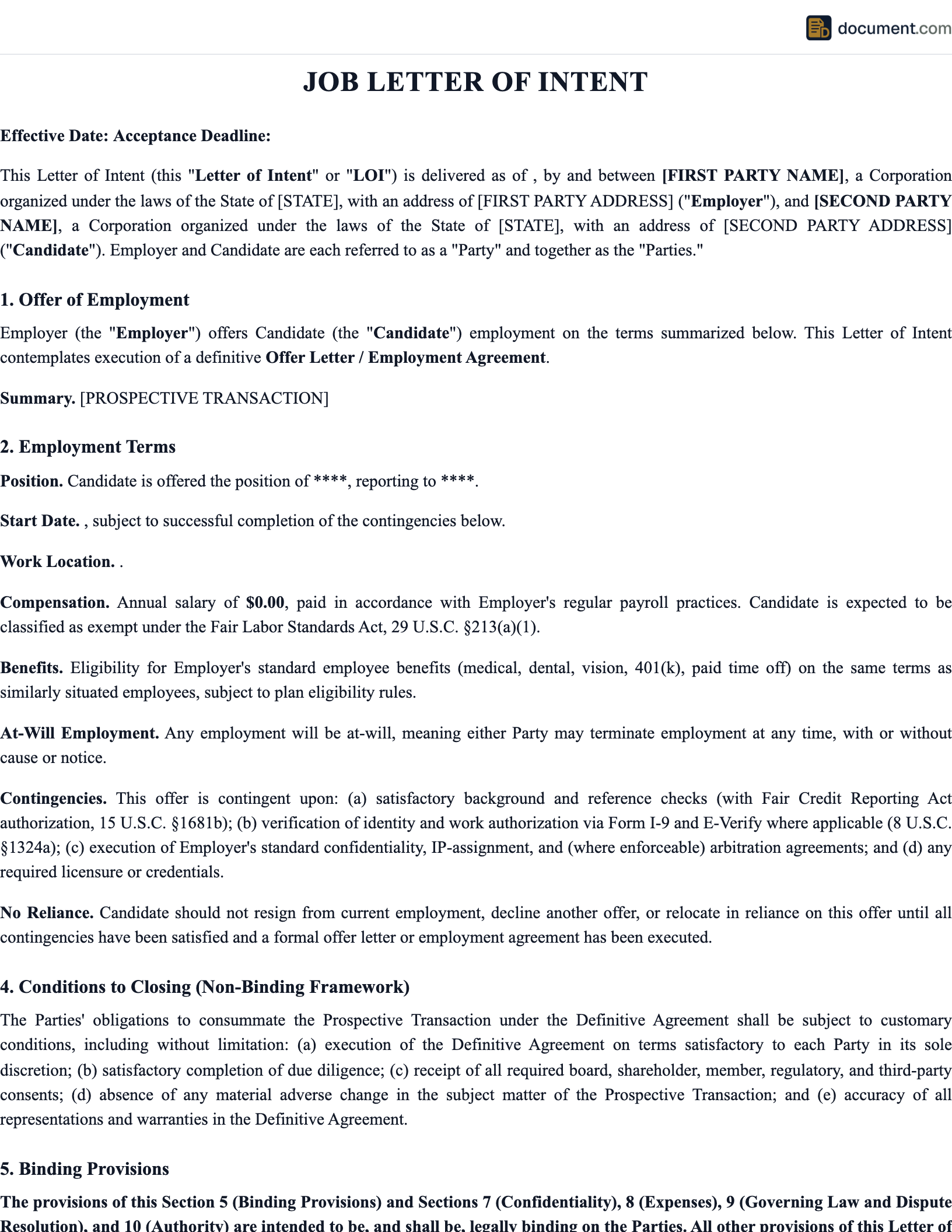



What Is a Job Letter of Intent?
A job letter of intent is a formal written document that communicates your professional interest in a specific employment opportunity, internal advancement, or continued employment arrangement. Unlike a general cover letter that accompanies a resume in a competitive application process, a job LOI is typically used in situations where there is already some degree of mutual interest or an established professional relationship. It serves as a bridge between informal discussions about employment and the formal offer letter or employment contract, allowing both the candidate and the employer to align on expectations before committing to a formal hiring process.
Job LOIs are particularly valuable in professional contexts where employment negotiations involve complex terms that benefit from preliminary documentation. In physician recruitment, for example, the LOI establishes proposed compensation structures, call schedules, malpractice insurance arrangements, and partnership track timelines before the parties invest months in formal contract negotiation and credentialing. In executive hiring, the LOI may outline equity participation, severance protections, and performance-based bonus structures that require board approval. For internal promotions and transfers, the LOI creates a written record of the employee's interest and qualifications that hiring managers can present to decision-makers.
The legal significance of a job LOI depends heavily on its language and the context in which it is used. In at-will employment states, a poorly worded LOI could inadvertently create implied contract claims if it contains specific promises about employment duration, termination protections, or compensation guarantees. Conversely, a well-drafted LOI with appropriate disclaimers preserves the preliminary nature of the communication while still demonstrating professional seriousness and commitment. Courts have generally held that LOIs expressing "interest" or "intent" without definitive terms do not create binding employment obligations, but LOIs containing specific compensation figures, start dates, and performance expectations have been treated as enforceable preliminary agreements in some jurisdictions.
Targeted Communication
Focuses on a specific position, promotion, or employment arrangement rather than a general application.
Preliminary Alignment
Establishes expectations on compensation, role, and timeline before formal negotiations begin.
Professional Record
Creates documented evidence of interest and proposed terms for internal decision-making processes.
Job Letter of Intent Form Preview
Letter of Intent
Employment Intent Declaration
1. INTENT AND POSITION
I, hereby express my intent to the position of with .
2. QUALIFICATIONS AND EXPERIENCE
I bring years of experience in , including demonstrated expertise in .
3. PROPOSED TERMS
Anticipated start date: . This letter is preliminary and subject to execution of a formal employment agreement.
CANDIDATE
DATE
Types of Job Letters of Intent
Job LOIs serve different purposes depending on the employment situation. Each type addresses specific professional circumstances and requires distinct content, tone, and level of detail.
Job Promotion LOI
Express formal interest in advancing to a higher position within your current organization
LOI to Continue Working
Communicate your intention to remain employed beyond a contract period or planned departure
LOI to Hire
Outline preliminary employment terms before drafting a formal offer letter or employment contract
Maternity LOI
Notify your employer of intended maternity leave dates, return plans, and accommodation requests
Physician LOI
Establish terms for physician recruitment including compensation, call schedules, and practice scope
Teacher LOI
Communicate your interest in a teaching position covering credentials, subject areas, and availability
Transfer Department LOI
Request an internal transfer to a different department, team, or office location within your organization
Key Components
Regardless of the specific type, every job letter of intent should address these essential elements to create a professional and effective communication:
| Component | Purpose | Key Details |
|---|---|---|
| Position Identification | Specifies the exact role being pursued | Job title, department, reporting structure, location, full-time or part-time designation |
| Qualifications Summary | Demonstrates fitness for the role | Relevant experience, education, certifications, skills, measurable achievements |
| Statement of Intent | Expresses clear interest and commitment | Specific interest in the position, motivation, alignment with career goals |
| Value Proposition | Articulates what you bring to the organization | Unique contributions, problem-solving capabilities, relevant domain expertise, leadership qualities |
| Proposed Terms | Outlines preliminary expectations | Expected start date, compensation range (if applicable), availability, notice period at current employer |
| Non-Binding Disclaimer | Preserves preliminary nature | Statement that LOI does not constitute an employment contract, subject to formal agreement |
| Professional Closing | Invites further discussion | Contact information, availability for interviews, references upon request |
How to Write a Job Letter of Intent
Research the Position and Organization
Before drafting your LOI, thoroughly research the target position, the organization's mission and recent developments, and the decision-makers who will receive your letter. For internal promotions, review the job description (if posted), understand the department's current challenges, and identify how your experience addresses those needs. For external positions, research the company's culture, competitive position, and strategic priorities. This research informs the specific language and examples you use throughout the LOI and demonstrates genuine interest beyond surface-level knowledge.
Open with a Clear Statement of Purpose
Begin your LOI with a direct statement identifying the specific position you are pursuing and your reason for writing. Avoid generic openings — instead, reference a specific conversation, job posting, or organizational need that prompted your letter. For example, reference a discussion with a hiring manager, an internal posting you identified, or a strategic initiative where your expertise would be valuable. The opening paragraph should immediately communicate what you want and why the reader should continue reading.
Present Your Qualifications with Evidence
Dedicate the body of your LOI to demonstrating your fitness for the role through specific, quantifiable achievements. Rather than listing job duties from your resume, describe outcomes: revenue generated, efficiency improvements achieved, teams built or managed, projects delivered, problems solved. Use the STAR format (Situation, Task, Action, Result) to frame your accomplishments in a narrative that connects your experience to the target role's requirements. For specialized positions like physician or teacher roles, include relevant credentials, certifications, and specialized training.
Articulate Your Value Proposition
Explain what you uniquely bring to the role that other candidates may not. This goes beyond qualifications to address strategic fit: how your background complements the team's existing strengths, what perspective or skills you add that the organization currently lacks, and how your career trajectory aligns with the position's growth potential. For internal candidates, leverage your institutional knowledge to describe specific improvements or initiatives you would pursue. For external candidates, describe transferable insights from your industry or functional background.
Address Terms and Logistics (When Appropriate)
For LOIs that involve preliminary employment terms — particularly LOIs to hire, physician LOIs, and executive-level positions — outline proposed compensation expectations, start date availability, relocation requirements, and any other material terms. Be specific enough to demonstrate seriousness but flexible enough to allow room for negotiation. If you are currently employed, state your notice period. If relocation is involved, address your timeline and any relocation assistance expectations. Always include a disclaimer that these terms are preliminary and subject to a formal employment agreement.
Close Professionally with a Call to Action
End your LOI with a clear statement of your interest and a specific next step. Rather than a passive 'I look forward to hearing from you,' propose a concrete action: 'I am available to meet during the week of [date] to discuss how my experience in [area] could support [department/initiative].' Provide your contact information, note your availability for interviews or further discussions, and express willingness to provide references, portfolio samples, or additional documentation upon request.
Frequently Asked Questions
Official Resources
Authoritative resources on employment law, workplace rights, and professional development for job seekers and employers.
U.S. Department of Labor - Wage and Hour Division
Federal guidance on employment standards, wage requirements, and worker classification rules that affect employment terms in LOIs.
EEOC - Employer Resources
Equal Employment Opportunity Commission guidance on non-discriminatory hiring practices, reasonable accommodations, and employment law compliance.
DOL - Family and Medical Leave Act
Federal FMLA guidance covering leave eligibility, employer obligations, and employee rights relevant to maternity leave LOIs.
Bureau of Labor Statistics - Occupational Outlook
Comprehensive data on job outlook, median pay, and qualification requirements across occupations to inform compensation discussions in LOIs.
SHRM - HR Templates and Tools
Society for Human Resource Management templates and guidance on hiring processes, offer letters, and employment documentation best practices.
CareerOneStop - Certification Finder
U.S. Department of Labor-sponsored tool for identifying professional certifications relevant to specific careers and industries.
Create Your Job Letter of Intent
Draft a professional LOI for job promotions, new hires, department transfers, physician recruitment, teaching positions, or maternity leave notifications.
Create DocumentNo account required. Free to create and preview.