
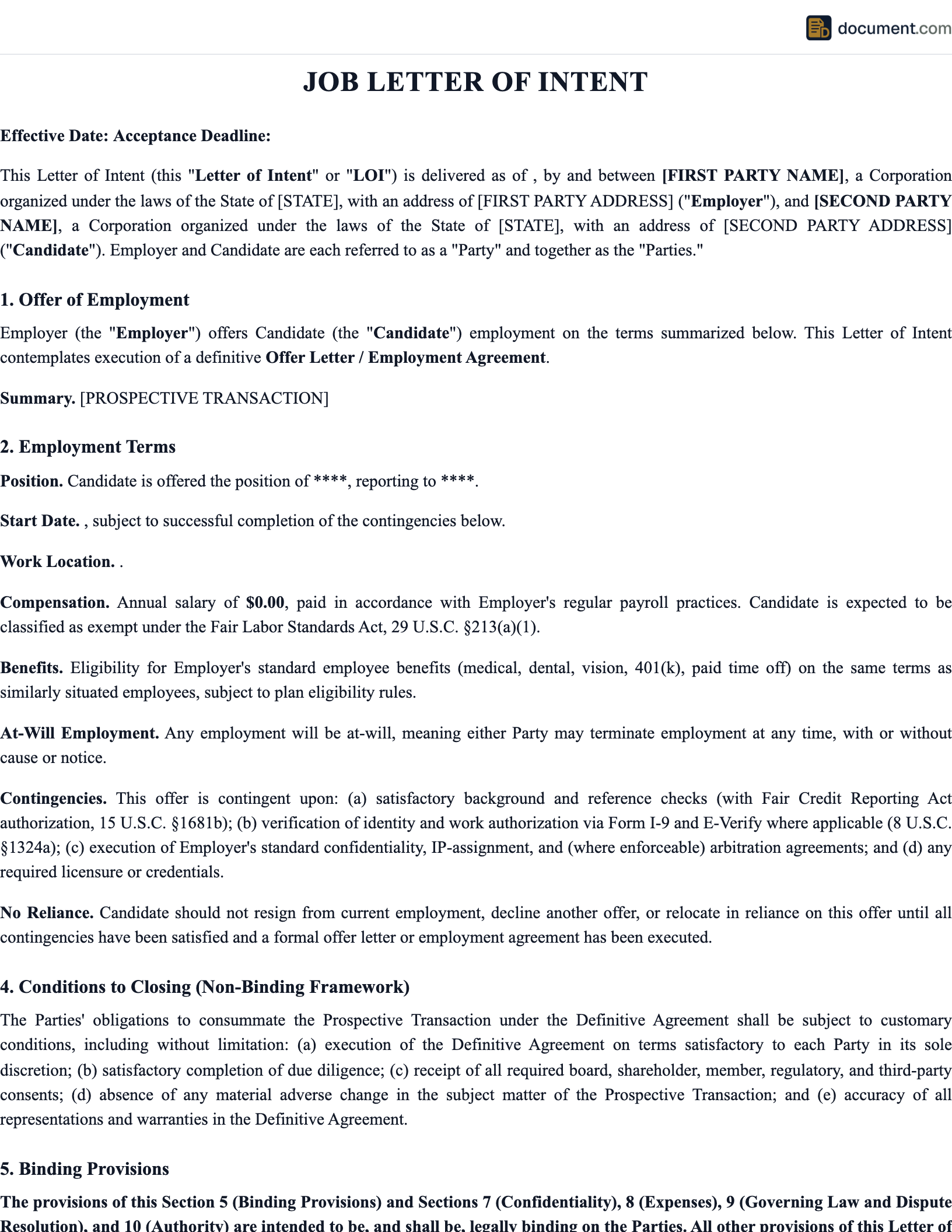



What Is a Teacher Letter of Intent?
A teacher letter of intent is a preliminary document used in educational employment that communicates either a teacher's formal interest in a position or a school district's preliminary commitment to hire a teacher, pending completion of required administrative processes. In public education, the LOI occupies an important position in the hiring timeline because teaching contracts require school board approval, which may not occur until weeks or months after the hiring decision is made at the administrative level. The LOI allows principals and HR departments to secure candidates while the formal approval process proceeds.
The teacher LOI differs from LOIs in other employment contexts because teaching positions are governed by multiple layers of regulation. State education codes dictate certification requirements, contract terms, probationary periods, and tenure provisions. Collective bargaining agreements in unionized districts establish salary schedules, work hours, evaluation procedures, and transfer rights. Federal laws including Title VII, the ADA, and the Individuals with Disabilities Education Act (IDEA) impose additional requirements on educational employers. The teacher LOI must navigate these overlapping regulatory frameworks while providing both parties with sufficient certainty to plan for the upcoming academic year.
For teachers, the LOI serves as a professional commitment device that signals serious interest while preserving negotiating flexibility on assignment details, extracurricular responsibilities, and professional development opportunities. For districts, it secures qualified candidates in competitive hiring markets, particularly for shortage areas where teacher supply is limited. The LOI also creates documentation that is important if questions arise about the hiring process, equal opportunity compliance, or contract formation.
Credential Alignment
Verifies certification, endorsements, and highly qualified status for the assigned position.
Assignment Clarity
Specifies grade level, subject area, building assignment, and extracurricular duties.
Salary Placement
Determines step and lane on the district salary schedule based on experience and education.
Teacher LOI Form Preview
Letter of Intent
Teaching Position
1. DISTRICT AND TEACHER
School District intends to recommend for a teaching position in , subject to board approval.
2. ASSIGNMENT AND COMPENSATION
Grade level/subject: . Salary schedule placement: Step , Lane , annual salary of $ .
3. CONTINGENCIES
This intent is contingent upon: board approval, verification of certification, satisfactory background check, and sufficient enrollment.
DISTRICT REPRESENTATIVE
TEACHER
Key Components
An effective teacher LOI should address these education-specific elements:
| Component | Purpose | Key Details |
|---|---|---|
| Teaching Assignment | Defines the position | Grade level, subject area, building, department, special programs (AP, IB, ESL) |
| Salary Placement | Sets compensation | Step, lane, annual salary, experience credit, education lane movement criteria |
| Certification Status | Verifies legal qualifications | License type, endorsements, Praxis scores, reciprocity status, renewal requirements |
| Contract Term | Establishes duration | Academic year dates, probationary vs. continuing contract, renewal conditions |
| Extracurricular Duties | Specifies additional responsibilities | Coaching, club sponsorship, department chair, stipend amounts, release time |
| Benefits Package | Summarizes coverage | Health insurance, retirement (TRS/PERS), tuition reimbursement, professional development |
How to Write a Teacher Letter of Intent
Identify the Position and Assignment
Specify the exact teaching position including grade level (elementary, middle, high school), subject area (mathematics, English language arts, science, social studies, world languages, fine arts), building assignment, and any specialized program responsibilities (Advanced Placement, International Baccalaureate, dual enrollment, English as a Second Language, special education). If the position involves teaching multiple subjects or grade levels, list each assignment. This precision prevents later disagreements about the scope of the teaching assignment and ensures the teacher holds appropriate certification for each assigned area.
Confirm Salary Schedule Placement
Reference the district's salary schedule and identify the proposed step (based on verified years of teaching experience) and lane (based on education level and graduate credits). Note which years of prior experience the district is crediting and whether verification of transcripts and previous employment is required before placement is finalized. If the district offers additional compensation components — signing bonuses for shortage areas, stipends for national board certification, housing allowances, or student loan repayment assistance — include those in the LOI.
Address Certification and Background Requirements
Detail the certification requirements for the position and confirm the teacher's credential status. If the teacher is certified in another state and needs to obtain reciprocal certification, specify the timeline and any additional requirements (state-specific examinations, coursework, mentoring programs). Include contingencies for satisfactory background check completion, fingerprint clearance, and any district-specific pre-employment requirements. For teachers on provisional or emergency credentials, outline the pathway and timeline for obtaining standard certification.
Outline Extracurricular Expectations
Many teaching positions include expectations for extracurricular involvement beyond the regular teaching day. The LOI should specify any coaching assignments, club sponsorships, activity supervision duties, or committee responsibilities that are part of the position. Include the stipend amount for each extracurricular duty, whether the duties are voluntary or required, and the expected time commitment. This transparency prevents surprises after the contract is signed and allows the teacher to negotiate these responsibilities before committing.
Specify Contingencies and Board Approval
List all contingencies that must be satisfied before the employment relationship is formalized: school board approval at a public meeting, verification of teaching credentials and endorsements, satisfactory completion of background checks and fingerprint clearance, verification of educational transcripts and prior teaching experience, and sufficient student enrollment to justify the position. If the position is funded by a grant or special program, note that continuation is contingent on funding availability.
Include Professional Development and Support
Address the professional development and support structures available to the teacher, particularly if they are new to the district or new to the profession. Include information about new teacher orientation, mentoring programs for probationary teachers, professional development opportunities and funding, tuition reimbursement for advanced degrees or additional certifications, and the district's teacher evaluation system. These provisions demonstrate the district's investment in teacher development and give the teacher a complete picture of the professional environment.
Certification and Licensure Considerations
Teaching certification is a prerequisite for employment in all public school districts and most private schools, and the LOI must carefully address the teacher's credential status. Each state has its own certification framework with different terminology (license, certificate, credential), different tiers (provisional, standard, professional, master), and different requirements for initial certification, renewal, and advancement. The Interstate Teacher Assessment and Support Consortium (InTASC) provides model standards, but implementation varies significantly by state.
For teachers moving between states, certification reciprocity is a critical concern that the LOI should address. While most states participate in interstate compacts that facilitate credential recognition, reciprocity is not automatic. Teachers may need to complete additional state-specific requirements such as passing the Praxis series or state-developed assessments, completing coursework in state government or state history, fulfilling continuing education requirements, and obtaining a state-specific background check. The LOI should specify the timeline for obtaining the new state credential and whether the district will provide administrative support for the process.
Contract Penalty States
Several states impose penalties on teachers who breach contracts or binding commitments after a specified cutoff date. States including Texas, Georgia, Indiana, and South Carolina can suspend a teaching license for one year or more if a teacher abandons a contract within a certain number of days before the school year begins (typically 45 to 60 days). Teachers should verify whether their state treats a signed LOI as creating obligations that trigger these penalty provisions.
Frequently Asked Questions
Official Resources
Authoritative resources on teacher employment, certification, and education law.
U.S. Department of Education - Teachers
Federal resources on teacher qualifications, preparation programs, certification requirements, and professional development.
Teach.org - Teaching Resources
Comprehensive information on teaching careers, state certification requirements, alternative certification pathways, and job search tools.
NEA - Professional Excellence
National Education Association resources on teacher contracts, collective bargaining, professional standards, and employment rights.
AFT - Teacher Quality
American Federation of Teachers resources on teacher preparation, certification standards, and employment conditions.
National Board for Professional Teaching Standards
National Board certification information, including eligibility, process, and the impact of board certification on salary and career advancement.
NASDTEC - Interstate Agreement
National Association of State Directors of Teacher Education and Certification resources on interstate certification reciprocity.
Create Your Teacher Letter of Intent
Draft a professional teacher LOI that addresses certification, salary placement, assignment details, and district-specific provisions for your teaching position.
Create DocumentNo account required. Free to create and preview.