
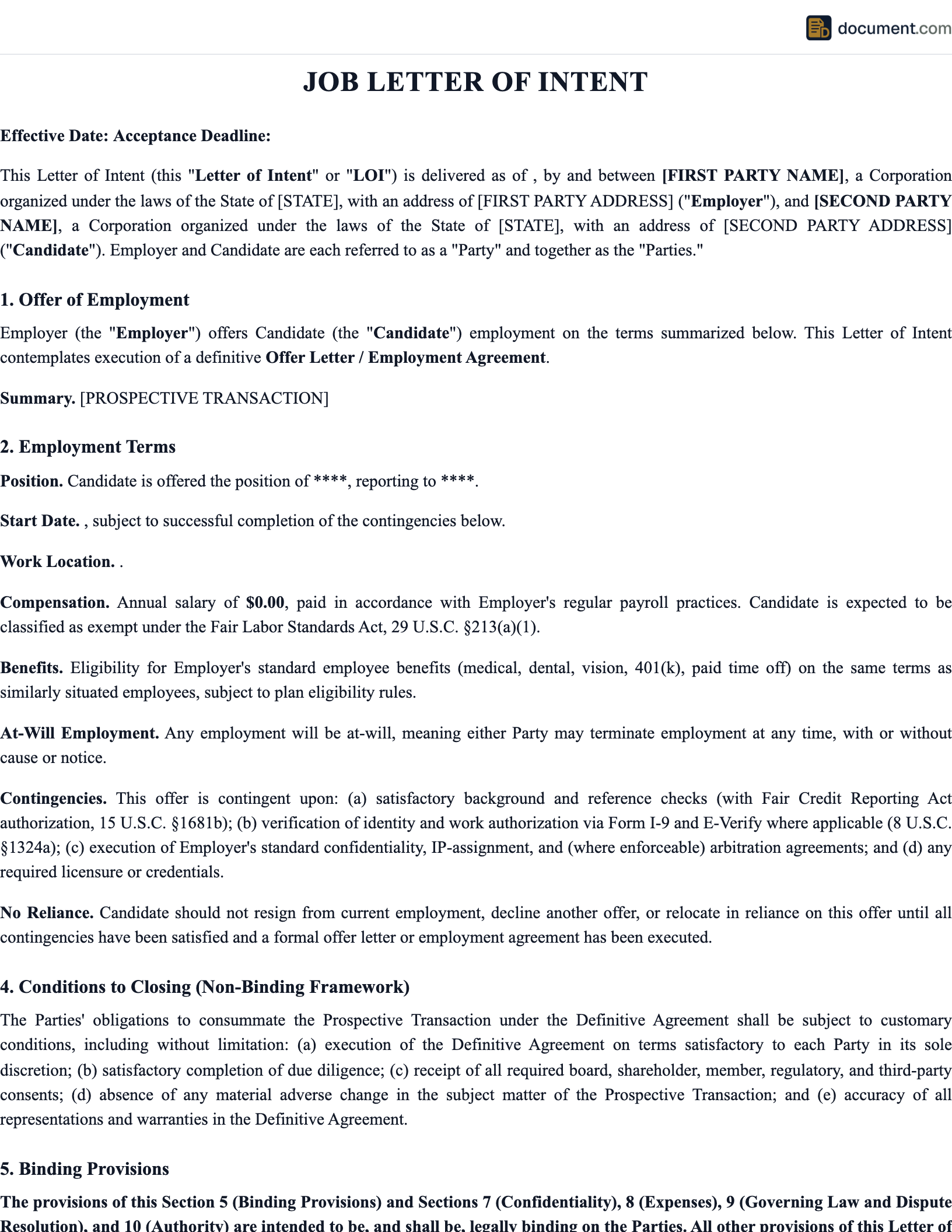



What Is a Letter of Intent to Hire?
A letter of intent to hire is a formal preliminary document issued by an employer to a prospective employee that communicates the organization's serious intention to extend a formal offer of employment. The LOI occupies a specific position in the hiring timeline: it follows successful interviews and internal approval to proceed with the candidate, but precedes the formal offer letter and definitive employment agreement. Employers use this document when they need to signal commitment to a top-choice candidate while administrative processes — background checks, budget approvals, board ratification, or credential verification — are still in progress.
The strategic value of the LOI to hire lies in candidate retention during the often-lengthy period between verbal agreement and formal offer. In competitive labor markets, highly qualified candidates may receive multiple offers simultaneously. Without a written document signaling commitment, the employer risks losing the candidate to a competitor who moves faster. The LOI provides the candidate with enough certainty to pause their job search and make preliminary arrangements (giving notice, planning relocation, arranging childcare) while the employer completes its internal processes. This function makes the LOI particularly valuable for executive-level positions, specialized technical roles, and candidates who must relocate or resign from secure positions.
From a legal perspective, the LOI to hire must be carefully drafted to achieve its purpose of signaling commitment without creating a binding employment contract. Courts have applied promissory estoppel principles when candidates relied on LOIs to their detriment — resigning from current employment, turning down other offers, or incurring relocation expenses — only to have the employer withdraw. The LOI must include clear non-binding disclaimers, at-will employment statements (where applicable), and explicit contingencies that must be satisfied before the employment relationship commences.
Candidate Retention
Secures top candidates while internal approvals and background checks are completed.
Legal Protection
Preserves at-will status and non-binding character while demonstrating good faith.
Negotiation Framework
Establishes proposed terms as a starting point for detailed offer negotiation.
LOI to Hire Form Preview
Letter of Intent
Intent to Hire
1. EMPLOYER AND CANDIDATE
("Company") hereby expresses its intent to hire ("Candidate") for the position of .
2. PROPOSED COMPENSATION
The anticipated annual base salary is $ , paid on a basis, subject to applicable withholdings.
3. CONTINGENCIES
This letter of intent is contingent upon satisfactory completion of:
EMPLOYER
CANDIDATE
Key Components
An effective LOI to hire must address these essential elements to provide the candidate with meaningful preliminary commitment while protecting the employer:
| Component | Purpose | Key Details |
|---|---|---|
| Position Description | Defines the role | Title, department, reporting line, location, FLSA classification (exempt/non-exempt) |
| Compensation Package | Outlines financial terms | Base salary, bonus structure, signing bonus, equity/stock options, commission schedule |
| Benefits Summary | Describes benefit package | Health insurance, 401(k) matching, PTO, parental leave, professional development |
| Start Date | Sets employment timeline | Proposed start date, flexibility, onboarding schedule, orientation details |
| Contingencies | Protects employer interests | Background check, drug screen, credential verification, reference checks, work authorization |
| At-Will Designation | Preserves employment flexibility | At-will statement, non-binding disclaimer, no guarantee of continued employment |
| Response Deadline | Creates urgency and timeline | Expiration date, acceptance method, contact person for questions |
How to Draft a Letter of Intent to Hire
Identify the Position and Candidate
Begin with a clear statement of the company's intent to hire the specific candidate for a defined position. Include the candidate's full legal name, the exact position title, the department or business unit, the work location (including remote work arrangements), and the anticipated FLSA classification. Precision here prevents misunderstandings about the role and establishes the scope of the preliminary commitment.
Outline Compensation and Benefits
Present the proposed compensation package in enough detail to give the candidate a meaningful understanding of the financial terms without committing to every line item. Include base salary (annual amount and pay frequency), any signing bonus, performance bonus structure or eligibility, equity or stock option grants if applicable, and a summary of major benefits including health insurance, retirement plan, and paid time off. Note that detailed benefits information will be provided in the formal offer package.
Specify Pre-Employment Contingencies
List every contingency that must be satisfied before the employment relationship commences. Background check requirements (criminal, credit, driving record), drug testing protocols, verification of educational credentials and professional licenses, employment eligibility verification (Form I-9/E-Verify), reference checks, and any required medical examinations or fitness-for-duty evaluations. State that the employer's obligation to proceed is conditional on satisfactory completion of all listed contingencies.
Include Non-Binding and At-Will Language
Draft clear disclaimers stating that the LOI does not constitute a binding offer of employment, does not create a contract, and does not guarantee employment for any specific duration. In at-will states, include a statement that the anticipated employment relationship is at-will and can be terminated by either party at any time. Specify that the LOI will be superseded by the formal offer letter and any employment agreement. This language is essential to prevent promissory estoppel claims.
Propose a Start Date and Response Timeline
Include a proposed start date that accounts for the candidate's notice period at their current employer, relocation timeline if applicable, and completion of pre-employment contingencies. Set a response deadline by which the candidate should acknowledge receipt and indicate their continued interest. This deadline creates a defined window for the employer to hold the position and prevents indefinite uncertainty.
Reference Ancillary Agreements
Note any additional agreements the candidate will be required to execute as a condition of employment: non-disclosure agreements, non-compete or non-solicitation covenants, intellectual property assignment agreements, arbitration agreements, or acknowledgment of the employee handbook and company policies. Identifying these requirements in the LOI avoids surprises at the offer stage and gives the candidate time to review these obligations with their own legal counsel.
LOI to Hire vs Offer Letter
Understanding the distinction between a letter of intent to hire and a formal offer letter is critical for both employers and candidates. The LOI is a preliminary communication that expresses intent and outlines proposed terms subject to contingencies and further negotiation. It is issued before pre-employment screening is complete and before the employer has finalized all internal approvals. The LOI explicitly preserves the employer's ability to withdraw if contingencies are not satisfied.
The formal offer letter, by contrast, is issued after contingencies are cleared and represents the employer's definitive commitment to hire the candidate under specific terms. The offer letter includes finalized compensation details, specific benefits enrollment information, a confirmed start date, and an acceptance signature line. When the candidate signs the offer letter, it typically creates an agreement to begin employment on the stated terms, though the at-will nature of the employment (where applicable) means either party can still terminate at any time after employment commences.
Promissory Estoppel Risk
Even with proper non-binding language, employers face promissory estoppel exposure if candidates detrimentally rely on the LOI. Courts in states including California, New York, Illinois, and Texas have awarded damages to candidates who resigned from secure positions, relocated, or turned down competing offers based on LOIs that were subsequently withdrawn. The risk increases when the LOI contains specific, detailed terms that resemble a formal offer rather than a general expression of intent.
Frequently Asked Questions
Official Resources
Authoritative resources on hiring practices, employment law, and pre-employment screening requirements.
EEOC - Pre-Employment Inquiries
EEOC guidance on lawful pre-employment screening, medical examinations, and disability-related inquiries during the hiring process.
DOL - Fair Labor Standards Act
Department of Labor guidance on FLSA classifications, minimum wage, overtime requirements, and exempt vs non-exempt status determinations.
USCIS - Employment Eligibility Verification
U.S. Citizenship and Immigration Services resources on Form I-9 requirements, E-Verify, and employment authorization documentation.
FTC - Fair Credit Reporting Act
Federal Trade Commission guidance on employer obligations when using consumer reports and background checks in hiring decisions.
SHRM - Talent Acquisition
Society for Human Resource Management resources on hiring best practices, offer letter templates, and pre-employment screening standards.
NLRB - Employer Rights and Obligations
National Labor Relations Board guidance on employer obligations during the hiring process in unionized workplaces.
Create Your Letter of Intent to Hire
Draft a professional LOI to hire that signals commitment to your top candidate while protecting your organization with proper contingencies and non-binding language.
Create DocumentNo account required. Free to create and preview.