
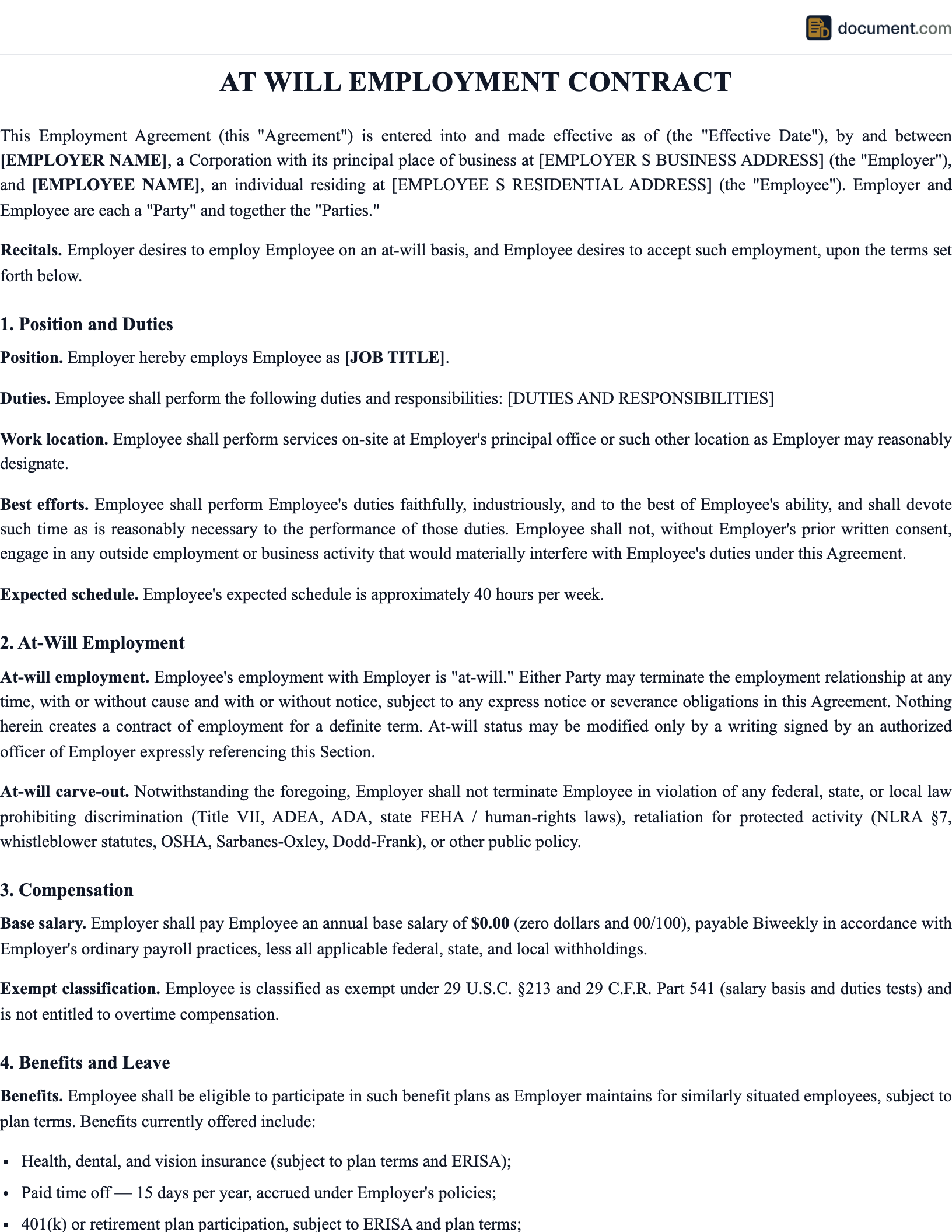



What Is At-Will Employment?
At-will employment is the default employment relationship in 49 of the 50 U.S. states. Under the at-will doctrine, either the employer or the employee may end the employment relationship at any time, for any reason or no reason at all, with or without advance notice — so long as the reason is not otherwise unlawful. The at-will rule originated in the late 19th century and remains the baseline rule for private-sector employment in the United States today. Only Montana, through its Wrongful Discharge from Employment Act, departs from the at-will doctrine and requires good cause for termination after a probationary period.
Although at-will is the default, several important legal limits restrict an employer's ability to terminate. Federal anti-discrimination laws (Title VII of the Civil Rights Act, the Americans with Disabilities Act, the Age Discrimination in Employment Act) prohibit termination based on race, color, religion, sex, national origin, disability, or age. Anti-retaliation statutes protect employees who engage in activity such as filing discrimination charges, reporting unsafe working conditions to OSHA, complaining about wage and hour violations, or taking leave under the Family and Medical Leave Act. State anti-discrimination laws and local ordinances often add further protected categories — sexual orientation, gender identity, marital status, source of income, and others. And virtually every state recognizes a public policy exception that prohibits terminations in violation of clear public policy, such as firing an employee for refusing to commit a crime or for exercising a legal right.
A written at-will employment contract serves two main purposes. First, it documents the relationship clearly: position, compensation, hours, duties, benefits, confidentiality, intellectual property ownership, and at-will status. Second, it defeats implied-contract claims that could otherwise arise from employee handbooks, oral promises, or a pattern of conduct suggesting guaranteed continued employment. Courts in most states recognize that an express written at-will clause, signed by the employee, is strong evidence that the parties intended an at-will relationship and that no implied contract exists.
Our at-will employment contract templates are drafted to work in the 49 at-will states and include all the standard protective provisions: a clear at-will acknowledgment, compensation and benefits terms, confidentiality obligations, IP assignment (with California Labor Code § 2870 carve-outs where applicable), non-solicitation language, governing law, and proper execution. For Montana-based employees, a separate Montana-specific employment agreement is required.
Maximum Flexibility
Either party may end employment at any time for any lawful reason.
Clear Documentation
Sets out position, pay, benefits, and duties in writing.
IP & Confidentiality
Protects trade secrets and assigns ownership of work product.
At-Will Contract Form Preview
At-Will Employment Agreement
Standard Full-Time / Part-Time
Section 1: Position & Duties
Section 2: Compensation
Section 3: At-Will Status
Employment is "at will" — either party may terminate at any time for any lawful reason, with or without notice.
Common Uses
Full-Time Hires
Standard W-2 full-time employees across most industries, including office and remote workers.
Part-Time Staff
Regular part-time employees working fewer than full-time hours with flexible scheduling.
Executives
Senior managers and executives, often with additional protections such as severance or change-of-control provisions layered on top.
Retail & Hospitality
Customer-facing staff in retail, restaurants, and hospitality where turnover is frequent and flexibility is valued.
Tech & Startups
Software engineers, product managers, and designers — often paired with IP assignment and confidentiality terms.
Small Businesses
Small-business owners hiring their first employees who want clear at-will status and basic terms in writing.
At-Will vs Fixed-Term Employment
| Factor | At-Will | Fixed-Term |
|---|---|---|
| Duration | Indefinite | Set period (e.g., 1–3 years) |
| Termination | Any time, any lawful reason | Only for cause (usually) |
| Notice Required | None | Often required |
| Best For | Standard employees | Executives, projects, academics |
| Employer Flexibility | High | Low |
| Employee Security | Lower | Higher during term |
How to Create an At-Will Employment Contract
Identify the parties
Use the legal name of the employer entity (Inc., LLC, etc.) and the full legal name of the employee.
Describe the position and duties
Job title, reporting line, principal duties, work location (including remote), and expected hours.
Set compensation and benefits
Base salary or hourly rate, bonus eligibility, commissions, benefits, PTO, and expense reimbursement.
Include the at-will clause
A clear, express statement that employment is at will and may be terminated at any time by either party for any lawful reason.
Add confidentiality and IP assignment
Standard protections for trade secrets and ownership of work product, with state-specific carve-outs where required (e.g., California § 2870).
Address restrictive covenants (if any)
Non-solicitation (of customers and employees) is generally enforceable; non-competes are subject to strict state-law limits.
Governing law, severability, and signatures
Choose the state whose law governs, include standard boilerplate, and execute with both parties' signatures.
Key Components
Parties
Legal name of employer entity and full name of employee.
Position and Duties
Job title, reporting line, responsibilities, and work location.
Compensation
Base pay, bonus, commissions, and pay schedule.
Benefits
Health insurance, retirement, PTO, and other benefits.
At-Will Clause
Express statement that employment is at will.
Confidentiality
Protection of trade secrets and proprietary information.
IP Assignment
Ownership of work product and inventions, with state-specific carve-outs.
Non-Solicitation
Restrictions on soliciting customers and employees after separation.
Return of Property
Return of company property, devices, and confidential information on separation.
Governing Law
State whose law governs the contract.
Entire Agreement
Supersedes prior oral or written understandings.
Signatures
Employer and employee, with date.
Exceptions to At-Will Employment
Even in at-will states, several exceptions limit the employer's ability to terminate.
Anti-Discrimination Laws
Title VII, ADA, ADEA, state laws, and local ordinances prohibit termination based on protected characteristics.
Retaliation Protections
Cannot fire for filing a charge, reporting unsafe conditions, taking FMLA leave, or similar protected activity.
Public Policy Exception
Cannot fire for refusing to commit an illegal act, exercising a legal right, or whistleblowing.
Implied-Contract Exception
Handbook promises or oral assurances can create an implied contract limiting at-will termination.
Good Faith and Fair Dealing
Recognized in a minority of states; prevents bad-faith terminations designed to deprive employees of earned benefits.
The Montana Exception
Montana is the only U.S. state that does not follow the at-will doctrine. Under the Montana Wrongful Discharge from Employment Act (MCA § 39-2-901 et seq.), an employer may only terminate an employee for "good cause" after completion of a probationary period (default six months). "Good cause" means reasonable, job-related grounds based on failure to satisfactorily perform job duties, disruption of the employer's operation, or other legitimate business reasons. Montana employees terminated without good cause may recover lost wages and fringe benefits for up to four years. If you hire employees in Montana, you need a Montana-specific agreement — a standard at-will contract from another state is not appropriate.
Best Practices
- Always include a clear, express at-will clause in both the employment contract and any offer letter.
- Include an at-will disclaimer in the employee handbook and require employees to sign an acknowledgment.
- Train managers to avoid oral promises of continued employment or job security.
- Document performance issues contemporaneously to support any termination decision.
- Follow a consistent, documented progressive discipline process where appropriate — without creating a contractual entitlement.
- Have terminations reviewed by HR or counsel before execution to ensure no protected-class or retaliation concerns.
- Update contracts and handbooks periodically to reflect current federal, state, and local law.
Sample At-Will Employment Agreement
AT-WILL EMPLOYMENT AGREEMENT
This At-Will Employment Agreement ("Agreement") is entered into as of [Effective Date] between [Employer] ("Employer") and [Employee] ("Employee").
1. POSITION AND DUTIES
Employer hires Employee as [Position], reporting to [Manager]. Employee shall perform the duties described in Exhibit A and such other duties as Employer may reasonably assign.
2. COMPENSATION
Employer shall pay Employee a base salary of $[Amount] per year, payable in accordance with Employer's standard payroll practices. Employee is eligible for Employer's standard benefits package, subject to the terms of each plan.
3. AT-WILL EMPLOYMENT
Employee's employment is "at will," which means that either Employee or Employer may terminate the employment relationship at any time, with or without cause or notice, subject only to applicable law. Nothing in this Agreement or any employee handbook, policy, or oral statement alters this at-will relationship, and no representative of Employer has authority to modify Employee's at-will status except in a writing signed by an authorized officer.
4. CONFIDENTIALITY
Employee agrees to hold in strict confidence all trade secrets and confidential information of Employer, to use such information solely for Employer's benefit, and not to disclose such information to any third party during or after employment.
5. INTELLECTUAL PROPERTY ASSIGNMENT
Employee assigns to Employer all right, title, and interest in any inventions, works of authorship, or other intellectual property created during employment that relate to Employer's business, subject to any carve-outs required by applicable state law (including California Labor Code § 2870 for California employees).
6. NON-SOLICITATION
For a period of [12] months following termination, Employee shall not solicit Employer's customers or employees for competing purposes.
7. RETURN OF PROPERTY
Upon termination, Employee shall promptly return all Employer property, including documents, devices, and confidential information.
8. GOVERNING LAW
This Agreement shall be governed by the laws of the State of [State], without regard to its conflict-of-law principles.
Frequently Asked Questions
Official Resources
U.S. Department of Labor
Federal wage, hour, and employment law resources.
EEOC - Equal Employment Opportunity Commission
Federal anti-discrimination enforcement and employer guidance.
NLRB - National Labor Relations Board
Federal labor-relations rules governing protected concerted activity.
OSHA - Workplace Safety
Occupational Safety and Health Administration.
FTC - Non-Compete Rulemaking
Federal Trade Commission rulemaking on non-compete agreements.
DOL - Family and Medical Leave Act
FMLA leave rights and employer obligations.
SSA - Employer Information
Social Security Administration employer resources.
IRS - Employer Tax Information
Federal tax obligations for employers.
Create your At Will Employment Contract in under 10 minutes.
Answer a few questions and download a compliant, attorney-drafted document ready for your state.