



What Is a Confidentiality Agreement?
A confidentiality agreement is a legally binding contract that obligates the parties to protect specific information shared during a business, employment, or professional relationship. In common commercial practice, the term is used interchangeably with "non-disclosure agreement" or NDA. Either label covers the same operative elements: identification of the parties, a clear definition of what counts as confidential, restrictions on the use and disclosure of that information, standard exclusions for information that is already public or independently known, a defined term and survival period, and contractual remedies for breach.
Confidentiality agreements are one of the most widely used commercial contracts in the United States. Every business that hires employees, engages contractors, partners with vendors, or explores new opportunities benefits from a standard confidentiality agreement. For employees, the agreement protects trade secrets, customer lists, and internal processes. For contractors and consultants, it protects proprietary workflows and data they encounter during an engagement. For partners and vendors, it enables meaningful business discussions without risking the loss of competitive advantage.
The enforceability of a confidentiality agreement is grounded in contract law — which applies in every U.S. state — and reinforced by state trade-secret statutes based on the Uniform Trade Secrets Act (UTSA) and the federal Defend Trade Secrets Act (DTSA) of 2016. The DTSA provides a federal cause of action for trade-secret misappropriation, allowing suits in federal court with remedies including injunctive relief, compensatory damages, unjust enrichment, and — for willful and malicious misappropriation — exemplary damages up to twice actual damages plus attorneys' fees.
Our confidentiality agreement templates are drafted for clarity, enforceability, and flexibility. Each template includes a broad-but-bounded definition of confidential information, standard carve-outs, a return-or-destroy clause, a survival period, governing-law and venue selection, the DTSA whistleblower notice, and electronic-signature-ready formatting.
Broad Protection
Covers trade secrets, customer data, financials, and technical information.
Flexible Structure
Unilateral, mutual, and multi-party variations available.
Enforceable Remedies
Injunctive relief, damages, attorneys' fees, and DTSA protection.
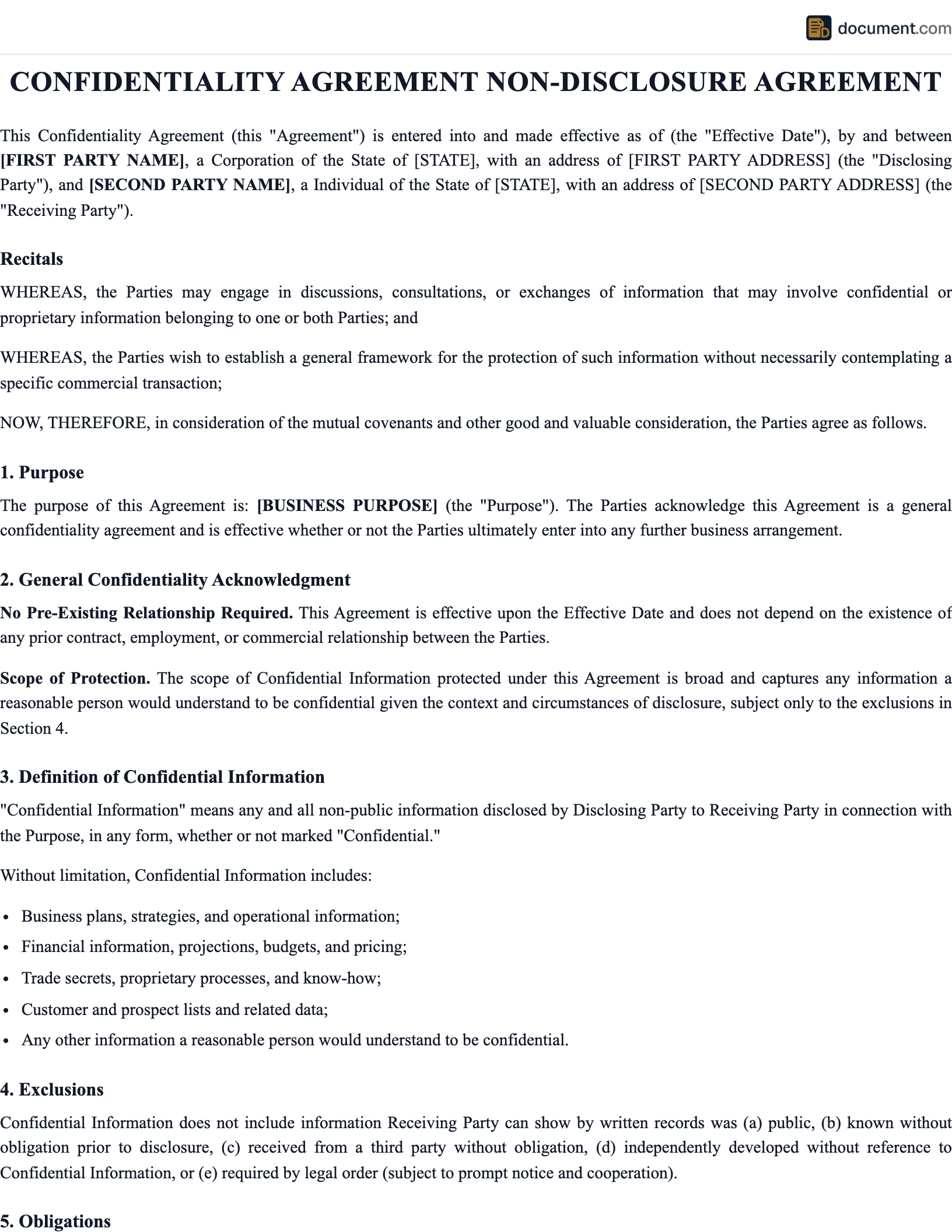
Confidentiality Agreement Form Preview
Preview of the structure and key fields in our confidentiality agreement template.
Confidentiality Agreement
Employment / Contractor / Vendor
Section 1: Parties
Section 2: Confidential Information
Common Uses
Confidentiality agreements are used across nearly every industry and relationship where non-public information is shared.
Employment
Protect proprietary information, customer data, and internal processes shared with employees during onboarding.
Board & Advisory
Require directors and advisors to protect sensitive board materials, financials, and strategic plans.
Professional Services
Lawyers, accountants, and consultants handling client information in the ordinary course of professional engagement.
Healthcare Staff
Non-HIPAA confidentiality obligations for staff handling sensitive patient and operational data (separate from a Business Associate Agreement).
Trade Shows
Exhibitors and attendees agreeing to protect demos, samples, and unreleased product information.
Research Collaboration
Academic institutions and industry partners protecting research data, methods, and unpublished findings.
Confidentiality Agreement vs NDA
The two terms are used interchangeably. Usage tends to split along formality and context.
| Factor | Confidentiality Agreement | NDA |
|---|---|---|
| Common Context | Employment, consulting, long-term relationships | Pre-deal, one-off, short discussions |
| Typical Length | Longer, more detailed | Shorter, focused |
| Legal Substance | Identical | Identical |
| Enforceability | Same standards | Same standards |
How to Create a Confidentiality Agreement
Identify the parties
Full legal names and entity types of every person or company bound by the agreement.
Describe the relationship or purpose
Why confidential information is being shared — employment, engagement, evaluation.
Define confidential information
List categories and include a reasonable-person catch-all.
Add standard carve-outs
Public domain, prior knowledge, independent development, third-party source, legal compulsion.
Set obligations and standard of care
Limit use, require reasonable protection, restrict access to need-to-know personnel.
Choose term and survival
Ordinary information 2–5 years; trade secrets indefinite.
Select remedies, governing law, and execute
Add injunctive relief language, DTSA notice, governing state, and sign electronically.
Key Components
Parties
Who is bound and who is protected.
Purpose or Relationship
Why information is being shared.
Definition of Confidential Information
Scope of protected material.
Carve-Outs
Standard exclusions.
Permitted Use
Use only for the defined purpose.
Standard of Care
At least reasonable protection; often the same as own confidential information.
Term & Survival
Duration and post-termination obligations.
Return or Destruction
Return or destroy upon request.
Remedies
Injunctive relief, damages, fees, DTSA remedies.
Governing Law & Venue
Chosen state and court.
DTSA Whistleblower Notice
Required to preserve exemplary damages.
Signatures
Authorized, with electronic signature support.
What Counts as Confidential Information
Confidential information is any non-public information of commercial value that the owner takes reasonable steps to keep secret. Typical categories include trade secrets, proprietary code, algorithms, financial information, customer and prospect lists, pricing, marketing strategy, product roadmaps, unreleased designs, and employee information. Standard exclusions include information that is already public, independently developed, already known, lawfully received from third parties, or disclosed under legal compulsion.
Term and Survival
Most confidentiality agreements run for the duration of the relationship plus a survival period of two to five years. Trade-secret obligations typically continue indefinitely because the protection depends on the information remaining secret.
Enforcement and Remedies
Courts routinely grant injunctive relief for confidentiality breaches and, where trade secrets are involved, apply the DTSA's enhanced remedies. Well-drafted agreements include an acknowledgment of irreparable harm so injunctions can be granted without a bond.
Sample Confidentiality Agreement
CONFIDENTIALITY AGREEMENT
This Confidentiality Agreement (this "Agreement") is made as of [Effective Date] between [Company] ("Company") and [Receiving Party] ("Receiving Party").
1. CONFIDENTIAL INFORMATION
"Confidential Information" means all non-public information disclosed by Company, in any form, including but not limited to trade secrets, know-how, business plans, customer and supplier information, financial data, technical specifications, source code, and any information marked as confidential or that a reasonable person would understand to be confidential.
2. OBLIGATIONS OF RECEIVING PARTY
Receiving Party agrees to (a) hold Confidential Information in strict confidence; (b) use it only for the purpose described in this Agreement; (c) protect it with at least reasonable care; and (d) not disclose it to any third party without Company's prior written consent.
3. EXCLUSIONS
Confidential Information does not include information that is or becomes publicly available through no fault of Receiving Party, was known to Receiving Party before disclosure, is independently developed without reference to Confidential Information, or is lawfully received from a third party.
4. TERM
This Agreement continues for [term], and the confidentiality obligations survive for [survival], with trade-secret obligations continuing indefinitely.
5. REMEDIES
Receiving Party acknowledges that a breach may cause irreparable harm and that Company shall be entitled to injunctive relief without the need to post a bond, in addition to any other remedies at law or in equity.
6. DTSA NOTICE
Pursuant to 18 U.S.C. § 1833(b), an individual shall not be held criminally or civilly liable for the disclosure of a trade secret made in confidence to a federal, state, or local government official, or to an attorney, solely for the purpose of reporting or investigating a suspected violation of law.
Frequently Asked Questions
Official Resources
USPTO - Trade Secret Policy
Federal guidance on trade-secret law and the DTSA.
Defend Trade Secrets Act
Full text of the DTSA of 2016.
ULC - Uniform Trade Secrets Act
State-by-state adoption of the UTSA.
FTC - Privacy & Data Security
FTC guidance for businesses handling confidential data.
U.S. Department of Labor
Worker protection and employment-related confidentiality.
EEOC
Equal Employment Opportunity Commission rules on NDAs and workplace claims.
Create your Confidentiality Agreement Non Disclosure Agreement in under 10 minutes.
Answer a few questions and download a compliant, attorney-drafted document ready for your state.