
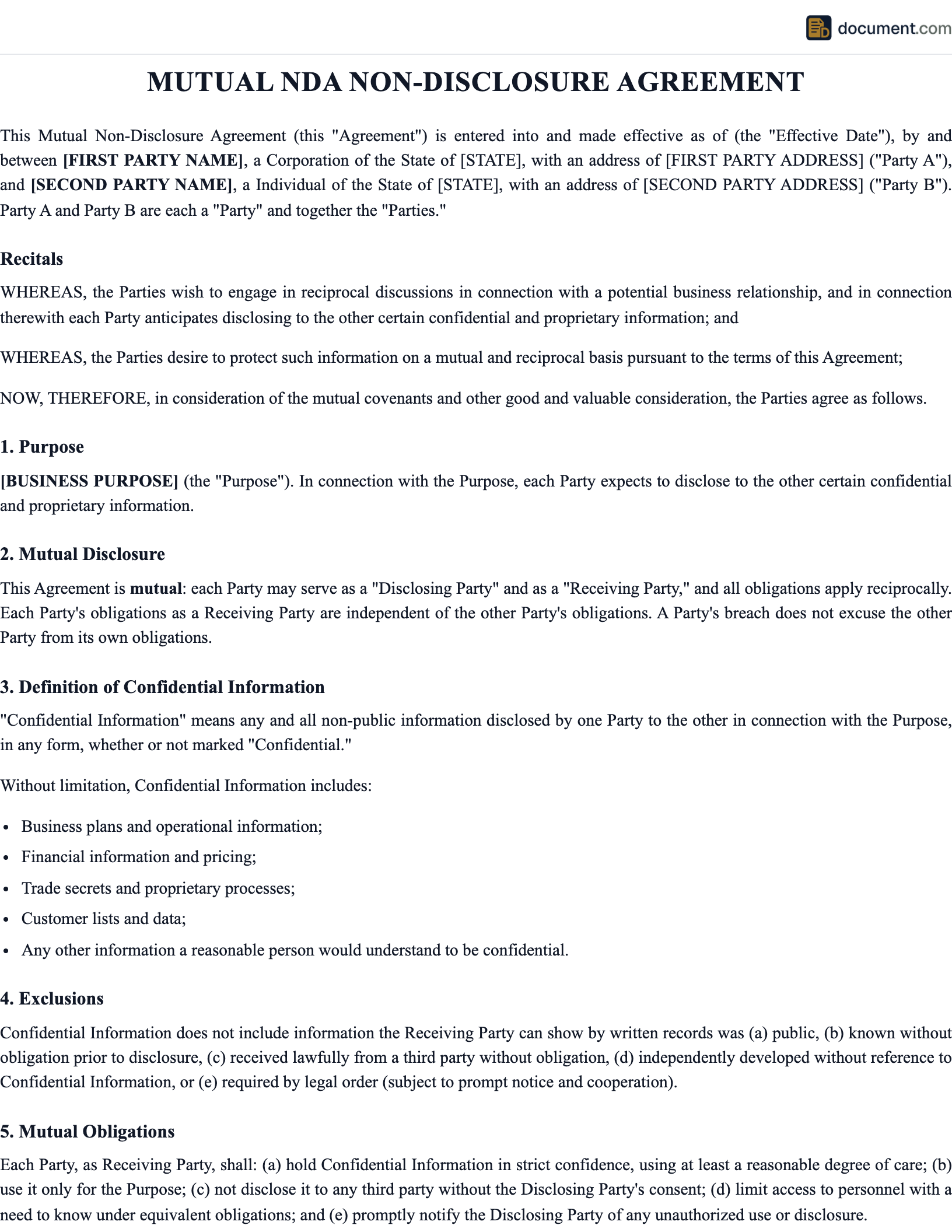



What Is a Mutual NDA?
A mutual non-disclosure agreement — often called a bilateral NDA or two-way NDA — is a contract in which both parties promise to protect confidential information they receive from the other. It is the right choice whenever two businesses expect to exchange sensitive information in both directions, such as during merger discussions, joint-venture planning, co-development, reseller agreements, or early-stage partnership evaluation. Because both sides bear the same obligations, a mutual NDA tends to be faster to negotiate than a one-sided agreement: neither party is disadvantaged by terms they will themselves rely on if the roles are reversed.
A mutual NDA typically defines the scope of confidential information broadly enough to cover trade secrets, financial data, customer lists, technical specifications, product roadmaps, and any information marked as confidential or that a reasonable person would understand to be confidential. It carves out information that is already public, independently developed, or lawfully obtained from third parties, so that neither side is liable for information that was never truly secret. It sets a term during which new disclosures are covered, and a survival period during which obligations continue after the agreement ends — often longer for trade secrets than for ordinary business information.
The enforceability of a mutual NDA depends on clear drafting, adequate consideration, and reasonable scope. Courts in every U.S. state enforce confidentiality contracts between sophisticated commercial parties as long as the terms are not unconscionable and do not function as a disguised restraint on trade. The federal Defend Trade Secrets Act (DTSA) of 2016 provides a federal cause of action for misappropriation of trade secrets, meaning a well-drafted mutual NDA that protects trade-secret information can be enforced in federal court and can support remedies including injunctive relief, actual damages, unjust enrichment, and — for willful misappropriation — exemplary damages of up to twice the amount of actual damages plus attorneys' fees.
Our mutual NDA templates are drafted to be practical and enforceable in any U.S. jurisdiction. They include the standard carve-outs, a clear definition of confidential information, reciprocal obligations, a survival clause, governing-law and venue provisions, the DTSA whistleblower notice, and a liquidated-damages option for situations where actual damages are difficult to measure. You can complete a signed mutual NDA in minutes, send it electronically, and begin substantive discussions with confidence.
Two-Way Protection
Both parties are equally protected when they share confidential information.
Faster Negotiation
Reciprocal terms mean neither side has an incentive to fight for lopsided language.
Enforceable Remedies
Injunctive relief, damages, and DTSA trade-secret protection in federal court.
Mutual NDA Form Preview
Below is a preview of the structure and key fields in our mutual NDA template. Your completed document will be professionally formatted and customized for your specific situation and governing state.
Mutual Non-Disclosure Agreement
Bilateral / Two-Way Confidentiality
Section 1: Parties
Section 2: Purpose
To evaluate a potential joint-development arrangement involving Party A's machine-learning platform and Party B's industrial sensor hardware.
Section 3: Confidential Information
Section 4: Term & Survival
When to Use a Mutual NDA
A mutual NDA is appropriate whenever both parties reasonably expect to share confidential information. Below are the most common commercial scenarios where a bilateral agreement is the right tool.
Joint Ventures
Two companies exploring a partnership exchange strategic plans, financials, and trade secrets under reciprocal protection.
M&A Due Diligence
Buyers and sellers share sensitive valuations, customer data, and operational metrics throughout deal negotiations.
Co-Development
Engineering teams at two firms collaborate on a product, each disclosing roadmaps, source code, or prototype designs.
Vendor Integrations
SaaS vendors and enterprise customers share API schemas, architecture diagrams, and infrastructure details.
Licensing Talks
IP owners and licensees evaluate patents, copyrighted works, or know-how before agreeing to commercial terms.
Investor Meetings
Founders and strategic investors discuss unreleased financials and cap tables when formal term sheets are not yet in place.
Mutual NDA vs Unilateral NDA
The core difference between a mutual NDA and a unilateral NDA is the direction of information flow. A unilateral NDA is one-sided: only the disclosing party is protected. A mutual NDA is bilateral: both parties are disclosers and receivers, and both owe the same duties.
| Factor | Mutual NDA | Unilateral NDA |
|---|---|---|
| Direction | Both parties disclose | Only one party discloses |
| Typical Use | JVs, M&A, partnerships | Employee, vendor, pitch |
| Negotiation Speed | Usually fast — reciprocal | Slower — asymmetric |
| Obligations | Identical on both sides | Only on receiver |
| Risk Balance | Symmetric | Asymmetric |
How to Create a Mutual NDA
Creating a mutual NDA is straightforward when you follow a clear process. Below are the seven steps to produce an enforceable bilateral agreement.
Identify the parties
Use exact legal names and entity types (e.g., 'Acme Corp., a Delaware corporation'). Identify an authorized signer.
State the purpose
Describe the specific business purpose — evaluating a partnership, diligence for an acquisition, joint product development, etc. A narrow purpose helps limit scope.
Define confidential information
List categories broadly (financials, technical, customer, roadmap) and include a catch-all for anything marked or reasonably understood to be confidential.
Include standard carve-outs
Public domain, independently developed, already known, lawfully received from a third party, and required disclosures by law or court order.
Set term and survival
Typical term is 1–3 years; survival 3–5 years for ordinary information and indefinite for trade secrets.
Specify remedies and governing law
Include injunctive relief, acknowledgment of irreparable harm, governing state law, and chosen venue for disputes.
Execute with authorized signatures
Each party signs through a representative with authority to bind the entity. Electronic signatures are enforceable under ESIGN and UETA.
Key Components of a Mutual NDA
A complete mutual NDA includes the following operative provisions. Missing any of these can materially weaken enforceability.
Parties & Effective Date
Full legal names, entity types, and the date the agreement takes effect.
Definition of Confidential Information
Scope of protected material including trade secrets, financial, technical, and marked information.
Carve-Outs / Exclusions
Public domain, prior knowledge, independent development, third-party sources, required disclosures.
Permitted Use
Information may be used only for the defined purpose and nothing else.
Standard of Care
Receiving party must use at least the same degree of care it uses for its own confidential information (and no less than reasonable care).
Term and Survival
How long the NDA lasts and how long confidentiality obligations persist afterward.
Return or Destruction
On termination or request, the receiving party returns or destroys confidential information and certifies compliance.
Remedies
Injunctive relief, damages, attorneys' fees, and DTSA trade-secret remedies.
No License or Ownership Transfer
Disclosure does not grant any IP or ownership rights to the receiving party.
Governing Law & Venue
State whose law controls and court where disputes will be heard.
Whistleblower Immunity Notice
Required DTSA notice preserving the right to report suspected legal violations.
Signatures
Authorized representative of each party, with electronic signature support.
What Counts as Confidential Information
Confidential information is generally any non-public information of commercial value that a party takes reasonable steps to keep secret. In a mutual NDA, the definition should be broad enough to cover everything you actually intend to share but specific enough that a court can identify what is and is not protected.
Usually Covered
- Trade secrets, formulas, algorithms
- Source code and technical specifications
- Financial statements and projections
- Customer and prospect lists
- Marketing plans and pricing
- Product roadmaps
- Employee and org information
Usually Excluded
- Information already public
- Information the receiver already knew
- Independently developed information
- Lawfully received from third parties
- Required disclosures by law or court order
Term and Survival
The term of the agreement — the window during which new disclosures are covered — is typically one to three years in commercial mutual NDAs. The survival period — how long confidentiality obligations persist after the agreement ends — is typically three to five years for ordinary business information, and often indefinite for trade secrets. Indefinite trade-secret obligations are enforceable because trade-secret status depends on the information remaining secret; once it becomes public, it is no longer a trade secret under state Uniform Trade Secrets Act statutes and the federal DTSA.
Enforcement and Remedies
If the other party breaches, your primary remedy is usually injunctive relief — a court order halting further disclosure or use. Monetary damages may also be available, including actual losses, unjust enrichment, and (for willful trade-secret misappropriation under the DTSA) exemplary damages up to twice actual damages plus attorneys' fees. Because damages from leaked information are often difficult to quantify, well-drafted NDAs include an explicit acknowledgment that breaches will cause irreparable harm and that equitable relief is appropriate without the need to post a bond.
Sample Mutual NDA
The following excerpt illustrates the operative language used in our mutual NDA template. The final document is fully customized for your parties and chosen governing state.
MUTUAL NON-DISCLOSURE AGREEMENT
This Mutual Non-Disclosure Agreement (the "Agreement") is entered into as of [Effective Date] by and between [Party A] ("Party A") and [Party B] ("Party B") (each a "Party" and collectively the "Parties").
1. PURPOSE
The Parties wish to explore a potential business relationship in connection with [purpose] (the "Purpose") and, in connection with the Purpose, may disclose to each other certain confidential and proprietary information.
2. CONFIDENTIAL INFORMATION
"Confidential Information" means any non-public information disclosed by one Party ("Discloser") to the other ("Recipient"), whether oral, written, visual, or electronic, that is designated as confidential or that a reasonable person would understand to be confidential, including without limitation trade secrets, financial information, technical data, business plans, customer and prospect lists, pricing, source code, product roadmaps, and marketing strategies.
3. OBLIGATIONS
Each Recipient shall (a) use Confidential Information solely for the Purpose; (b) protect Confidential Information with at least the same degree of care it uses to protect its own confidential information of like importance, and in no event less than reasonable care; and (c) limit access to Confidential Information to those of its employees, contractors, and advisors who have a need to know and who are bound by confidentiality obligations at least as protective as those in this Agreement.
4. EXCLUSIONS
Confidential Information does not include information that: (i) is or becomes publicly available through no fault of Recipient; (ii) was rightfully known to Recipient without restriction before disclosure; (iii) is independently developed by Recipient without reference to the Confidential Information; or (iv) is rightfully received from a third party without confidentiality obligations.
5. TERM AND SURVIVAL
This Agreement is effective as of the Effective Date and continues for [term]. Each Party's confidentiality obligations survive termination for [survival], except that obligations with respect to trade secrets continue for as long as such information remains a trade secret under applicable law.
6. REMEDIES
Each Party acknowledges that a breach of this Agreement may cause irreparable harm for which monetary damages would be inadequate, and agrees that the non-breaching Party shall be entitled to seek injunctive relief without the requirement of posting a bond, in addition to any other remedies available at law or in equity.
7. DTSA NOTICE
Pursuant to 18 U.S.C. § 1833(b), an individual shall not be held criminally or civilly liable for the disclosure of a trade secret that is made in confidence to a federal, state, or local government official, or to an attorney, solely for the purpose of reporting or investigating a suspected violation of law.
Frequently Asked Questions
Answers to common questions about mutual NDAs, bilateral confidentiality, and enforcement.
Official Resources
Authoritative resources on trade-secret law, NDA enforcement, and confidentiality obligations.
USPTO - Trade Secret Policy
U.S. Patent and Trademark Office guidance on trade secrets and the DTSA.
Defend Trade Secrets Act (DTSA)
Full text of the federal Defend Trade Secrets Act of 2016.
ULC - Uniform Trade Secrets Act
Uniform Law Commission resources on the UTSA and state adoption.
FTC - Privacy & Data Security
Federal Trade Commission guidance on protecting confidential business information.
SEC - Material Non-Public Information
Securities and Exchange Commission rules on confidential financial information.
ABA - Intellectual Property Law
American Bar Association IP section resources on NDAs and trade secrets.
Create your Mutual Nda Non Disclosure Agreement in under 10 minutes.
Answer a few questions and download a compliant, attorney-drafted document ready for your state.