
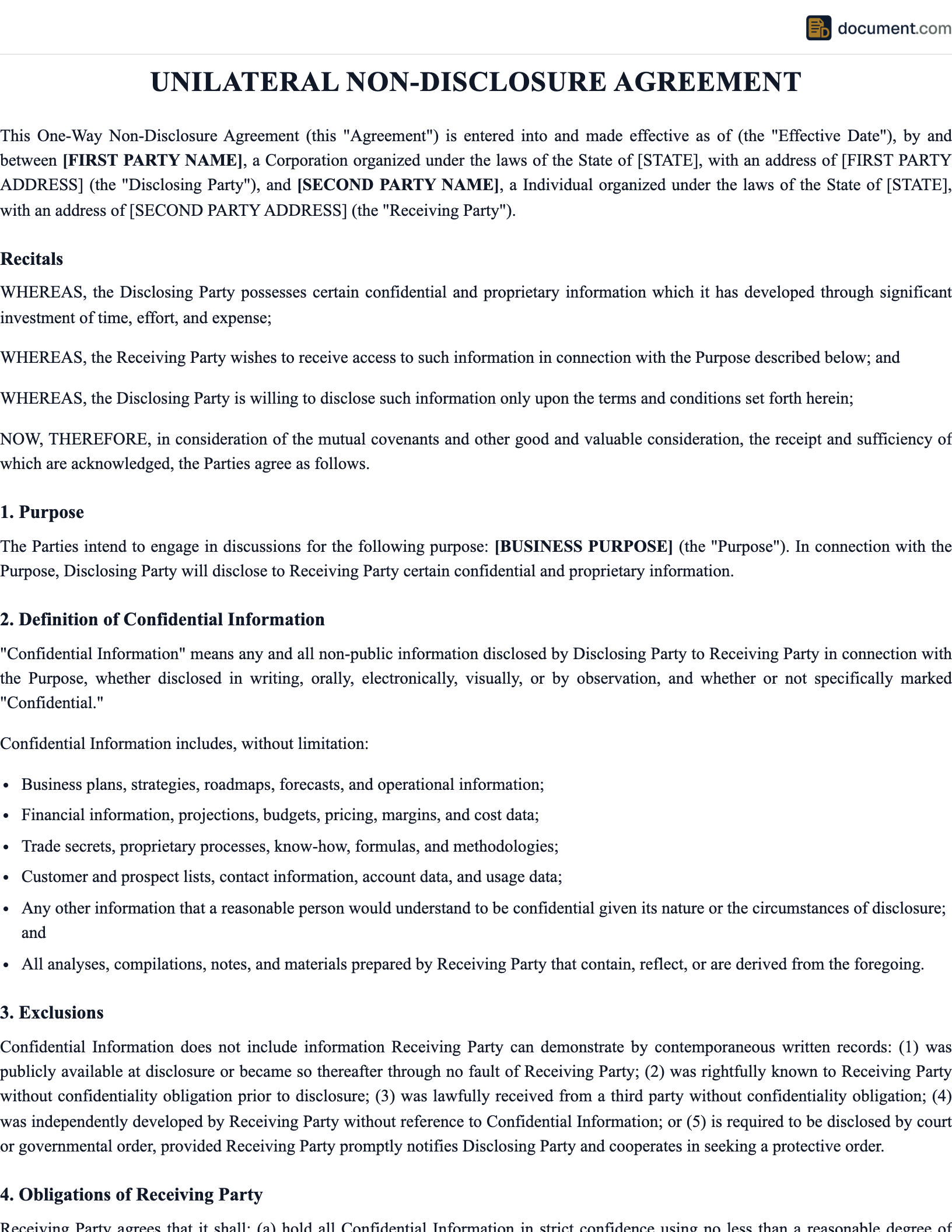



What Is a Unilateral NDA?
A unilateral non-disclosure agreement — also known as a one-way NDA — is a contract in which only one party discloses confidential information and only the other party owes confidentiality obligations. It is the right choice whenever the information flow is asymmetric: an employer onboarding an employee, a startup pitching to an investor, a company engaging a contractor, or a product team demonstrating an unreleased feature to a prospect. Because only one party is protected, unilateral NDAs tend to be more aggressive in favor of the discloser than reciprocal mutual NDAs.
A well-drafted unilateral NDA defines confidential information broadly enough to cover the full scope of trade secrets, financial data, customer lists, technical specifications, and any information marked or reasonably understood to be confidential. It requires the receiving party to use the information only for a specific purpose, to limit access to those with a need to know, and to return or destroy the information upon request. It carves out information that is already public, independently developed, lawfully obtained from third parties, or required by law — so the receiver is not liable for information that was never truly secret.
Courts enforce unilateral NDAs as ordinary contracts under state law, and the Defend Trade Secrets Act of 2016 provides a federal cause of action for misappropriation of trade secrets. Together, these frameworks give a disclosing party a range of remedies including injunctive relief, actual damages, disgorgement of profits, and — for willful misappropriation — exemplary damages and attorneys' fees. Because damages from leaked confidential information can be difficult to measure, injunctive relief is often the most important remedy.
Our unilateral NDA templates are drafted for practical, enforceable use in any U.S. jurisdiction. They include standard carve-outs, a broad definition of confidential information, clear obligations on the receiving party, return-and-destroy provisions, a survival clause, governing-law and venue selection, and the DTSA whistleblower notice required to preserve full trade-secret remedies.
Focused Protection
Obligations run only in favor of the disclosing party.
Trade-Secret Ready
Includes DTSA whistleblower notice to preserve full remedies.
Enforceable Anywhere
Works across all 50 states with a customizable governing-law clause.
Unilateral NDA Form Preview
Preview of the structure and key fields in our one-way NDA template.
Non-Disclosure Agreement
Unilateral / One-Way Confidentiality
Section 1: Parties
Section 2: Purpose
To evaluate a potential engagement providing backend development services for Discloser's payments platform.
Section 3: Confidential Information
When to Use a Unilateral NDA
A unilateral NDA is appropriate whenever only one party is sharing confidential information.
New Employees
A company shares trade secrets, customer lists, and internal processes with a new hire who has no proprietary information of their own to share.
Investor Pitches
A founder pitches a business idea, technology, or financial projections to a potential investor or accelerator.
Contractors & Freelancers
A business discloses proprietary workflows, customer data, or source code to a freelance developer, designer, or consultant.
Product Demos
A software vendor shows an unreleased product to a prospect under confidentiality obligations before launch.
Licensing Pitches
An inventor presents a patent, manuscript, or creative work to a publisher, studio, or manufacturer.
Beta Testers
An unreleased product is shared with test users who agree not to disclose bugs, features, or performance data.
Unilateral NDA vs Mutual NDA
Choose based on the direction of information flow.
| Factor | Unilateral NDA | Mutual NDA |
|---|---|---|
| Direction | One-way | Two-way |
| Best For | Employees, pitches, vendors | JVs, M&A, partnerships |
| Tone | Protective of discloser | Balanced / reciprocal |
| Length | Often longer | Usually shorter |
How to Create a Unilateral NDA
Identify discloser and receiver
Use full legal names and, if corporate, the entity type and state of formation.
State the purpose narrowly
Describe exactly why the information is being shared. A narrow purpose helps limit the receiver's permitted use.
Define confidential information
Include specific categories plus a reasonable-person catch-all.
List standard carve-outs
Public domain, prior knowledge, independent development, third-party source, and legal compulsion.
Impose obligations
Use only for the purpose, protect with reasonable care, limit to need-to-know personnel, return or destroy on request.
Set term and survival
Term 1–5 years; survival 3–5 years or indefinite for trade secrets.
Add governing law, venue, DTSA notice, and signatures
Choose a state, include the DTSA whistleblower carve-out, and execute electronically.
Key Components of a Unilateral NDA
Parties
Discloser and receiver with full legal names.
Purpose
Specific reason information is being shared.
Definition of Confidential Information
Broad scope with clear categories.
Carve-Outs
Public, prior, independent, third-party, legal compulsion.
Obligations
Restricted use, reasonable care, need-to-know access.
Return/Destroy
Return or destroy upon request with certification.
Term & Survival
Duration and post-termination obligations.
Remedies
Injunctive relief, damages, DTSA protection.
Governing Law & Venue
Choice of state and court.
DTSA Whistleblower Notice
Required to preserve full trade-secret remedies.
What Counts as Confidential Information
Confidential information is non-public information of commercial value that the discloser takes reasonable steps to keep secret. A broad definition helps protect everything you actually intend to share.
Usually Covered
- Trade secrets and proprietary processes
- Source code, APIs, architecture
- Financial statements and forecasts
- Customer and prospect lists
- Pricing and business strategy
- Unreleased product designs
Usually Excluded
- Already in the public domain
- Known to the receiver before disclosure
- Independently developed
- Lawfully received from third parties
- Required disclosures by law or court order
Term and Survival
The term is the period during which new disclosures are covered. Survival is how long obligations persist after the agreement ends. For ordinary business information, a survival period of three to five years is common; for trade secrets, survival is typically indefinite because trade-secret status depends on continued secrecy under state and federal law.
Enforcement and Remedies
Remedies typically include injunctive relief, actual damages, disgorgement, attorneys' fees (if provided), and DTSA exemplary damages for willful misappropriation. A well-drafted NDA acknowledges that breach causes irreparable harm so courts can issue injunctions without requiring a bond.
Sample Unilateral NDA
UNILATERAL NON-DISCLOSURE AGREEMENT
This Non-Disclosure Agreement (this "Agreement") is entered into as of [Effective Date] by [Discloser] ("Discloser") and [Receiver] ("Receiver").
1. PURPOSE
Discloser intends to share certain confidential information with Receiver in connection with [purpose] (the "Purpose").
2. CONFIDENTIAL INFORMATION
"Confidential Information" means any non-public information disclosed by Discloser that is designated as confidential or that a reasonable person would understand to be confidential, including without limitation trade secrets, business plans, financial data, customer information, source code, and technical specifications.
3. OBLIGATIONS
Receiver shall (a) use Confidential Information solely for the Purpose; (b) protect Confidential Information with reasonable care, and in no event less than the standard of care it uses for its own confidential information; (c) limit access to personnel with a need to know who are bound by confidentiality obligations; and (d) not reverse engineer, disassemble, or decompile any technical materials provided.
4. EXCLUSIONS
Confidential Information does not include information that (i) is or becomes public through no fault of Receiver; (ii) was known to Receiver before disclosure; (iii) is independently developed; or (iv) is lawfully received from a third party without confidentiality obligations.
5. RETURN OR DESTRUCTION
Upon Discloser's written request, Receiver shall promptly return or destroy all Confidential Information in its possession and certify such return or destruction in writing.
6. TERM
This Agreement is effective for [term], and Receiver's confidentiality obligations survive for [survival period], provided that trade-secret obligations continue for as long as such information remains a trade secret.
7. DTSA WHISTLEBLOWER NOTICE
Pursuant to 18 U.S.C. § 1833(b), Receiver shall not be held criminally or civilly liable for disclosing a trade secret in confidence to a federal, state, or local government official or to an attorney solely for the purpose of reporting or investigating a suspected violation of law.
Frequently Asked Questions
Official Resources
USPTO - Trade Secret Policy
Federal guidance on trade-secret protection.
Defend Trade Secrets Act (DTSA)
Full text of the 2016 federal trade-secret statute.
ULC - Uniform Trade Secrets Act
State adoption and text of the UTSA.
FTC - Privacy & Data Security
Federal Trade Commission guidance for businesses.
U.S. Department of Labor
Employment-related confidentiality and worker protections.
ABA - IP Law Section
American Bar Association resources on NDAs and IP.
Create your Unilateral Non Disclosure Agreement in under 10 minutes.
Answer a few questions and download a compliant, attorney-drafted document ready for your state.