
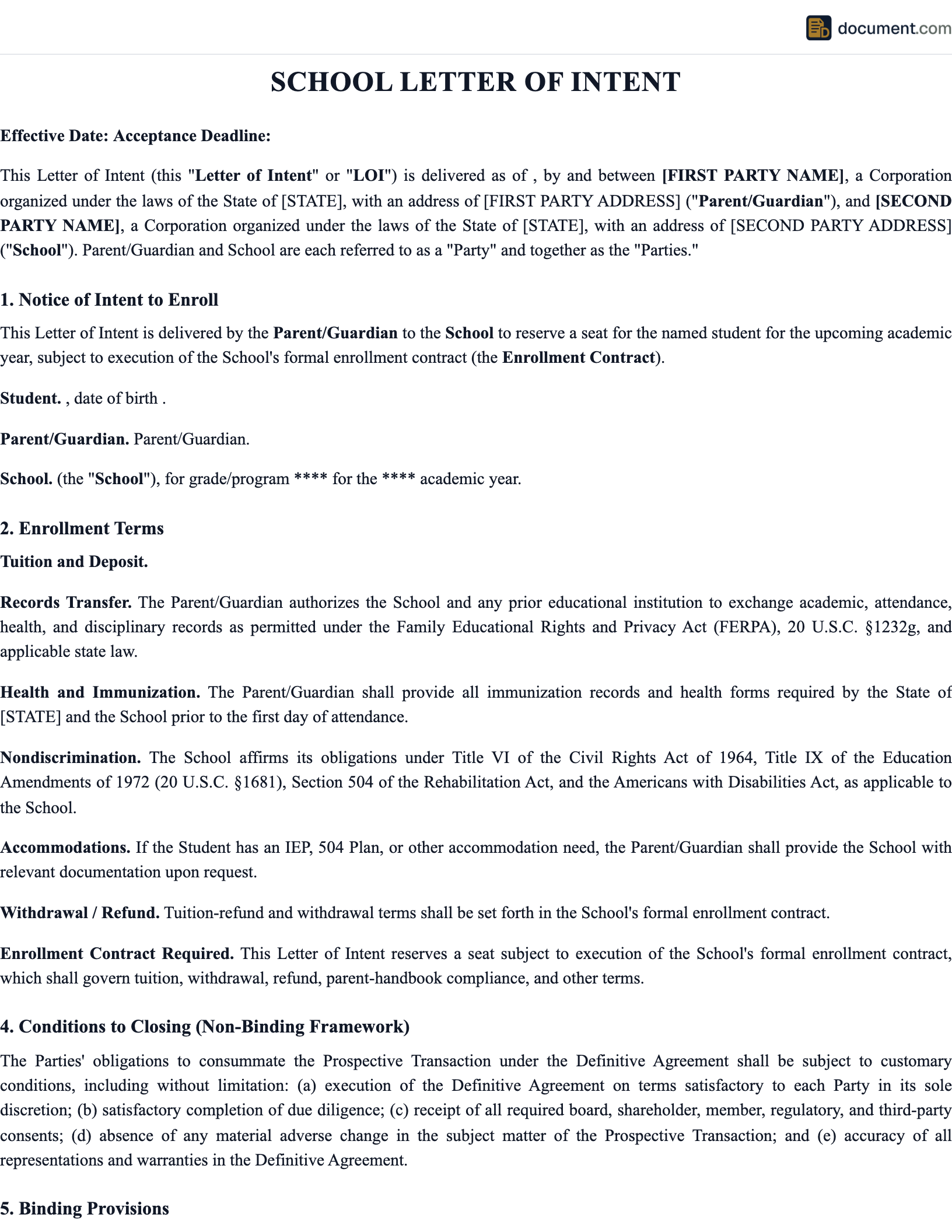



What Is a School Letter of Intent?
A school letter of intent is a formal document submitted to an academic institution expressing your specific interest in a program and your commitment to attend if admitted. It serves a fundamentally different purpose than a personal statement or statement of purpose: while those documents focus broadly on your background and motivations, the LOI targets a specific program at a specific institution, explaining why that program is your top choice and how your academic profile aligns with its particular strengths, faculty, research opportunities, and clinical training facilities.
School LOIs are most commonly used in three contexts within the admissions cycle. First, as a required application component where the program explicitly requests a letter of intent as part of the application materials, typically in addition to the personal statement. Second, as a post-waitlist communication where the applicant sends an LOI to reaffirm interest and provide updates after being placed on a waitlist. Third, as a post-interview follow-up where the applicant reinforces their interest after visiting the program. Each context requires slightly different content and tone, but the core function remains the same: demonstrating that your interest in the program is informed, specific, and genuine.
The strategic importance of school LOIs varies by field. In medical school admissions, where applicants routinely apply to 15-30 programs and interview at 8-15, the LOI helps admissions committees identify applicants who are genuinely likely to matriculate rather than using an acceptance as a negotiating position elsewhere. In dental school admissions, the LOI serves a similar yield-management function. In graduate school admissions for research-focused programs, the LOI helps faculty identify students whose research interests align with their lab's direction, making mentor-match an explicit part of the evaluation. Nursing school LOIs tend to focus more on clinical interests and patient care philosophy, reflecting the practice-oriented nature of nursing education.
Program-Specific Focus
Targets one specific program with reasons tailored to its unique offerings, faculty, and opportunities.
Demonstrated Research
Shows you have investigated the program thoroughly, referencing specific faculty, curriculum, and resources.
Commitment Signal
Communicates to admissions that you will accept an offer, reducing the committee's yield uncertainty.
School Letter of Intent Form Preview
Letter of Intent
Academic Program Application
1. PROGRAM AND APPLICANT
Dear Admissions Committee of the program at , I am writing to express my sincere interest in your program for the admissions cycle.
2. ACADEMIC BACKGROUND AND FIT
My academic preparation in and research experience in align directly with your program's focus on .
3. COMMITMENT
Your program is my first choice, and I will accept an offer of admission if extended.
APPLICANT
DATE
Types of School Letters of Intent
Each academic discipline has distinct expectations for LOI content, tone, and emphasis. Select the type that matches your application to access a template tailored to that program's admissions requirements.
Graduate School LOI
Express interest in a graduate program covering research alignment, academic background, and career objectives
Dental School LOI
Communicate your commitment to dental education with clinical exposure, manual dexterity experience, and patient care philosophy
Medical School LOI
Demonstrate your dedication to medicine including clinical experience, research involvement, and healthcare commitment
Nursing School LOI
Convey your passion for nursing practice covering patient care experience, clinical interests, and professional development goals
Key Components
An effective school LOI weaves together several essential elements that collectively demonstrate informed interest and academic readiness:
| Component | Purpose | Key Details |
|---|---|---|
| Program Identification | Targets the specific program | Program name, degree type, concentration or track, admission cycle year |
| Academic Alignment | Demonstrates intellectual fit | Research interests, academic background, coursework relevant to program strengths |
| Faculty References | Shows genuine research into the program | Specific faculty, their research, how it connects to your interests, prior correspondence |
| Program-Specific Reasons | Differentiates this LOI from generic versions | Unique curriculum features, clinical sites, labs, dual-degree options, community engagement |
| Career Objectives | Connects education to professional goals | Post-graduation plans, specialty interest, research career path, practice setting preference |
| Commitment Statement | Signals yield commitment | Explicit statement that this is your top choice and you will attend if admitted |
| Updates Since Application | Provides new evaluative information | New publications, clinical hours, awards, relevant experiences since initial application |
How to Write a School Letter of Intent
Research the Program Thoroughly
Before writing a single word, conduct deep research into the program's curriculum structure, faculty research areas, clinical training affiliations (for health professions), recent publications by faculty, student organizations, dual-degree offerings, and community engagement opportunities. Read the program's mission statement, review recent alumni outcomes, and identify any unique features that distinguish it from competing programs. This research forms the foundation of a credible LOI — admissions committees can immediately distinguish between applicants who have done genuine research and those who are submitting generic letters with the school name swapped in.
Open with Specificity, Not Flattery
Begin your LOI by identifying the specific program and clearly stating your intent. Avoid generic praise ('I have always admired your prestigious institution') and instead lead with a substantive connection: a specific research area that matches your interests, a curriculum feature that aligns with your career goals, or a conversation with a faculty member during an interview that reinforced your interest. The opening should immediately signal to the reader that this letter was written specifically for their program, not adapted from a template used for multiple applications.
Connect Your Background to Program Strengths
The body of your LOI should draw explicit connections between your academic and professional experiences and the program's particular strengths. If the program is known for community-based research, describe your relevant community engagement. If a faculty member's lab studies a topic related to your undergraduate research, explain how your experience would contribute to that research agenda. For clinical programs, connect your clinical exposure to the specific training environments the program offers. Each connection should be bidirectional — explain what you bring to the program, not just what you hope to gain from it.
Provide Meaningful Updates (If Post-Application)
If you are writing a post-waitlist or post-interview LOI, include substantive updates that strengthen your candidacy since the original application was submitted. New clinical hours, research publications or presentations, relevant coursework, volunteer experiences, certifications, or awards all provide the admissions committee with new data points. Quantify where possible: 'Since submitting my application, I have completed 200 additional clinical hours at [facility] and presented my research at [conference].' Avoid trivial updates that do not add evaluative information.
State Your Commitment Clearly
Include an unambiguous statement of your commitment to the program. For your genuine top-choice program, state clearly: 'If admitted, I will accept your offer of admission.' For programs where you are interested but not exclusively committed, use softer language that expresses strong interest without making a binding commitment you may not honor. Be aware that in small professional communities, admissions directors communicate with colleagues at other programs, and insincere commitment statements can damage your reputation across multiple applications.
Close with Professional Brevity
End your LOI with a brief professional closing that reiterates your interest, provides your contact information, and expresses willingness to provide any additional materials the committee may need. Avoid lengthy emotional appeals or desperate pleas. The closing should leave the reader with the impression of a confident, prepared applicant who has made an informed choice. Keep the entire LOI to one page — admissions committees read thousands of documents and will appreciate conciseness over verbosity.
Common Mistakes to Avoid
Admissions committee members report that certain mistakes appear repeatedly in school LOIs and can significantly weaken an otherwise strong application. Understanding these pitfalls helps you craft a more effective document.
Using generic language that could apply to any program
Phrases like 'your esteemed program' or 'world-renowned faculty' signal that you have not researched the specific program. Replace generic praise with specific references to curriculum features, faculty research, or program resources that are unique to this institution.
Repeating your personal statement verbatim
The LOI and personal statement serve different purposes. If the committee sees identical content in both documents, the LOI adds no new information and may suggest laziness. Use the LOI to provide new perspectives, updates, or program-specific connections not covered in your personal statement.
Making emotional appeals instead of evidence-based arguments
Statements like 'It has been my lifelong dream to attend your school' are less persuasive than concrete evidence of fit. Admissions decisions are based on qualifications, preparedness, and alignment — not emotional intensity. Focus on demonstrating fit rather than expressing desire.
Sending identical LOIs to multiple programs
An LOI that pledges exclusive commitment to a program loses all credibility if the admissions committee discovers you sent the same letter to competing programs. In professional health education communities, admissions directors at different schools regularly communicate with each other, making this risk real.
Referencing faculty who have left the program
Mentioning a faculty member who retired, moved to another institution, or shifted research focus signals outdated research. Verify all faculty references against the program's current website before submitting your LOI.
Frequently Asked Questions
Official Resources
Authoritative resources on academic admissions processes and application requirements for various professional and graduate programs.
AAMC - Applying to Medical School
Association of American Medical Colleges guidance on the medical school application process, including secondary application and post-interview communications.
ADEA - Dental Education Pathways
American Dental Education Association resources on dental school admissions, application timelines, and supplementary materials.
AACN - Find a Nursing Program
American Association of Colleges of Nursing database of accredited nursing programs with admissions information and program details.
CGS - Resources for Graduate Students
Council of Graduate Schools resources covering graduate admissions best practices, funding opportunities, and application guidance.
U.S. Department of Education - College Resources
Federal resources on higher education applications, financial aid (FAFSA), and student rights in the admissions process.
NCES College Navigator
National Center for Education Statistics tool for researching programs, admissions rates, and institutional data across accredited schools.
Create Your School Letter of Intent
Draft a compelling admissions LOI for graduate school, dental school, medical school, or nursing school with program-specific guidance and professional formatting.
Create DocumentNo account required. Free to create and preview.