



What Is a Nursing School Letter of Intent?
A nursing school letter of intent is a focused written document that communicates an applicant's genuine commitment to a specific nursing program and explains why that program is the applicant's first choice. Nursing education spans multiple degree levels — from associate degree programs and traditional BSN programs to accelerated second-degree BSN programs, MSN programs for advanced practice roles, and doctoral programs (DNP and PhD) — and the LOI should be tailored to the appropriate level of education and the specific program's culture and mission.
Nursing program admissions have become increasingly competitive due to the combination of growing demand for nurses and limited clinical placement capacity. According to the American Association of Colleges of Nursing (AACN), U.S. nursing schools turned away over 91,000 qualified applicants from baccalaureate and graduate nursing programs in recent years due to insufficient faculty, clinical sites, and classroom space. This means that many qualified applicants — those with strong GPAs, solid TEAS scores, and relevant healthcare experience — are still denied admission because programs cannot accommodate everyone. In this competitive environment, an LOI that demonstrates genuine commitment to a specific program can be the factor that distinguishes an accepted applicant from a waitlisted one.
The nursing profession values empathy, communication, teamwork, and patient advocacy — qualities that your LOI should embody in its tone and content. Unlike medical or dental school LOIs, which may emphasize research achievements and academic credentials, nursing school LOIs should prominently feature patient care experiences, interprofessional collaboration, and the applicant's understanding of nursing's unique scope of practice. Admissions committees want to see that you understand what nurses actually do — the 12-hour shifts, the emotional weight of patient loss, the satisfaction of patient recovery, the critical thinking required in acute situations — and that you are choosing nursing deliberately rather than as a default career path.
Patient Care Focus
Highlights direct patient care experiences and compassionate caregiving skills.
Team Collaboration
Demonstrates interdisciplinary teamwork and communication abilities.
Clinical Readiness
Shows preparedness for the clinical demands of nursing education.
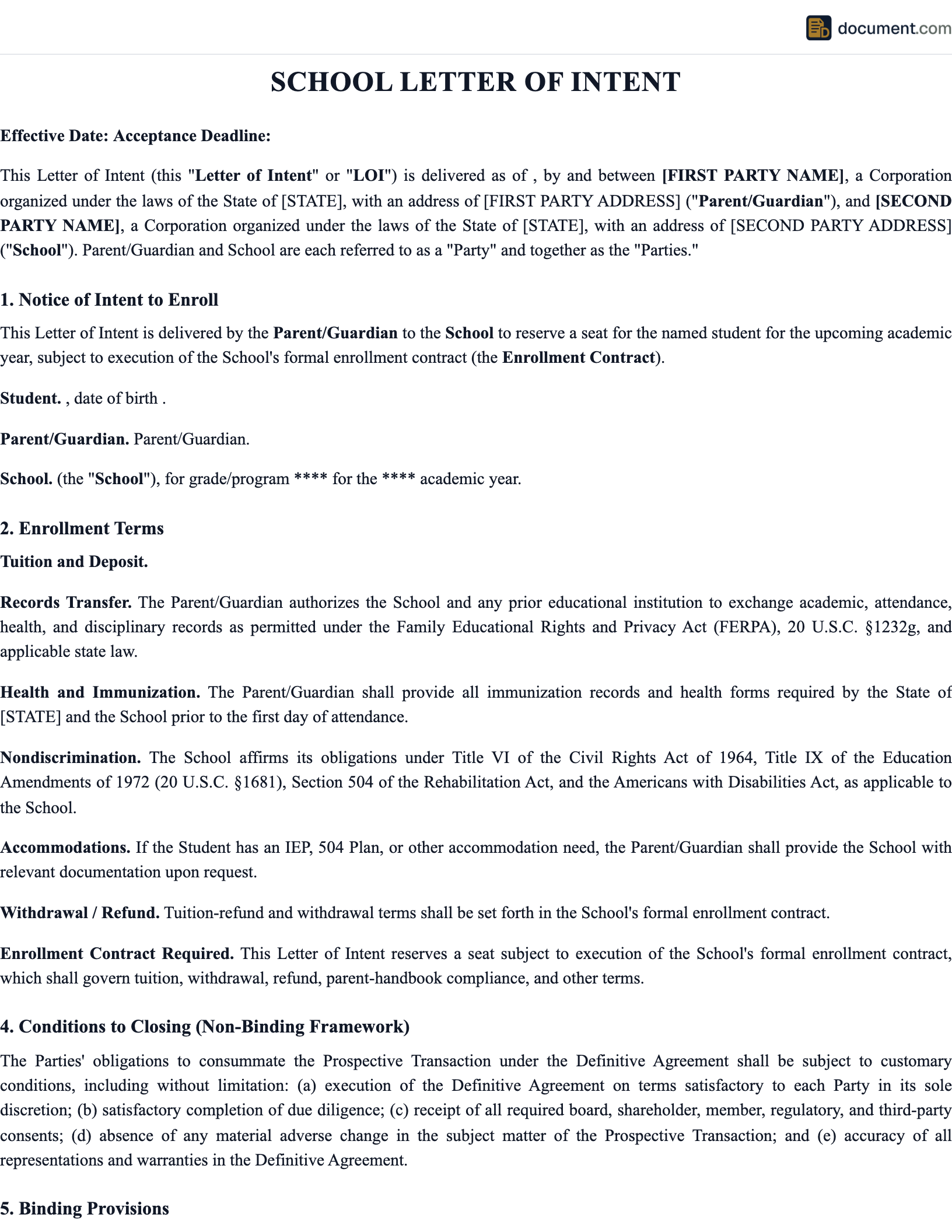
Nursing School LOI Form Preview
Dear ,
I am writing to express my wholehearted commitment to the nursing program. After visiting your campus and learning about your , I am confident that your program is the ideal environment for my nursing education...
Since my application, I have continued to develop my clinical skills through ...
Sincerely,
Applicant ID:
Key Components
An effective nursing school LOI includes these essential elements:
| Component | Purpose | Key Details |
|---|---|---|
| Commitment Declaration | Signals enrollment intent | First-choice statement, willingness to enroll immediately upon acceptance |
| Patient Care Experiences | Demonstrates clinical readiness | CNA work, volunteering, EMT experience, hospital employment, patient interactions |
| Program-Specific Fit | Shows genuine interest | Clinical sites, simulation labs, faculty expertise, specialty tracks, community partnerships |
| Application Updates | Strengthens candidacy | New certifications (BLS, CNA), additional healthcare hours, improved TEAS scores |
| Career Goals | Contextualizes motivation | Specialty interests, practice setting, community health, advanced practice aspirations |
| Professional Tone | Reflects maturity | Formal letter format, one page, correct addressee, error-free writing |
How to Write a Nursing School Letter of Intent
Open with Sincere Commitment
Begin with a clear, heartfelt statement that the program is your first choice: 'I am writing to express my sincere and unwavering commitment to the [Program Name] at [University Name]. Your program is my first choice, and I will immediately accept an offer of admission.' The opening should convey genuine enthusiasm without being gushing or overly emotional — nursing admissions committees value emotional intelligence but also professional composure.
Highlight Patient Care Experiences
Describe specific patient care experiences that have prepared you for nursing education and deepened your commitment to the profession. Rather than listing activities, tell brief stories that illustrate your clinical skills, empathy, and understanding of the nursing role: a CNA experience that taught you the importance of patient dignity, an emergency room volunteer shift that revealed the teamwork required in acute care, or a hospice visit that showed you the profound impact of compassionate end-of-life care. These narratives demonstrate both your experience and the reflective practice that nursing education demands.
Connect to Program-Specific Strengths
Demonstrate genuine knowledge of the program by referencing specific features that attracted you: the school's clinical placement sites and hospital affiliations, simulation lab technology, faculty expertise in areas aligned with your interests, student-to-faculty ratio, NCLEX pass rates, community health partnerships, interprofessional education opportunities, or specialty tracks (pediatrics, oncology, mental health, critical care). Explain why these features matter to your education and career goals — the committee should feel that you are choosing this program over others for substantive, informed reasons.
Provide Meaningful Updates
Include substantive updates since your application: new CNA certification or additional clinical hours, completion of prerequisite courses with strong grades, new healthcare employment experiences, volunteer work in community health settings, leadership roles in pre-nursing organizations, CPR/BLS/ACLS certification, improved TEAS scores, or completion of a CNA, medical assistant, or EMT program. Each update should demonstrate continued growth and preparation for the rigors of nursing school.
Articulate Your Nursing Career Vision
Briefly describe your long-term career goals in nursing and how this program specifically prepares you to achieve them. Whether you aspire to work in a pediatric ICU, become a nurse practitioner in a rural family practice, pursue nurse educator certification, specialize in psychiatric nursing, or eventually earn a DNP to lead healthcare system improvements, connect your vision to the program's strengths and opportunities. Show the committee that you have a thoughtful, realistic understanding of where this education will take you.
Close Professionally with Gratitude
Reaffirm your commitment, express gratitude for the committee's consideration, and offer to provide any additional information. Include your applicant ID number and contact information. Format the letter as a one-page formal business letter. Have it reviewed by a nursing mentor, academic advisor, or healthcare professional who can provide feedback on both content and tone. Ensure the letter reflects the communication skills, attention to detail, and professionalism that the nursing profession demands.
LOIs by Nursing Program Type
The content and emphasis of your nursing school LOI should vary based on the program level you are applying to. Each level of nursing education has different admissions priorities, and your LOI should address the specific concerns and expectations of the admissions committee for that program type.
For BSN programs, admissions committees evaluate academic preparation, foundational healthcare experiences, and genuine understanding of the nursing profession. Your LOI should emphasize CNA or patient care technician experience, hospital volunteering, understanding of the nursing scope of practice, and your readiness for the clinical demands of the program. For accelerated BSN (ABSN) programs targeting second-degree students, highlight how your previous degree and professional experience uniquely prepare you for nursing — a psychology degree informs psychiatric nursing understanding, a communications degree enhances patient education skills, or a business background prepares you for healthcare administration.
For MSN and DNP programs, the LOI should demonstrate advanced clinical thinking, leadership capacity, and a clear professional development trajectory. Reference your nursing clinical experience with specificity — years of practice, specialty areas, patient populations, leadership roles, and practice improvements you have implemented. Discuss your scholarly interests, quality improvement projects, and how the advanced degree will enable you to address specific gaps or opportunities you have identified in your clinical practice. DNP applicants should particularly emphasize their systems-level perspective and commitment to translating evidence into practice at the organizational or community level.
Nursing vs. Medical School LOIs
A common mistake is writing a nursing school LOI that reads like a medical school LOI — emphasizing research publications, GPA, and academic prestige. Nursing admissions committees prioritize patient care experience, empathy, teamwork, and understanding of nursing's distinct role in healthcare. Your LOI should reflect nursing values: patient advocacy, holistic care, health promotion, and interdisciplinary collaboration. Show the committee that you understand what nursing is and that you are deliberately choosing this profession.
Frequently Asked Questions
Official Resources
Authoritative resources on nursing education, program accreditation, and career development.
AACN - American Association of Colleges of Nursing
National organization for baccalaureate and graduate nursing education with program data, accreditation info, and career resources.
NLN - National League for Nursing
Resources for nursing education including program accreditation, faculty development, and nursing education research.
NCSBN - NCLEX Information
National Council of State Boards of Nursing information on NCLEX examination, licensure requirements, and practice standards.
ANA - American Nurses Association
Professional nursing organization resources on nursing practice, advocacy, continuing education, and career development.
HRSA - Nursing Workforce
Health Resources and Services Administration data on nursing workforce supply, demand projections, and shortage areas.
Federal Student Aid
U.S. Department of Education information on federal financial aid programs available to nursing students.
Create Your Nursing School LOI
Draft a compelling letter of intent that highlights your patient care experience and strengthens your nursing school application.
Create DocumentNo account required. Free to create and preview.