
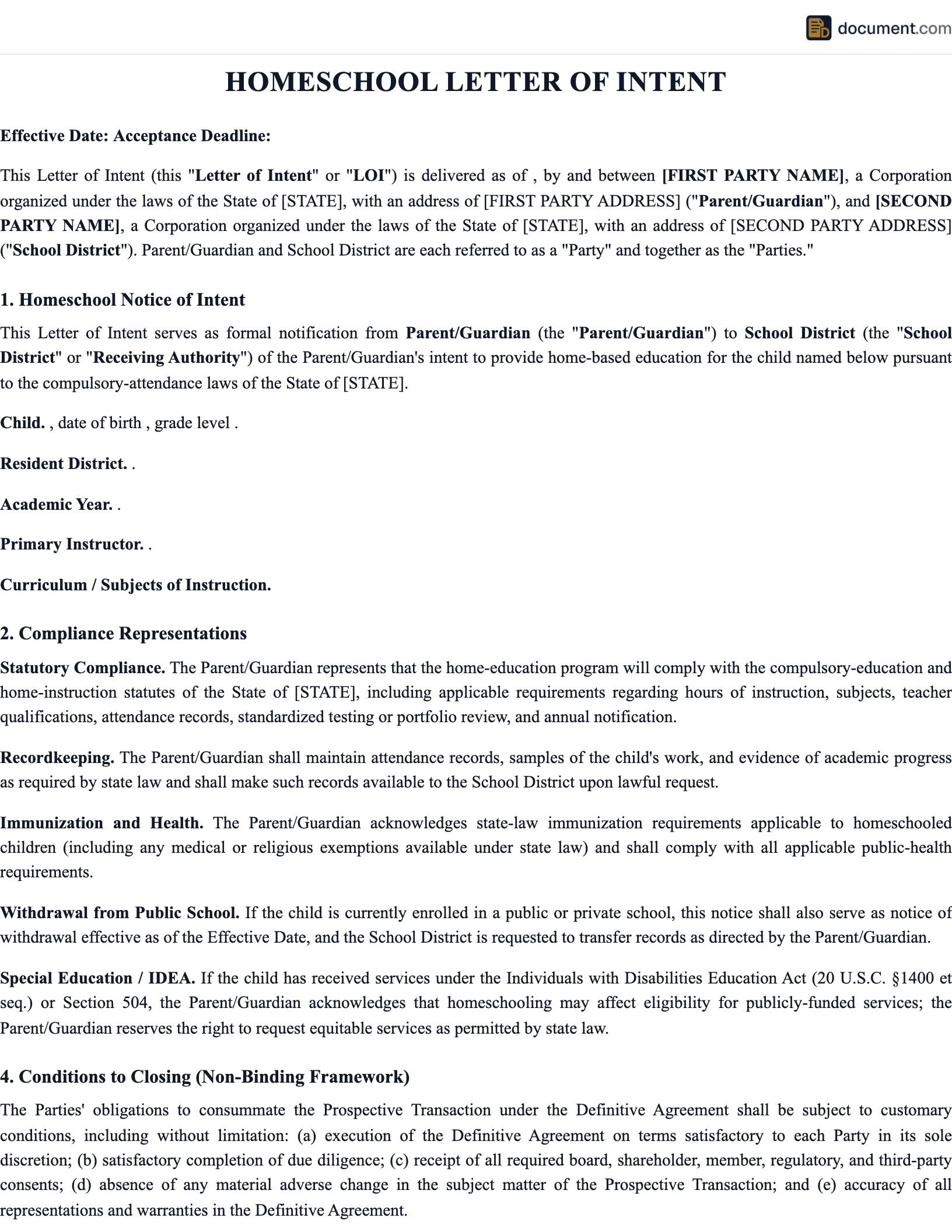



What Is a Homeschool Letter of Intent?
A homeschool letter of intent is a formal written notification that a parent or legal guardian submits to their local school district, county superintendent, or state education agency to declare their intention to educate their child at home instead of enrolling them in a public or private school. This document is not a request for permission — the U.S. Supreme Court recognized in Wisconsin v. Yoder(1972) and subsequent rulings that parents have a fundamental liberty interest in directing the education of their children. The letter of intent is a compliance mechanism that satisfies the state's legitimate interest in ensuring all children of compulsory school age receive an education, while respecting the parent's constitutional right to choose the method and content of that education.
The regulatory landscape for homeschooling varies enormously across the 50 states. States generally fall into four categories based on regulatory intensity. High- regulation states (New York, Pennsylvania, Massachusetts, Vermont, Rhode Island) require notification, curriculum approval or disclosure, standardized testing or professional evaluation, and ongoing progress reporting. Moderate- regulation states (Virginia, North Carolina, Colorado, Minnesota, Oregon) require notification and standardized testing or evaluation but not curriculum approval. Low- regulation states (California, Georgia, Nevada, Washington) require notification but impose minimal or no testing requirements. No-regulation states (Texas, Alaska, Idaho, Indiana, Iowa until recently) impose no notification requirement at all — parents simply begin homeschooling without government interaction.
The practical importance of properly filing a homeschool letter of intent cannot be overstated. In states that require notification, failure to file is the single most common trigger for truancy investigations and educational neglect complaints. When a child is withdrawn from public school without notification, the school marks the child as truant and may refer the case to the district's attendance officer or local child protective services. A timely, properly formatted letter of intent creates a clear legal record that the family is operating within the state's homeschool framework and is not in violation of compulsory attendance laws. This record protects the family from truancy charges, CPS investigations, and court-ordered school enrollment.
State Compliant
Meets notification requirements for your specific state's homeschool regulations.
Legal Protection
Creates a documented record preventing truancy charges and attendance investigations.
Curriculum Ready
Includes subject coverage and assessment plan sections required by regulated states.
Homeschool Letter of Intent Form Preview
Notice of Intent to Homeschool
Declaration of Home Education
1. PARENT/GUARDIAN INFORMATION
I, , hereby provide notice of my intent to establish a home education program for the following child(ren) pursuant to [state statute].
2. STUDENT INFORMATION
Student Name: Date of Birth: Grade Level:
3. INSTRUCTION PLAN
Instruction will commence on and will include the following subjects:
PARENT/GUARDIAN SIGNATURE
DATE
Key Components
A complete homeschool letter of intent should include these elements to satisfy notification requirements in most regulated states:
| Component | Purpose | Key Details |
|---|---|---|
| Parent Identification | Identifies the responsible instructor | Full legal name, address, phone number, email, relationship to student, qualifications (if required) |
| Student Information | Identifies children being homeschooled | Full name, date of birth, grade level, school previously attended (if withdrawing) |
| Statutory Reference | Establishes legal authority | Citation to specific state homeschool statute under which the home education program is established |
| Instruction Period | Defines the school year | Start date, end date, total instructional days or hours (must meet state minimum requirements) |
| Subject Coverage | Demonstrates required instruction | List of subjects to be taught, aligned with state- mandated subject requirements |
| Assessment Plan | Outlines student evaluation method | Standardized testing schedule, portfolio review, professional evaluation, or state-approved alternative |
| Curriculum Description | Documents educational approach | Curriculum provider names, textbooks, online platforms, or description of educational methodology |
| Signature & Date | Authenticates the notification | Parent/guardian signature, date signed, notarization (if required by state) |
How to Create a Homeschool Letter of Intent
Research Your State's Requirements
Before drafting the letter, identify your state's specific homeschool notification requirements by consulting the state Department of Education website, the Home School Legal Defense Association (HSLDA) state law map, or your state homeschool association. Determine: who receives the notification (school district superintendent, county education office, state DOE), the filing deadline, required content, any required forms (some states mandate a specific form rather than accepting a general letter), and whether a curriculum plan or assessment schedule must be submitted with the notification.
Identify the Correct Recipient
Address the letter to the specific official or office required by your state law. In most states, this is the local school district superintendent, but it may be the county superintendent of schools, the local school board, the state Commissioner of Education, or the town/city clerk. Use the official's name, title, and mailing address. If you are withdrawing a child from a specific school, some states also require a separate withdrawal notification to the school principal. Sending the notification to the wrong recipient may not satisfy the legal requirement.
Include Required Student Information
List each child who will be homeschooled, including their full legal name, date of birth, current grade level, and the school they most recently attended (if applicable). If you are homeschooling multiple children, list each one separately with individual grade levels. Some states require the child's gender, address, and social security number (though many homeschool advocacy organizations advise against providing the SSN unless specifically required by statute).
Outline the Instructional Program
Describe the subjects you plan to teach, the curriculum materials or providers you will use, and the general educational methodology (traditional textbook, classical education, Charlotte Mason, unschooling, online hybrid, etc.). In states requiring detailed curriculum plans (like New York's IHIP), list specific textbooks, workbooks, and supplementary materials for each subject. In states with minimal requirements, a general statement that instruction will include the state-required subjects is typically sufficient. Confirm that the planned instructional days or hours meet the state minimum (typically 172-180 days or 900-1,000 hours per year).
Address Assessment and Record-Keeping
If your state requires standardized testing or professional evaluation, specify the assessment method you plan to use (name of standardized test, name of certified evaluator, or portfolio review process) and the schedule for assessments. Even in states without mandatory assessment, describe your approach to tracking student progress — this demonstrates educational diligence and creates a record that can be useful for future school re-enrollment, college applications, or potential interactions with school officials. Note: standardized test scores for homeschool students are typically not reported to colleges unless the student chooses to include them in applications.
Send via Certified Mail and Retain Records
Send the completed letter via certified mail with return receipt requested to create proof of delivery and filing date. Keep the certified mail receipt and the signed return receipt card in your homeschool records. Also retain a complete copy of the letter and any attachments. Some states accept electronic filing through an online portal — in those cases, save the confirmation email or screen and any reference numbers. This documentation protects the family if there is ever a question about whether or when the notification was filed. File the letter annually (in states requiring annual renewal) well before the deadline to avoid any lapse in legal compliance.
State Notification Requirements
Homeschool notification and compliance requirements span a wide spectrum across the United States. Understanding where your state falls on this spectrum is essential for drafting a letter of intent that meets all legal requirements without including unnecessary information that could create administrative complications.
High-regulation states like New York require submission of an Individualized Home Instruction Plan (IHIP) listing each subject, the syllabus, textbooks, and assessment methods — followed by quarterly reports and annual standardized testing beginning in grade 4. Pennsylvania requires an affidavit filed with the school district, a portfolio review by a certified evaluator, and standardized testing in grades 3, 5, and 8. At the opposite extreme, states like Texas classify homeschools as private schools with no registration, notification, testing, or curriculum reporting requirements — parents need only provide instruction in reading, spelling, grammar, mathematics, and good citizenship in a bona fide manner. Most states fall somewhere between these extremes, requiring a notification letter with basic information and some form of periodic assessment.
Mid-Year Withdrawal
If you are withdrawing a child from public school mid-year to begin homeschooling, additional steps may be required beyond the standard letter of intent. Many districts require a formal withdrawal form to be completed at the school, and some states impose a waiting period or require the current school to release the child's records before the home education program can officially begin. Failure to formally withdraw can result in continued truancy reporting by the school. File both the school withdrawal paperwork and the homeschool notification simultaneously to avoid any gap in compliance status.
Frequently Asked Questions
Official Resources
Authoritative resources on homeschool law, compliance, curriculum, and family education rights.
HSLDA - State Homeschool Laws
Home School Legal Defense Association state-by-state guide to homeschool laws, notification requirements, and assessment obligations.
U.S. Department of Education - Parents & Families
Federal education resources including FERPA rights, special education requirements, and standardized testing information.
Coalition for Responsible Home Education
Non-partisan state-by-state analysis of homeschool laws, including notification requirements and assessment mandates.
National Home Education Research Institute
Research and statistics on homeschool outcomes, academic achievement, and socialization studies.
A2Z Homeschooling - State Laws
Community-maintained reference for state homeschool statutes, required forms, and filing procedures.
DOE - State Regulation Map
Department of Education interactive map showing the regulatory framework for non-public education in each state.
Create Your Homeschool Letter of Intent
File a compliant homeschool notification that meets your state's legal requirements and protects your family from truancy issues.
Create DocumentNo account required. Free to create and preview.