
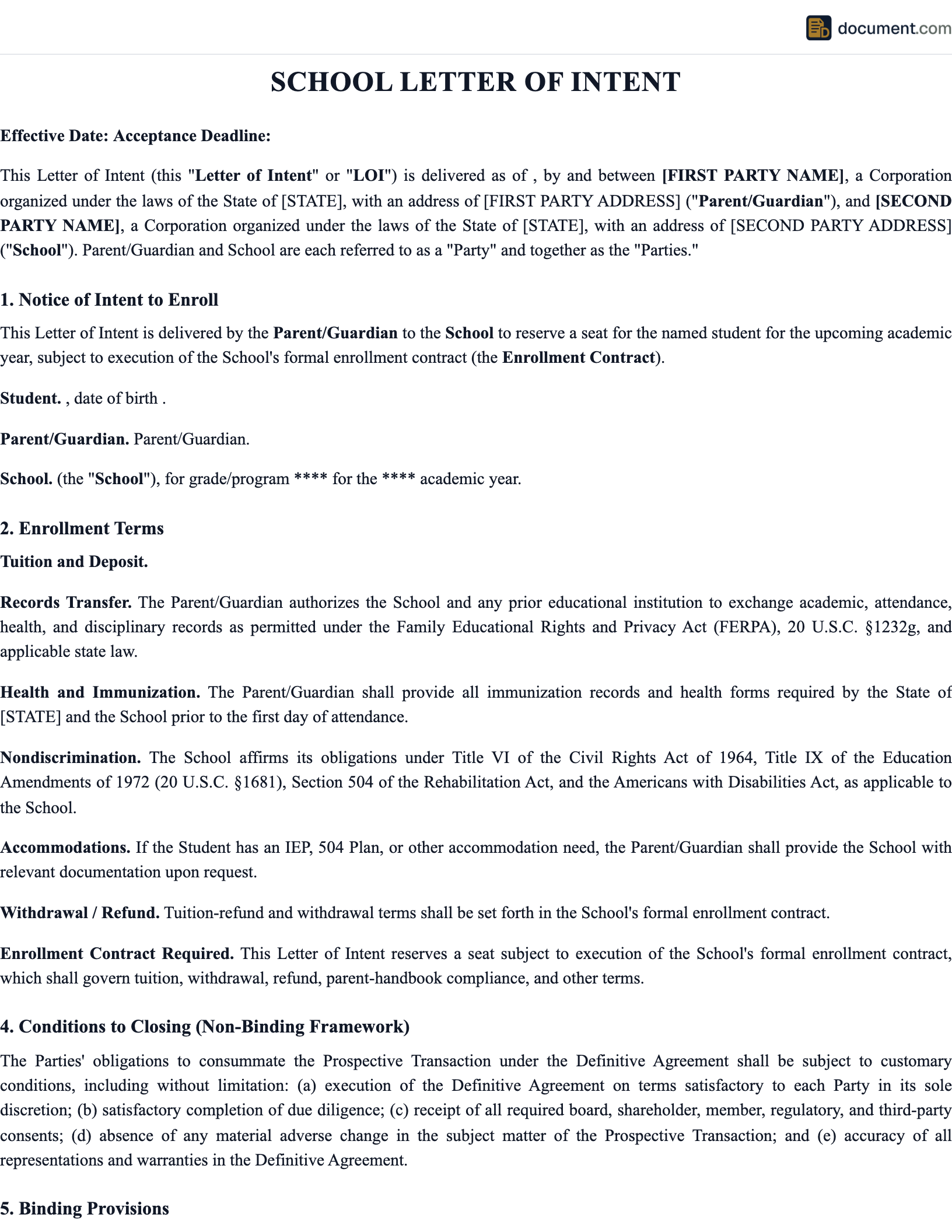



What Is a Medical School Letter of Intent?
A medical school letter of intent is a formal declaration to one medical school that the program is your unequivocal first choice and that you will matriculate if offered a seat. This document carries significant weight in the admissions process because medical schools are acutely concerned with yield — the ratio of admitted students who actually enroll. Schools invest substantial resources in each admissions decision, and when admitted students choose to go elsewhere, the school must draw from the waitlist, disrupting class planning, financial aid allocation, and housing logistics. An LOI that credibly commits you to matriculating removes that uncertainty for the school.
The medical school application landscape has become extraordinarily competitive. According to AAMC data, the average applicant applies to 18 medical schools, and the average acceptance rate at MD-granting programs hovers around 5-7%. This competition means admissions committees receive far more qualified applicants than they can admit, and the margin between accepted and waitlisted candidates is often razor-thin. In this environment, a well-crafted LOI that demonstrates genuine commitment, deep knowledge of the program, and strong fit can provide the incremental advantage that moves your file from the waitlist to the accepted pile.
The credibility of a medical school LOI depends on specificity. Admissions committees can immediately distinguish between a generic letter that could be sent to any school and a letter that reflects genuine engagement with their specific program. References to particular faculty members whose research aligns with your interests, specific curriculum features (problem-based learning, longitudinal clinical experiences, service-learning requirements), unique clinical training sites, student organizations you would join, and community health initiatives you would participate in all demonstrate that your commitment is informed and authentic rather than strategic and hollow.
Yield Signal
Demonstrates guaranteed matriculation to reduce admissions uncertainty.
Research Alignment
Connects your research interests to specific faculty and program strengths.
Clinical Readiness
Highlights clinical experiences and patient care commitment since applying.
Medical School LOI Form Preview
Dear ,
I am writing to express my unequivocal commitment to School of Medicine. After my interview on and learning about the program's , I am certain your program is my first choice...
Since my application, I have continued to strengthen my candidacy through ...
Respectfully,
AMCAS ID:
Key Components
An effective medical school LOI includes these essential elements:
| Component | Purpose | Key Details |
|---|---|---|
| Exclusive Commitment | Guarantees yield | Unambiguous first-choice statement, willingness to withdraw other acceptances |
| Mission Alignment | Demonstrates fit | Connection to school's mission (research, primary care, underserved, rural health) |
| Program Knowledge | Shows genuine interest | Specific curriculum features, faculty, clinical sites, research centers, student life |
| Meaningful Updates | Strengthens candidacy | New clinical hours, research publications, volunteer work, leadership, MCAT retake |
| Career Vision | Contextualizes commitment | Specialty interests, practice setting goals, patient population focus, academic medicine |
| Interview Reflection | Personalizes connection | Specific conversations, campus impressions, student interactions, memorable experiences |
How to Write a Medical School Letter of Intent
Open with Unambiguous Commitment
State in the first sentence that this program is your first choice and you will accept an offer of admission. Use clear, direct language that leaves no room for misinterpretation: 'I am writing to declare that [School Name] School of Medicine is my unequivocal first choice. If offered admission, I will immediately accept and withdraw all other applications and acceptances.' This upfront commitment is the primary purpose of the LOI and should not be buried in later paragraphs.
Connect to the Program's Mission
Demonstrate that your commitment is rooted in genuine alignment between your values and the school's mission. If the school emphasizes primary care, discuss your commitment to serving as a primary care physician in an underserved community. If the school is research-intensive, connect your research experiences to specific faculty labs or research initiatives. If the school has a strong community health focus, reference your volunteer experiences with medically underserved populations. This section should make clear that you are not just choosing any school — you are choosing this school for reasons that are deeply personal and professionally strategic.
Reference Specific Program Features
Identify two or three specific aspects of the program that solidified your commitment: a unique curricular approach (problem-based learning, longitudinal integrated clerkships, early clinical exposure), a specific research center or institute whose work aligns with your interests, clinical training sites that serve populations you are passionate about, global health opportunities you would pursue, dual-degree programs (MD/PhD, MD/MPH, MD/MBA) that match your career goals, or student-led initiatives you would contribute to. Name faculty members whose work inspires you and explain how you would engage with their research or clinical programs.
Provide Substantive Updates
Include meaningful updates that strengthen your candidacy since your initial application: additional clinical volunteering or shadowing hours (with specific totals and settings), new research findings, poster presentations, or publications, completion of challenging coursework or post-baccalaureate programs, new leadership positions in premedical organizations or community health initiatives, relevant employment experiences in clinical settings, and any improved MCAT scores. Quantify achievements whenever possible and explain how each update has deepened your commitment to medicine and to this program specifically.
Reflect on Your Interview Experience
Reference specific moments from your interview day that reinforced your commitment: a conversation with a faculty member about their approach to patient care, a student ambassador whose enthusiasm for the program was contagious, a facility tour that revealed the school's investment in simulation-based education, or an interaction with current students that illustrated the collaborative culture you value. These specific references demonstrate that your commitment is based on firsthand experience, not just website research, and they remind the committee of your positive in-person impression.
Close with Confidence and Professionalism
Reaffirm your commitment in the closing paragraph, offer to provide any additional information, and include your AMCAS or AACOMAS ID number for easy file retrieval. Format the letter as a one-page business letter addressed to the Dean of Admissions or the specific admissions officer with whom you interacted. Proofread exhaustively — ask a premedical advisor, English professor, or professional mentor to review for grammar, tone, and clarity. The letter should reflect the same communication skills that the profession demands: clear, concise, accurate, and empathetic.
Waitlist Strategy for Medical School Applicants
Being placed on a medical school waitlist is not a rejection — it means the school considers you a qualified candidate but does not have a seat for you at this moment. Waitlist movement varies significantly by school, with some programs admitting 10-50% of their class from the waitlist depending on the year. An LOI is one of the most effective tools for improving your position because it addresses the committee's primary concern: whether you will actually attend if offered a seat.
The AAMC's traffic rules create predictable windows of waitlist movement. After April 15, accepted applicants must narrow their acceptances to three schools, which frees seats and triggers the first wave of waitlist offers. After April 30 (or the date set by individual schools for deposit deadlines), additional seats open as applicants commit to single schools. Understanding these deadlines helps you time your LOI and any follow-up communications strategically.
While on the waitlist, continue to strengthen your application through meaningful activities — not superficial resume padding. Additional clinical volunteering at free clinics, continuation of ongoing research projects, new leadership opportunities, and community health advocacy all demonstrate the sustained commitment that medical schools value. Report these activities in brief, professional update communications that complement your LOI without overwhelming the admissions office.
AMCAS Traffic Rules
The AAMC's traffic rules require applicants holding multiple acceptances to narrow to a single school by late April. Schools know that waitlist movement accelerates after this deadline, so timing your LOI to arrive before the committee reviews the waitlist post-April 15 can be strategically advantageous. Check each school's specific deposit and commitment deadlines, as they may differ from the AAMC general timeline.
Frequently Asked Questions
Official Resources
Authoritative resources on medical school admissions, the AMCAS application, and premedical advising.
AAMC - AMCAS Application
Official centralized application service for MD-granting medical schools with application guidance and school profiles.
AAMC - Applying to Medical School
Comprehensive guide to the medical school application process including timelines, requirements, and strategies.
AAMC FACTS Data
Application, matriculation, enrollment, and graduation statistics for U.S. medical schools.
AAMC Financial Aid
Financial aid resources for medical students including federal loans, scholarships, and budgeting tools.
AACOM - Applying to DO Schools
American Association of Colleges of Osteopathic Medicine application guidance for DO programs.
Federal Student Aid
U.S. Department of Education information on federal loan programs available to medical students.
Create Your Medical School LOI
Draft a persuasive letter of intent that demonstrates your commitment and strengthens your medical school application.
Create DocumentNo account required. Free to create and preview.