
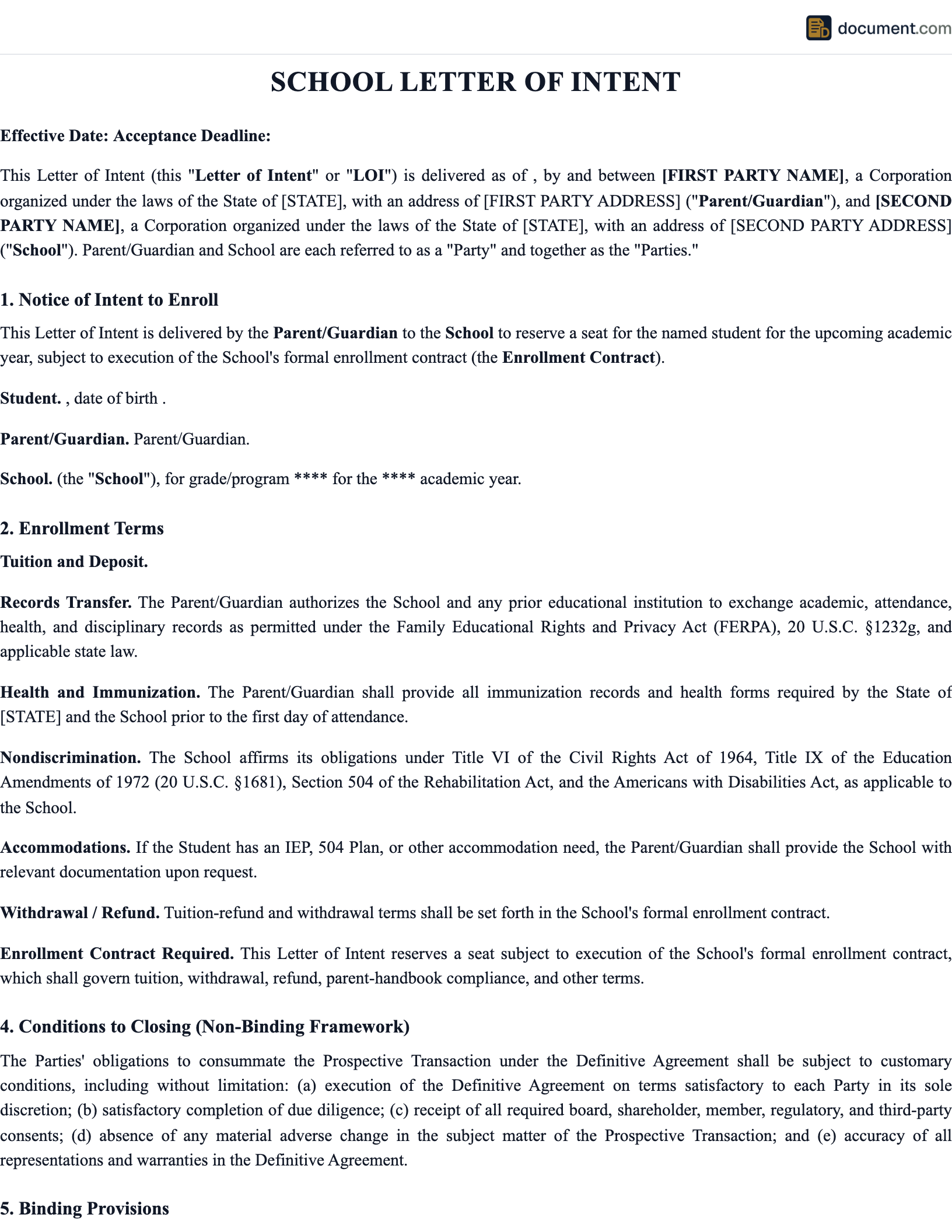



What Is a PhD Letter of Intent?
A PhD letter of intent is a targeted scholarly communication that demonstrates an applicant's genuine commitment to a specific doctoral program and articulates how their research interests align with the department's intellectual strengths. The PhD LOI differs fundamentally from professional school LOIs because doctoral admissions decisions are driven primarily by research fit rather than academic metrics alone. A candidate with perfect GRE scores and a stellar GPA but misaligned research interests will be less attractive to a department than a candidate with strong (but not perfect) credentials whose research agenda complements existing faculty projects and fills a gap in the department's intellectual portfolio.
The faculty mentoring model that characterizes most PhD programs means that individual professors have significant influence over admissions decisions. When a faculty member reads an LOI that articulates a research agenda closely aligned with their own work — and that demonstrates genuine engagement with their published scholarship — they become invested in the applicant's admission. This faculty advocacy can be decisive in committee deliberations, where multiple qualified candidates compete for limited funded positions. The LOI, therefore, serves a dual audience: the admissions committee evaluating overall fit with the program, and specific faculty members evaluating potential mentoring relationships.
PhD programs invest heavily in each doctoral student — typically 5-7 years of funding, faculty mentoring time, and departmental resources — making admissions decisions among the most consequential that departments make. The LOI helps the committee assess not just whether you can succeed in the program but whether you will: whether your research agenda is feasible within the department's resources, whether your intellectual interests will sustain your motivation through the challenges of doctoral study, and whether you will accept an offer of admission rather than choosing a competing program. A well-crafted LOI addresses all three concerns by demonstrating research fit, intellectual maturity, and genuine commitment.
Research Alignment
Connects your research agenda to specific faculty expertise and departmental strengths.
Scholarly Vision
Articulates a clear, feasible research trajectory for your doctoral work.
Intellectual Community
Shows how you will contribute to the department's scholarly culture.
PhD LOI Form Preview
Dear ,
I am writing to express my sincere commitment to the PhD program in at . After my campus visit and conversations with , I am certain that your program provides the ideal scholarly environment for my doctoral research on ...
Since my application, I have advanced my research by , which has further confirmed the alignment between my interests and your department's expertise...
Respectfully,
Application ID:
Key Components
An effective PhD LOI includes these essential elements:
| Component | Purpose | Key Details |
|---|---|---|
| Program Commitment | Signals enrollment intent | First-choice declaration, willingness to accept immediately upon admission |
| Research Agenda | Demonstrates scholarly preparation | Research questions, theoretical frameworks, methodology, dissertation direction |
| Faculty Alignment | Identifies mentoring relationships | Specific faculty, their published work, how your research extends their scholarship |
| Scholarly Updates | Shows continued development | New publications, conference presentations, research findings, grants, awards |
| Visit Reflections | Personalizes commitment | Faculty conversations, seminar observations, graduate student interactions, lab visits |
| Career Trajectory | Contextualizes doctoral goals | Academic career, research institution, industry R&D, policy, teaching aspirations |
How to Write a PhD Letter of Intent
Open with Commitment and Context
Begin with a clear statement of commitment that immediately contextualizes your interest: 'I am writing to declare that the PhD program in [Field] at [University] is my first choice for doctoral study. After my campus visit and conversations with Professors [Name] and [Name], I am confident that your program provides the intellectual environment and mentoring relationships that will enable my research on [Topic].' This opening establishes both commitment and specificity in the first two sentences.
Articulate Your Research Fit
This is the core of a PhD LOI and should receive the most space. Describe your specific research interests and explain how they align with faculty expertise in the department. Reference specific published works by faculty members and explain how your research builds on, extends, or complements their scholarship. For example: 'Professor [Name]'s recent work on [specific topic in specific publication] directly intersects with my interest in [your research area]. I envision a dissertation that extends their framework to examine [specific questions], utilizing [methodological approaches] that I developed during my master's research.' This level of specificity demonstrates genuine scholarly engagement rather than superficial name-dropping.
Highlight Departmental Resources
Demonstrate knowledge of the program's specific resources that would support your research: research centers or institutes, specialized laboratories or equipment, archival collections, datasets, interdisciplinary programs, and collaborative opportunities with other departments or institutions. Reference specific seminars, reading groups, or colloquia that you would participate in. For example: 'The [Center/Institute Name]'s focus on [topic] and its partnership with [organization] would provide access to [specific resources] essential for my proposed research on [topic].' This shows the committee that you understand the program's infrastructure, not just its faculty roster.
Provide Scholarly Updates
Include meaningful research and academic developments since your application: new publications (peer-reviewed articles, book chapters, edited volumes), conference presentations or invited talks, research grants received, completion of a master's thesis or significant research project, new teaching experience, or methodological training (statistical software, fieldwork methods, archival research, laboratory techniques). Each update should connect to your doctoral research plans: 'My recent conference presentation at [Conference Name] on [topic] generated productive feedback that has refined my proposed dissertation methodology, particularly regarding [specific methodological question].'
Reflect on Your Visit and Interactions
Reference specific experiences from your campus visit or interactions with the program's community: conversations with faculty members about research questions or theoretical debates, attendance at departmental seminars or colloquia, meetings with current graduate students about their experiences and the program's culture, tours of research facilities, or discussions about teaching opportunities. These references demonstrate firsthand engagement and give the committee confidence that your commitment is based on direct experience with the program's intellectual environment, not just its reputation.
Close with Academic Professionalism
Reaffirm your commitment, briefly mention your career aspirations (academic position, research institution, policy work, industry R&D) and how the doctoral training connects to them, and offer to provide any additional information or discuss your research interests further. Include your application ID and contact information. The letter should be one to two pages, reflecting the scholarly communication standards of your discipline. Have it reviewed by your master's advisor, a faculty mentor, or a colleague in the field who can evaluate both the content and the tone for appropriateness in your specific discipline's academic culture.
Demonstrating Research Alignment
Research alignment is the defining feature of a strong PhD LOI. Unlike professional school LOIs, where commitment and career goals take center stage, the PhD LOI must convince the committee — and especially potential faculty advisors — that you have a clear, feasible research agenda that can be productively pursued within their specific intellectual community. This requires going beyond stating your general area of interest and articulating how your research questions, theoretical orientation, and methodological approach connect to the work being done in the department.
Effective research alignment arguments are built on genuine engagement with the faculty's published work. Read their recent articles and books, not just their faculty webpage summaries. Reference specific arguments, findings, or theoretical contributions from their scholarship and explain how your research extends, challenges, or applies their ideas in new contexts. For example, rather than saying "I am interested in Professor X's work on climate policy," write: "Professor X's analysis of carbon pricing mechanisms in developing economies, particularly the framework developed in their recent Journal of Environmental Economicsarticle, provides the theoretical foundation for my proposed research on how subnational climate policies interact with national regulatory frameworks in Southeast Asian contexts."
It is also important to demonstrate flexibility alongside specificity. Faculty members want doctoral students who have clear research interests but who are also intellectually curious and open to evolution as they deepen their expertise. Signal that you have a strong starting point but are eager to refine your research direction through coursework, mentoring, and engagement with the department's intellectual community. This balance between preparation and openness characterizes the most successful doctoral students and the most effective LOIs.
Disciplinary Variation
PhD LOI conventions vary significantly by discipline. In laboratory sciences, emphasizing specific techniques, equipment, and hands-on research experience is expected. In humanities, demonstrating theoretical sophistication and archival or textual analysis skills takes priority. In social sciences, articulating methodological orientation (quantitative, qualitative, mixed methods) and familiarity with current theoretical debates is essential. Tailor your LOI not just to the specific program but to the disciplinary norms that the committee expects. Reading published doctoral student profiles on the department's website can provide insight into the kind of research articulation the program values.
Frequently Asked Questions
Official Resources
Authoritative resources on doctoral program admissions, graduate education, and research careers.
CGS - Council of Graduate Schools
National organization representing graduate education with best practices, advocacy, and data on doctoral programs.
NSF - Survey of Earned Doctorates
National Science Foundation annual survey providing comprehensive data on PhD recipients in the United States.
ETS - GRE General Test
Official GRE resources including test preparation, score reporting, and graduate program information.
NCES - Digest of Education Statistics
National Center for Education Statistics data on graduate enrollment, degrees conferred, and educational outcomes.
APA Graduate Education Resources
American Psychological Association resources on doctoral program selection, application strategies, and academic careers.
Federal Grad PLUS Loans
U.S. Department of Education information on federal loan programs available to doctoral students.
Create Your PhD LOI
Draft a compelling letter of intent that articulates your research vision and strengthens your doctoral program application.
Create DocumentNo account required. Free to create and preview.