
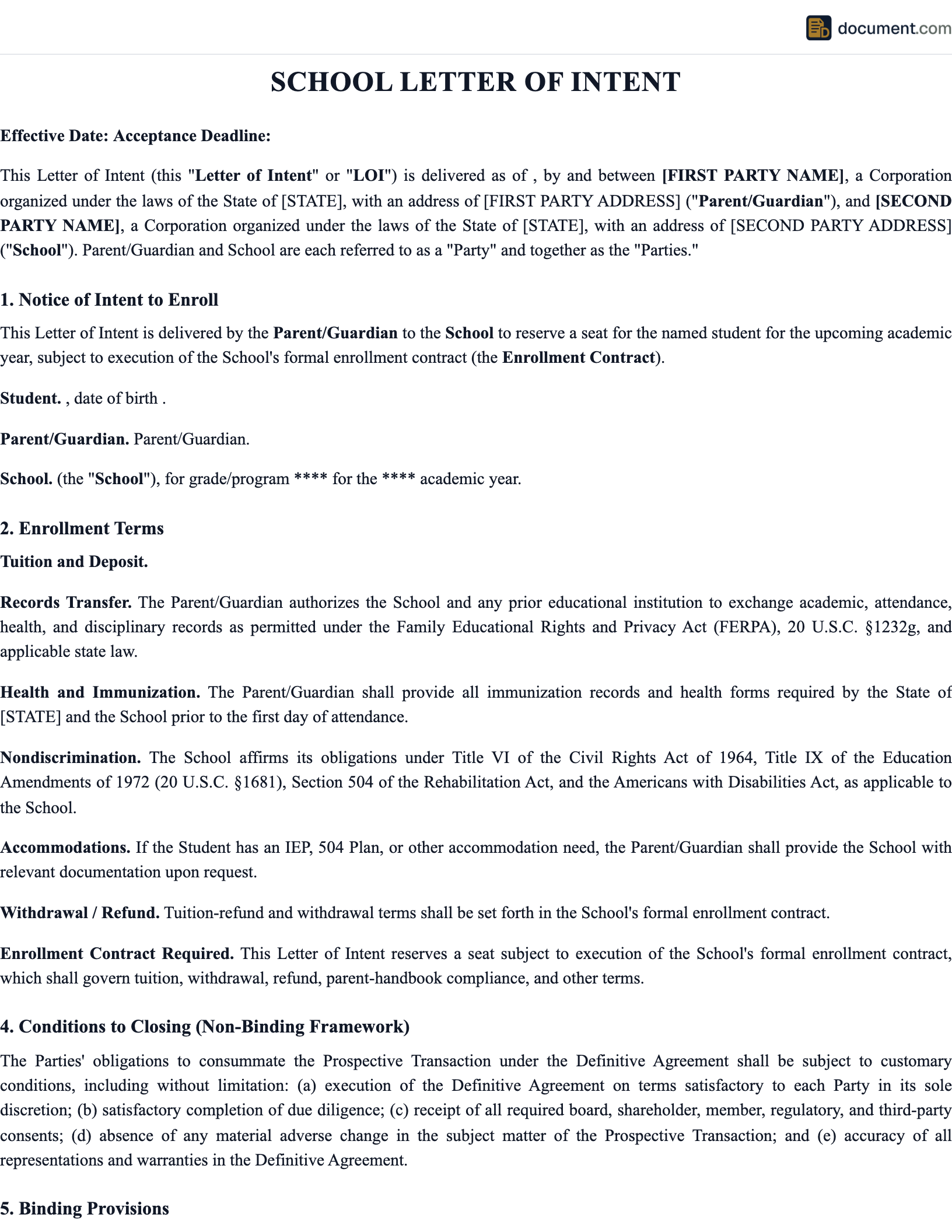



What Is a Graduate School Letter of Intent?
A graduate school letter of intent is a formal document submitted to an academic institution that communicates your specific interest in a graduate program, demonstrates how your academic background and research experience align with the program's strengths, and signals your commitment to attend if admitted. It differs from the broader statement of purpose by focusing narrowly on the match between you and one particular program rather than narrating your general academic journey.
The graduate school LOI operates in an admissions context where fit matters as much as qualifications. Graduate programs — particularly research-intensive PhD programs — invest significant resources in each admitted student through funding, mentorship, lab access, and professional development. Admissions committees use the LOI to assess whether a candidate has done genuine research into the program, whether their interests align with available faculty mentors, and whether they are likely to accept an offer of admission. For MBA programs, the LOI helps admissions committees evaluate whether the candidate understands the program's distinctive culture, pedagogical approach, and career development resources well enough to thrive in that specific environment.
Graduate school LOIs serve their most critical function in two scenarios: as a required application component and as a post-waitlist communication. When required as part of the application, the LOI provides the committee with a focused document that complements the broader statement of purpose. When sent after a waitlist decision, the LOI serves as both a reaffirmation of interest and an opportunity to present new information that strengthens your candidacy. In either case, the most effective LOIs share a common characteristic: they could not have been written about any other program because they reference specific, verifiable details about the program's faculty, curriculum, research infrastructure, and community.
Research Alignment
Connects your scholarly interests to specific faculty research and lab opportunities at the program.
Mentor-Student Fit
Demonstrates that you have identified potential advisors whose work matches your research trajectory.
Scholarly Contribution
Articulates what you bring to the academic community beyond consuming educational resources.
Graduate School LOI Form Preview
Letter of Intent
Graduate Program Admissions
1. PROGRAM AND APPLICANT
Dear Graduate Admissions Committee, I am writing to express my strong interest in the program at for the admissions cycle.
2. RESEARCH ALIGNMENT
My research experience in aligns with the work of Professor , whose studies on directly inform my research interests.
3. COMMITMENT AND GOALS
Your program is my first choice. I am prepared to accept an offer of admission and contribute to the scholarly community through .
APPLICANT
DATE
MBA vs PhD Letters of Intent
MBA and PhD LOIs differ fundamentally in focus, content, and evaluation criteria. Understanding these differences ensures your LOI addresses what the admissions committee actually cares about for your specific program type.
MBA LOI
Express interest in an MBA program covering leadership experience, business impact, and career transition goals
PhD LOI
Communicate your research agenda, faculty alignment, and scholarly contributions for doctoral program admission
| Dimension | MBA LOI | PhD LOI |
|---|---|---|
| Primary Focus | Career impact and leadership | Research agenda and faculty fit |
| Key Evidence | Professional achievements, leadership roles | Publications, research experience, methodology |
| Program Elements to Reference | Concentrations, experiential learning, alumni network | Faculty labs, research centers, departmental seminars |
| Career Discussion | Specific post-MBA roles, industries, companies | Academic career, research trajectory, dissertation topics |
| Tone | Professional, results-oriented, strategic | Scholarly, intellectually curious, methodical |
Key Components
Every graduate school LOI, regardless of program type, should address these fundamental elements:
| Component | Purpose | Key Details |
|---|---|---|
| Program Specificity | Proves genuine, researched interest | Specific program name, degree, track, unique features only available at this institution |
| Faculty Alignment | Demonstrates mentor-student match | Named faculty, their research areas, how your interests connect, prior conversations |
| Academic Preparation | Shows readiness for graduate-level work | Research experience, relevant coursework, methodological training, publications |
| Research Agenda | Articulates scholarly direction | Research questions, methodology, how the program enables this work |
| Contribution Statement | Indicates what you bring to the community | Diverse perspectives, collaborative skills, teaching interests, community involvement |
| Career Vision | Connects degree to professional trajectory | Post-graduation plans, how the degree enables specific career outcomes |
How to Write a Graduate School Letter of Intent
Research the Program Beyond Surface Level
Go beyond the program's website overview. Read recent publications by faculty you might work with. Review the curriculum for specific courses that align with your interests. Look at recent dissertations or theses produced by the program's students. Check whether faculty are currently accepting students and whether their research direction matches your timeline. For MBA programs, review the employment report, speak with alumni in your target industry, and understand the program's pedagogical approach (case method, experiential, lecture). This deep research produces the specific references that distinguish a compelling LOI from a generic one.
Open with Your Specific Connection to the Program
Begin your LOI with a concrete statement that immediately establishes your connection to this particular program. For PhD applicants, this might be a reference to a faculty member's recent publication that informed your own research. For MBA applicants, it might be a conversation with an alumnus who described a specific program feature that aligned with your career goals. Avoid opening with flattery ('Your renowned program...') or autobiography ('Since childhood, I have been fascinated...'). The opening should answer the committee's primary question: 'Why us specifically?'
Draw Bidirectional Connections
The most effective LOIs demonstrate fit in both directions — explaining not only what you will gain from the program but what you will contribute. For PhD programs, describe how your research experience prepares you to contribute to a faculty member's lab from day one. For MBA programs, explain how your professional background will enrich classroom discussions and study group dynamics. Admissions committees are building cohorts, not filling seats, and they want students who will add value to the community.
Address the 'Why Now' Question
Explain why pursuing graduate study at this particular point in your career makes strategic sense. For PhD applicants, describe how your research questions have matured to the point where doctoral training is the natural next step. For MBA applicants, articulate the career inflection point you have reached and why additional business education is necessary to achieve your next-stage goals. This narrative prevents the LOI from reading as a generic aspiration and positions it as a deliberate, timed career decision.
Provide Updates If Post-Application
If you are sending your LOI after initial application — particularly from a waitlist — include substantive updates that provide new evaluative information. New research publications, conference presentations, professional promotions, additional coursework, relevant certifications, or awards give the committee fresh reasons to move your application forward. Present these updates concisely with specific details: 'Since submitting my application, I have published a paper in [journal] on [topic] and completed an additional 120 hours of [relevant activity].'
Close with Confidence and Clarity
End with a clear commitment statement and professional closing. State unambiguously that the program is your top choice and that you will accept an offer if extended (if this is genuinely true). Provide your contact information and express willingness to provide additional materials. Keep the closing brief — one short paragraph is sufficient. The overall LOI should not exceed one page. Proofread meticulously for errors, verify all faculty names and research references, and ensure the tone is confident without being presumptuous.
Research and Faculty Alignment
For research-focused graduate programs, demonstrating alignment between your scholarly interests and the program's faculty expertise is the single most important element of your LOI. Admissions committees evaluate whether a credible mentoring relationship can develop between you and available faculty advisors, and the LOI is your primary opportunity to make that case.
Effective faculty references go beyond naming professors and citing their publications. Instead, they explain the intellectual connection: how your research questions emerged from or extend the faculty member's work, what methodological approaches you share, and what specific contribution you could make to their research agenda. For example, rather than writing "I am interested in Professor Lee's work on computational linguistics," write "Professor Lee's recent work on cross-lingual transfer learning in low-resource settings directly extends my undergraduate research on morphological analysis of under-documented languages, and I am eager to explore how zero-shot approaches could improve performance on the Bantu language family I have been studying."
Verify that your faculty references are current and accurate. Check the department's website to confirm the professor is still actively teaching and conducting research at the institution. Review their most recent publications (within the last two to three years) to ensure your references reflect their current research direction, not outdated work. If you have had any direct communication with the faculty member — email exchanges, conversations at conferences, or interview-day meetings — reference those interactions to demonstrate an established connection.
Frequently Asked Questions
Official Resources
Authoritative resources on graduate school admissions, program evaluation, and academic career development.
Council of Graduate Schools - Student Resources
National organization providing guidance on graduate admissions processes, funding opportunities, and program evaluation criteria.
NSF Graduate Research Fellowship Program
National Science Foundation fellowship for graduate students in STEM fields, including application guidance and eligibility requirements.
ETS - About the GRE
Educational Testing Service information on the GRE General Test, including score requirements and test preparation resources for graduate applicants.
GMAC - About the GMAT Exam
Graduate Management Admission Council resources on the GMAT exam for MBA and business graduate program applicants.
NCES College Navigator
National Center for Education Statistics tool for researching graduate programs, admissions statistics, and institutional data.
U.S. Department of Education - College Resources
Federal resources on graduate education applications, financial aid options including FAFSA, and student consumer protection.
Create Your Graduate School LOI
Draft a compelling letter of intent for MBA or PhD program admissions with research-aligned content and professional formatting.
Create DocumentNo account required. Free to create and preview.