
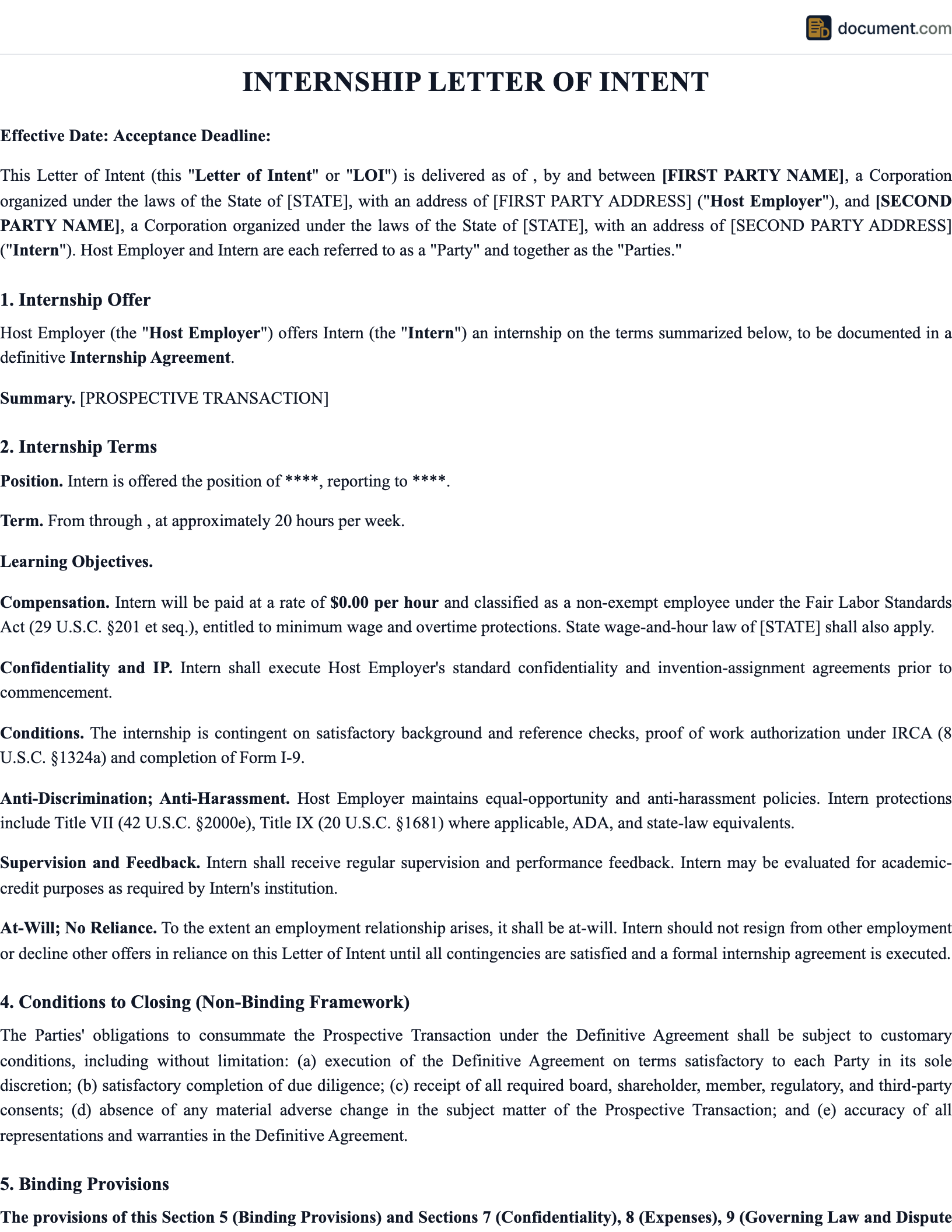



What Is an Internship Letter of Intent?
An internship letter of intent is a preliminary written agreement between an organization and a prospective intern that sets forth the essential terms of a planned internship engagement. The document bridges the gap between an informal verbal offer and a binding internship agreement, providing both parties with a structured framework to confirm mutual expectations before committing to the formal onboarding process. For the organization, the LOI represents a recruiting tool that secures a candidate's commitment while internal approvals, background checks, and departmental planning are finalized. For the intern, it provides written assurance of the opportunity's terms, enabling informed decisions about competing offers, housing arrangements, academic scheduling, and potential relocation.
The internship LOI occupies a distinct position in employment documentation because internships involve unique legal considerations that standard employment letters do not address. The Fair Labor Standards Act (FLSA) and its state equivalents impose specific requirements for unpaid internships under the "primary beneficiary" test adopted by the Department of Labor. The LOI should reflect these regulatory requirements by articulating the educational nature of the experience, the training and mentorship the organization will provide, and the degree to which the intern's activities benefit the intern rather than the employer. Failure to properly structure the internship relationship can result in the intern being reclassified as an employee entitled to minimum wage, overtime, and other employment protections.
Beyond regulatory compliance, a well-crafted internship LOI establishes the professional tone of the relationship from its inception. It defines reporting structures, sets performance evaluation milestones, identifies specific projects or rotational assignments, and addresses practical matters like work schedules, remote work eligibility, dress code expectations, and access to company facilities and systems. Organizations that invest in thorough LOIs consistently report higher intern satisfaction, better retention through program completion, and stronger conversion rates from intern to full-time employee.
Learning Objectives
Defines educational goals, skill development targets, and mentorship expectations for the placement.
Duration and Schedule
Specifies start and end dates, weekly hours, and flexibility for academic obligations.
Evaluation Framework
Establishes performance benchmarks, review schedules, and criteria for successful completion.
Internship LOI Form Preview
Letter of Intent
Internship Placement
1. PARTIES AND POSITION
This Letter of Intent confirms the mutual interest of ("Organization") in offering an internship position to ("Intern") in the department.
2. DURATION AND SCHEDULE
The internship shall commence on and conclude on , with an expected schedule of hours per week.
3. LEARNING OBJECTIVES
The intern will gain practical experience in under the supervision of .
ORGANIZATION
INTERN
Key Components
An effective internship LOI addresses the following elements to establish clear expectations and protect both the organization and the intern:
| Component | Purpose | Key Details |
|---|---|---|
| Position Description | Defines role and responsibilities | Title, department, reporting manager, daily duties, project assignments, team interactions |
| Duration and Schedule | Sets temporal boundaries | Start and end dates, weekly hours, remote vs on-site, holiday schedule, flexibility for exams |
| Compensation | Establishes financial terms | Hourly rate or stipend, payment frequency, housing or transportation allowances, expense reimbursement |
| Learning Objectives | Ensures educational value | Skills to develop, training programs, mentorship pairing, rotation through departments |
| Academic Credit | Links internship to education | Institution requirements, credit hours, faculty advisor coordination, progress reports |
| Evaluation Process | Measures intern performance | Mid-term and final reviews, feedback mechanisms, completion criteria, letter of recommendation |
| Confidentiality | Protects proprietary information | NDA requirements, IP assignment, data handling protocols, post-internship obligations |
| Termination Provisions | Defines exit conditions | Notice periods, grounds for early termination, return of company property, final evaluation |
How to Write an Internship Letter of Intent
Identify the Parties and Position
Begin with the full legal name of the organization, the intern's full name, the specific department or team, the position title, and the name and title of the direct supervisor. Include the organization's address and the primary work location (on-site, remote, or hybrid). If the internship is part of a structured program, name the program and any cohort designation.
Define the Duration and Work Schedule
Specify the anticipated start date, end date, and total duration in weeks. State the expected weekly hours, daily schedule, and any flexibility for academic commitments such as exams, thesis defenses, or class schedules. Clarify whether the schedule is fixed or flexible, whether remote work days are available, and how holidays and organization closures affect the internship timeline.
Outline Learning Objectives and Projects
Articulate specific, measurable learning objectives the intern will pursue during the placement. Identify the primary projects or assignments, any departmental rotations, training programs the intern will attend, and the skills the intern is expected to develop. Connect these objectives to the intern's academic program or career goals where applicable.
Specify Compensation and Benefits
State whether the internship is paid or unpaid. For paid internships, detail the hourly rate or total stipend, payment schedule, overtime eligibility, and any additional benefits like housing assistance, transportation subsidies, meal allowances, or conference attendance sponsorship. For unpaid internships, confirm compliance with DOL primary beneficiary test factors and reference any academic credit arrangement.
Establish Supervision and Evaluation
Name the assigned mentor or supervisor, define the frequency of check-in meetings (weekly, bi-weekly), describe the mid-term and final evaluation process, and specify the criteria for successful completion. Address whether the intern will receive a formal performance review, a letter of recommendation upon completion, or consideration for full-time employment after graduation.
Address Confidentiality and IP Assignment
Include provisions requiring the intern to maintain confidentiality of proprietary business information, customer data, and trade secrets encountered during the internship. Reference any separate NDA or CIIAA the intern must sign as a condition of starting. Clarify intellectual property ownership for work product created during the internship, including code, designs, research, and written materials.
Include Conditions and Disclaimers
State that the LOI is contingent on successful completion of background checks, verification of academic enrollment or eligibility, and any required visa or work authorization. Include a clear disclaimer that the LOI is a preliminary expression of intent, not a binding employment contract, and that the formal internship agreement will govern the relationship. Specify an expiration date for the LOI if the intern does not respond within a given timeframe.
Paid vs Unpaid Internships
The distinction between paid and unpaid internships carries significant legal implications that directly affect how the LOI should be structured. Under the FLSA, the Department of Labor applies a "primary beneficiary" test with seven non-exhaustive factors to determine whether an unpaid intern at a for-profit employer is actually an employee entitled to minimum wage and overtime. The factors examine whether the intern and employer clearly understand there is no expectation of compensation, whether the internship provides training similar to an educational environment, whether the internship is tied to the intern's formal education program, whether the internship accommodates the intern's academic calendar, whether the internship's duration is limited to the period of beneficial learning, whether the intern's work complements rather than displaces existing employees, and whether both parties understand no entitlement to a paid job at the conclusion.
For paid internships, the LOI should specify the hourly wage or stipend amount and confirm compliance with federal minimum wage ($7.25/hour) and any higher state or local minimum wage requirements. Many states, including California, New York, and Washington, have minimum wages substantially above the federal floor. The LOI should also address overtime eligibility — most paid interns are non-exempt employees entitled to time-and-a-half for hours exceeding 40 in a workweek. Organizations frequently supplement base compensation with housing stipends, relocation assistance, transportation passes, and meal allowances, all of which should be documented in the LOI to set clear expectations.
State-Specific Intern Protections
Several states extend workplace protections to unpaid interns that traditionally applied only to employees. New York, California, Oregon, Illinois, and the District of Columbia have enacted laws prohibiting sexual harassment and discrimination against unpaid interns. Some jurisdictions also require workers' compensation coverage for interns. The LOI should acknowledge applicable state protections and reference the organization's compliance policies.
Frequently Asked Questions
Official Resources
Authoritative resources on internship regulations, compliance requirements, and best practices.
DOL - Internships Under the FLSA
Department of Labor fact sheet on the primary beneficiary test for determining whether interns at for-profit employers are employees entitled to minimum wage and overtime.
EEOC - Internship Guidance
Equal Employment Opportunity Commission resources on anti-discrimination protections applicable to interns and workplace harassment prevention.
NACE - Career Readiness Competencies
National Association of Colleges and Employers framework for internship learning objectives and career competency development.
SHRM - Employing Interns Toolkit
Society for Human Resource Management comprehensive toolkit covering internship program design, legal compliance, and best practices.
IRS - Worker Classification
IRS guidance on classifying workers as employees, independent contractors, or interns for federal tax withholding and reporting purposes.
OSHA - Young Worker Safety
Occupational Safety and Health Administration resources on workplace safety protections and prohibited tasks for young workers and interns.
Create Your Internship LOI
Formalize an internship placement with a professional letter of intent covering role details, learning objectives, compensation, and evaluation criteria.
Create DocumentNo account required. Free to create and preview.