
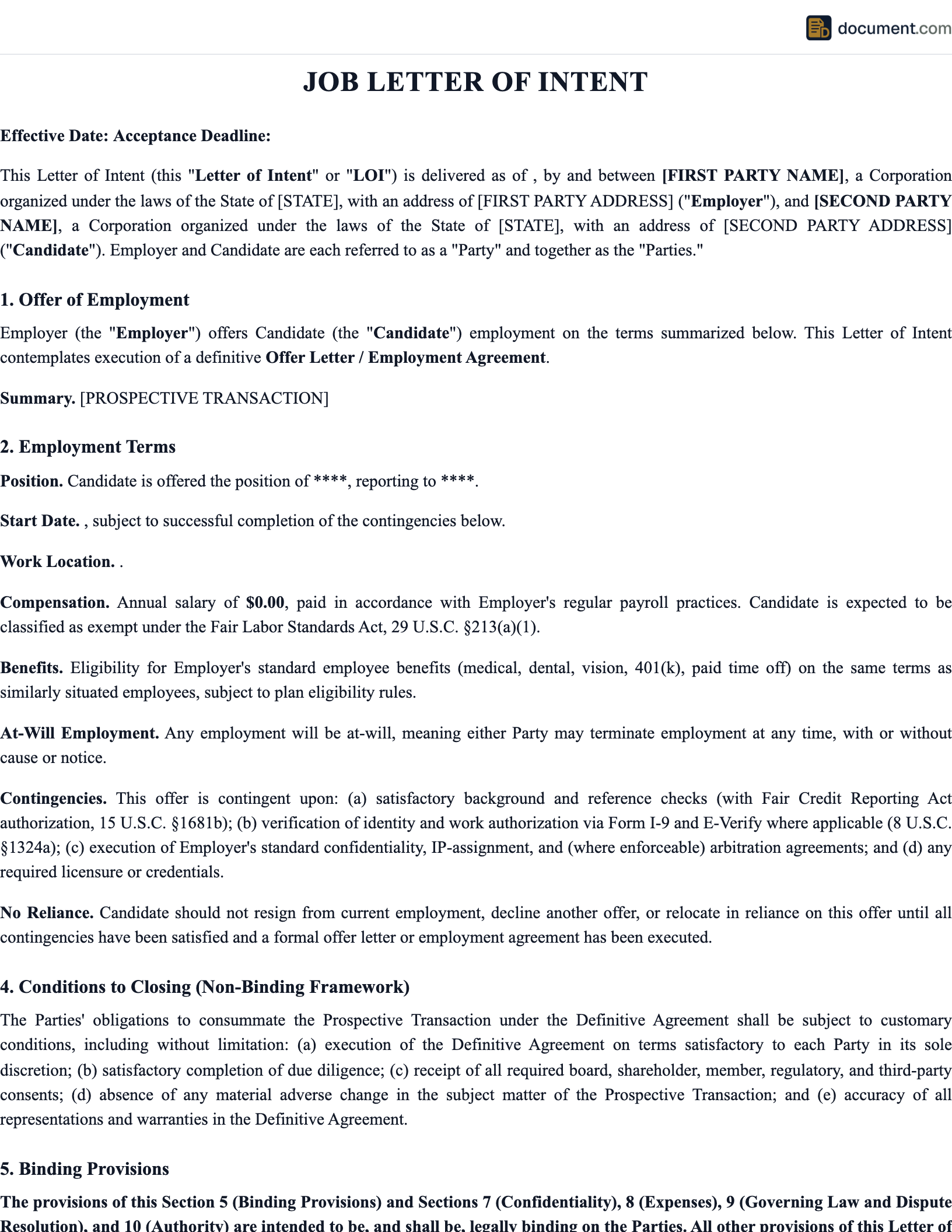



What Is a Physician Letter of Intent?
A physician letter of intent is a preliminary agreement document used in healthcare employment negotiations that outlines the key terms under which a physician will join a medical practice, hospital, or health system. The physician LOI addresses complexities unique to medical employment that general employment LOIs do not cover: multi-component compensation structures combining base salary with productivity incentives measured in work Relative Value Units (wRVUs), call coverage schedules and compensation, malpractice insurance arrangements including the critically important tail coverage allocation, medical staff privileges and credentialing processes, clinical support staffing commitments, and restrictive covenant parameters.
The physician LOI serves a particularly important function in medical employment because physician contracts are among the most complex employment agreements in any industry. A comprehensive physician employment agreement can run 40 to 80 pages and require weeks of legal review and negotiation. The LOI establishes agreement on the fundamental deal points before either party invests in the expensive process of drafting and negotiating the definitive contract. For the physician, the LOI provides enough certainty about compensation, call duties, and practice scope to make the decision to relocate, resign from a current position, or decline competing opportunities. For the employer, the LOI secures a commitment from the physician while the credentialing, privileging, and contract drafting processes proceed.
The healthcare regulatory environment adds layers of complexity to physician LOIs that do not exist in other employment contexts. Physician compensation must comply with the Stark Law (physician self-referral prohibition), the Anti-Kickback Statute, and fair market value requirements to avoid allegations that compensation is structured to induce patient referrals. The LOI should reference these compliance frameworks and note that the definitive agreement will include appropriate compliance provisions and fair market value opinions.
Clinical Terms
Defines practice scope, call schedule, patient volume expectations, and clinical support.
Compensation Structure
Outlines base salary, RVU productivity bonuses, call pay, and ancillary income.
Malpractice Coverage
Specifies policy type, coverage limits, and tail coverage responsibility allocation.
Physician LOI Form Preview
Letter of Intent
Physician Employment
1. PARTIES AND POSITION
("Practice") proposes to employ , M.D./D.O., ("Physician") in the specialty of .
2. COMPENSATION
Base salary of $ per year, with productivity bonus of $ per wRVU above annual threshold.
3. MALPRACTICE INSURANCE
Practice shall provide malpractice coverage with limits of $ /.
PRACTICE
PHYSICIAN
Key Components
A physician LOI must address healthcare-specific employment terms that go well beyond standard employment agreements:
| Component | Purpose | Key Details |
|---|---|---|
| Compensation Structure | Defines income model | Base salary, wRVU rate, productivity thresholds, guarantee period, quality bonuses |
| Call Coverage | Sets on-call obligations | Call frequency, compensation, weekend/holiday rotation, backup coverage, trauma call |
| Malpractice Insurance | Allocates liability risk | Policy type (occurrence/claims-made), limits, tail coverage, premium payment responsibility |
| Hospital Privileges | Addresses credentialing | Facilities, privilege categories, application support, credentialing timeline, interim privileges |
| Non-Compete Covenant | Restricts post-employment practice | Geographic radius, duration, specialty scope, buyout provision, state law limitations |
| Clinical Support | Defines practice resources | Medical assistants, nursing staff, office space, equipment, EMR system, billing support |
| Partnership Track | Outlines ownership path | Eligibility timeline, buy-in terms, governance rights, profit sharing, exit provisions |
How to Negotiate a Physician Letter of Intent
Research Market Compensation Data
Before engaging in LOI negotiations, obtain current market compensation data for your specialty, geographic region, and practice setting. The Medical Group Management Association (MGMA) publishes the most widely cited physician compensation surveys, and the American Medical Group Association (AMGA) provides additional benchmarking data. Compare base salary, total compensation, wRVU production, and benefits packages. Understanding the 25th, 50th, and 75th percentile compensation for your specialty gives you a factual basis for negotiation and helps you evaluate whether the proposed terms are competitive.
Evaluate the Compensation Model
Analyze the proposed compensation structure beyond just the total dollar amount. A high guaranteed salary with no productivity component provides income security but may limit upside. A lower base with generous wRVU productivity bonuses rewards high producers but creates income volatility. Understand the wRVU thresholds, the dollar-per-wRVU rate, how wRVUs are counted (personally performed vs. incident-to billing), and whether quality or patient satisfaction metrics affect compensation. Request historical wRVU production data for the position to assess whether the productivity targets are realistic.
Negotiate Malpractice and Tail Coverage
Determine whether the employer provides occurrence or claims-made malpractice insurance, the coverage limits (common limits are $1M/$3M per occurrence/aggregate), and critically, who bears the cost of tail coverage if the physician departs a claims-made policy. If the employer insists on the physician paying tail coverage, negotiate a vesting schedule where the employer assumes an increasing percentage of the tail cost based on years of service (for example, 25% per year, fully vested at four years). Alternatively, negotiate for occurrence-based coverage, which eliminates the tail coverage issue entirely.
Address Call Coverage and Clinical Schedule
Call coverage is a significant quality-of-life factor and should be negotiated carefully. Specify the call frequency (1:4, 1:5, 1:6), the type of call (phone-only vs. in-house), compensation for call shifts (per-diem rate, additional wRVUs, or included in base salary), and protections against excessive call burden. Negotiate the clinical schedule including clinic days per week, expected patient volume, protected administrative time, and whether the schedule includes weekend or evening clinics. These terms directly affect burnout risk and should not be deferred to the definitive agreement.
Define Non-Compete Parameters
Push back on overly restrictive non-compete clauses during the LOI stage when you have the most leverage. Negotiate the geographic radius (aim for the narrowest reasonable scope), the duration (one to two years rather than three or more), and carve-outs for specific practice settings (academic medicine, government service, or telemedicine). Consider negotiating a buyout provision that allows you to practice within the restricted area in exchange for a defined payment, which gives you flexibility while compensating the employer for the competitive impact. Research your state's specific laws on physician non-compete enforceability.
Secure Signing Bonus and Relocation Terms
If the position requires relocation or you are leaving an established practice, negotiate a signing bonus and relocation package. Typical physician signing bonuses range from $10,000 to $100,000 depending on specialty and market demand. The LOI should specify the bonus amount, payment timing, and any repayment obligation if the physician departs before a specified period (often prorated over two to three years). Relocation packages may include moving expense reimbursement, temporary housing, house-hunting trips, and assistance with spousal employment.
Physician Compensation Models
Understanding the prevailing compensation models is essential for evaluating and negotiating physician LOI terms. The healthcare industry has shifted significantly from pure collections-based models toward value-based compensation that incorporates quality metrics alongside productivity measures. The LOI should clearly identify which model applies and how each component is calculated.
The guaranteed salary model provides a fixed annual compensation regardless of patient volume or billing collections. This model is common during the first one to two years of employment (the "ramp-up period") when the physician is building a patient panel, and in hospital-employed settings where the institution absorbs the revenue risk. The productivity model ties compensation directly to work Relative Value Units generated, with the physician earning a specified dollar-per-wRVU rate. Hybrid models combine a base salary guarantee with productivity bonuses above a threshold, offering income stability with upside potential for high producers.
Stark Law Compliance
Physician compensation arrangements must comply with the Stark Law (42 U.S.C. 1395nn), which prohibits physicians from referring Medicare or Medicaid patients for designated health services to entities with which the physician has a financial relationship, unless an exception applies. The employment exception requires that compensation be set at fair market value, not determined by the volume or value of referrals, and commercially reasonable. The LOI should note that final compensation terms will be validated against fair market value benchmarks and structured to comply with applicable fraud and abuse laws.
Frequently Asked Questions
Official Resources
Authoritative resources on physician employment, healthcare compliance, and medical practice management.
AMA - Physician Contract Resources
American Medical Association guidance on physician employment contracts, compensation benchmarks, and negotiation strategies.
CMS - Physician Self-Referral (Stark Law)
Centers for Medicare & Medicaid Services guidance on Stark Law compliance, exceptions, and physician compensation requirements.
OIG - Fraud and Abuse Laws
HHS Office of Inspector General resources on the Anti-Kickback Statute, Civil Monetary Penalties Law, and compliance program guidance.
MGMA - Physician Compensation Data
Medical Group Management Association compensation benchmarking data used industry-wide for physician salary negotiations.
FSMB - State Medical Licensing
Federation of State Medical Boards resources on medical licensure requirements, disciplinary actions, and physician credentialing standards.
Joint Commission - Accreditation Standards
Joint Commission resources on hospital accreditation, credentialing requirements, and medical staff privileging standards.
Create Your Physician Letter of Intent
Draft a comprehensive physician LOI covering compensation structure, call coverage, malpractice insurance, and all the healthcare-specific terms that standard employment templates miss.
Create DocumentNo account required. Free to create and preview.